

Dealing with health insurance can be tricky. Sometimes, you may have health insurance premium issues. A health insurance premium dispute arises when you disagree with your insurer. It could be about billing errors or overcharges. A refund request is how you ask for your money back. The goal is to correct the mistake and recover your funds.
Filing a health insurance premium dispute can seem daunting. Writing a refund request letter can be confusing. We are here to help. This article provides examples. You’ll find templates and samples of health insurance premium dispute letters. We make it easy.
Our goal is simple. We want to empower you. These samples will guide you. Writing your letter will be a breeze. Get ready to resolve your health insurance premium problems!
[Your Name]
[Your Address]
[Your Phone Number]
[Your Email Address]
[Date]
[Insurance Company Name]
[Insurance Company Address]
Subject: Dispute of Health Insurance Premium and Request for Refund
Dear Sir/Madam,
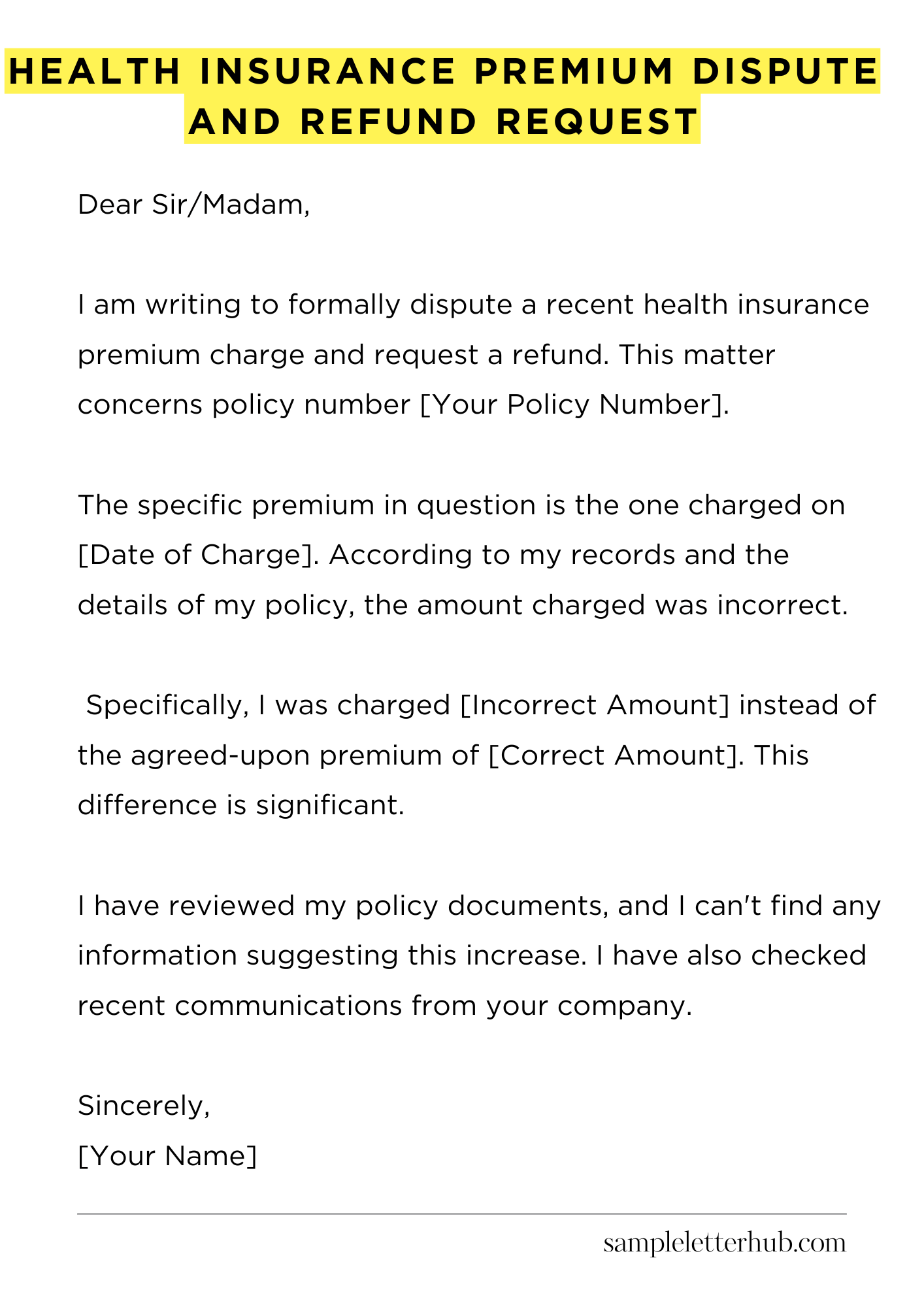
I am writing to formally dispute a recent health insurance premium charge and request a refund. This matter concerns policy number [Your Policy Number]. I believe there has been an error in the billing process.
The specific premium in question is the one charged on [Date of Charge]. According to my records and the details of my policy, the amount charged was incorrect. Specifically, I was charged [Incorrect Amount] instead of the agreed-upon premium of [Correct Amount]. This difference is significant.
I have reviewed my policy documents, and I can’t find any information suggesting this increase. I have also checked recent communications from your company and haven’t received any notification of a premium adjustment. These things should not have happened.
I kindly request that you investigate this discrepancy promptly. To support my claim, I have attached [Mention any supporting documents, e.g., copies of previous bills, policy documents, bank statements]. These should help with clarification.
I would appreciate it if you could verify the correct premium amount and issue a refund for the difference of [Difference in Amount]. Please credit the refund to [Your Preferred Refund Method, e.g., the original payment method, or provide bank details if necessary]. This would resolve the problem completely.
I look forward to your prompt response and confirmation of the refund. Please contact me at your earliest convenience to discuss this matter further. I can be reached by phone or email. Thank you for your time and attention to this issue.
Sincerely,
[Your Name]
How to Write Health Insurance Premium Dispute and Refund Request
Navigating the labyrinthine world of health insurance can be challenging, but understanding how to contest an erroneous premium charge and request a refund is crucial. This guide provides a comprehensive framework for crafting a persuasive and successful dispute letter.
1. Commence with a Formal Salutation and Identification
Begin by addressing the insurance provider with a formal salutation; “Dear Claims Department” or “To Whom It May Concern” is suitable. Immediately follow this with your full name, policy number, and any other pertinent identification information. This ensures your communication is properly directed and easily tracked.
2. Clearly Articulate the Contention: Specify the Grievance
The crux of your letter lies in clearly and concisely stating the reason for the dispute. Be specific. State the exact dates, amounts, and any supporting documentation you have (bills, payment records, etc.). Explain *why* you believe the premium charge is incorrect. Did you cancel the policy? Were you overcharged? Precision is key to a swift resolution.
3. Present Comprehensive Substantiation of the Allegations
This is where you marshal your evidence. Attach copies (never originals!) of any supporting documentation, like previous payment records, policy terms, and communications demonstrating your side of the narrative.
This serves as irrefutable corroboration of your assertion. Emphasize the relevant documents to highlight crucial points. For example: “As illustrated in the attached policy excerpt…”. This enhances credibility.
4. Delimit the Desired Redress and Refund Parameters
State explicitly what resolution you are seeking. Do you want a full refund of the disputed amount, or a partial adjustment? Quantify your request. For example: “I am requesting a full refund of $XXX.XX for the overcharged premium during the period of…” This leaves no ambiguity and ensures the provider knows your expectations.
5. Integrate Concise but Cogent Counterarguments and Rebuttals
Anticipate potential counterarguments from the insurance provider and proactively address them. For instance, if they might claim a policy lapse, counter it with proof of continuous coverage.
Proactively rebutting these potential issues demonstrates foresight and reinforces your claim’s validity. Employ clear and concise rebuttals to preempt the insurance provider’s potential defensive position.
6. Ensure Professionalism: Maintain a Courteous and Formal Tone
Even when exasperated, maintain a professional and courteous tone. Avoid accusatory language or emotional outbursts. This is not about anger, but about resolving a financial dispute.
A polite, but firm, tone is more likely to elicit a positive response. Professionalism can substantially elevate your chances of receiving a successful resolution.
7. Conclude with a Call to Action and Proper Closure
End your letter with a clear call to action. State that you expect a written response within a specific timeframe (e.g., 30 days). Include your contact information again (phone number, email address, mailing address).
Use a formal closing, such as “Sincerely,” or “Respectfully,” followed by your full name and signature. This final step solidifies your expectations and provides all the necessary information for a swift reply.
FAQs about Health Insurance Premium Dispute and Refund Request
What situations typically lead to a health insurance premium dispute?
Premium disputes often arise due to several reasons, including billing errors (incorrect charges, duplicate payments), policy cancellations, incorrect application of discounts, changes in coverage that were not accurately reflected in the premium.
What steps should I take to dispute a health insurance premium?
First, gather all supporting documentation, such as billing statements, policy documents, explanation of benefits (EOBs), and any relevant communication with the insurance provider. Next, carefully review the disputed charges or issues and prepare a clear, concise written explanation of the dispute.
Contact the insurance company’s customer service or claims department to file the dispute, following their specific procedures for appeals. Make sure to keep records of all communications, including dates, times, names of representatives spoken to, and the content of the conversations.
How does the refund request process work for health insurance premiums?
The refund request process typically begins after a premium dispute is resolved in the policyholder’s favor. Once the insurance company acknowledges the overpayment or the basis for the refund, the policyholder needs to initiate a refund request.
The process usually involves submitting a formal written request along with any supporting documentation needed to prove the overpayment or entitlement to a refund.
The insurance company will then process the request and issue the refund via the method specified by the policyholder, which could be a check, direct deposit, or credit to the original payment method. The timeline for receiving a refund can vary depending on the insurance company’s policy and the complexity of the dispute.
What are the timeframes involved in filing a health insurance premium dispute and refund request?
Timeframes vary depending on the insurance provider and the specific circumstances of the dispute. The time to file a dispute is often dictated by the policy’s terms, sometimes within a set period from the date of the billing or the event leading to the dispute. Similarly, there may be deadlines for filing a refund request after a dispute is resolved.
The insurance company also typically has a time frame for investigating the dispute, which can range from a few weeks to several months. Policyholders should pay close attention to the deadlines provided by their insurance company to ensure their requests are considered.
What are my options if the health insurance company denies my premium dispute or refund request?
If the insurance company denies your dispute or refund request, you typically have several options for further action. You can often appeal the decision through the insurance company’s internal appeals process, providing additional supporting documentation or information to support your case.
If the internal appeals process is unsuccessful, you can explore the option of filing a complaint with your state’s insurance regulatory agency, which can investigate the matter and mediate between you and the insurance company. Finally, if all other options fail, legal action, potentially through small claims court, could be considered. However, this is generally a last resort.
Related:
Resignation letter due to rude boss
Resignation letter moving to another state
Resignation letter due to illness of family member
Resignation letter due to study