

Dealing with health insurance can be tricky. Sometimes, your health insurance provider needs extra information. This is where a Health Insurance Missing Documents Submission Letter comes in. Its purpose is simple. It’s a formal way to provide the missing paperwork. This ensures your health insurance claim gets processed.
Are you struggling to write one? Don’t worry! We’ve got you covered. We’re sharing templates and examples. These are for a health insurance missing documents submission letter. We’ll provide ready-to-use samples. They can save you time and hassle.
Crafting the perfect letter is now easier. Find the right format. Adapt it to your situation. This guide helps you write a clear and concise letter. Get your health insurance matters sorted today!
[Your Name/Insurance Company Name – if applicable]
[Your Address]
[Your Phone Number]
[Your Email Address]
[Date]
[Recipient Name/Insurance Company Name]
[Recipient Address]
Subject: Submission of Missing Documents for Health Insurance Application
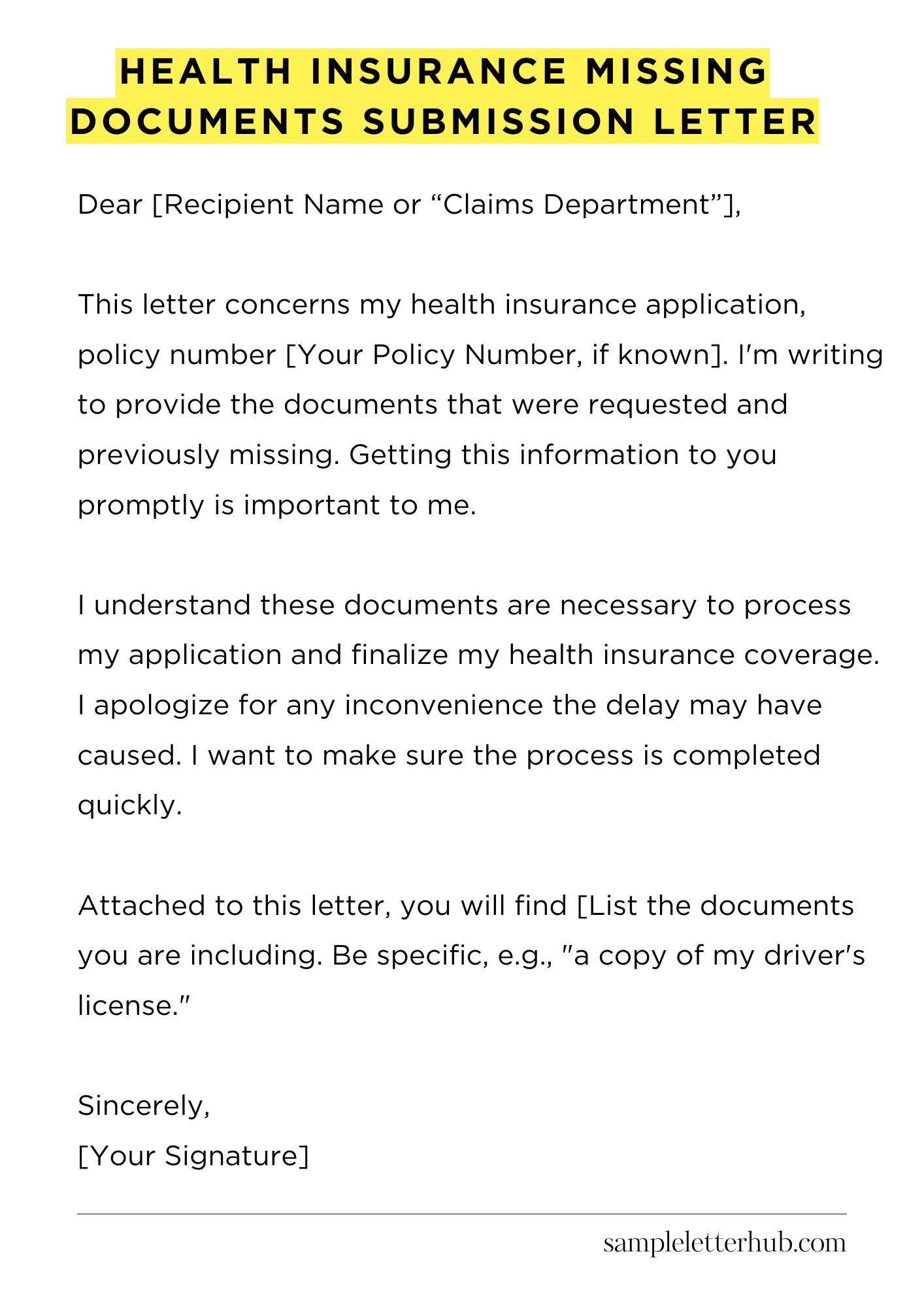
Dear [Recipient Name or “Claims Department”],
This letter concerns my health insurance application, policy number [Your Policy Number, if known]. I’m writing to provide the documents that were requested and previously missing. Getting this information to you promptly is important to me.
I understand these documents are necessary to process my application and finalize my health insurance coverage. I apologize for any inconvenience the delay may have caused. I want to make sure the process is completed quickly.
Attached to this letter, you will find [List the documents you are including. Be specific, e.g., “a copy of my driver’s license,” “a completed medical history form,” etc.]. Each document is clearly labelled for easy identification. Please review everything carefully.
I have taken great care in assembling these documents. I believe everything needed is included now. I am available if you need any clarification or have any further questions.
Please let me know if you require any additional information. You can reach me at the phone number or email address listed above. I look forward to hearing from you soon regarding the status of my application. Thank you very much for your time and assistance in this matter.
Sincerely,
[Your Signature]
How to Write Health Insurance Missing Documents Submission Letter
Submitting documents for health insurance claims can sometimes feel like navigating a bureaucratic labyrinth. Often, insurance providers request additional documentation to substantiate your claims.
A well-crafted missing documents submission letter is paramount to ensuring your claim proceeds without unnecessary impedance.
1. Commence with a Cogent Salutation
Begin your letter with a formal salutation. Address it to the specific claims department or the individual handling your case if you have their details.
“Dear Sir/Madam” is acceptable, but if possible, try to address the letter to a named individual. This personal touch can add a layer of gravitas to your correspondence. Maintain a professional demeanor from the get-go; this is the initial impression.
2. Clearly State the Purpose: The Declarative Clause
Immediately declare the intent of your missive. Clearly state that you are submitting the requested missing documents for claim number [Insert Claim Number].
Be forthright and avoid ambiguity. This direct approach ensures the recipient immediately grasps the letter’s purpose, streamlining the processing workflow. Keep it short and accurate.
3. Itemized Nomenclature: Listing the Enclosures
Provide a detailed, itemized list of each document you are including. This section is critical for organization and clarity. Specify the name of each document (e.g., “Medical Report from Dr. Smith,” “Pharmacy Receipt dated October 26, 2024”).
This inventory allows the reviewer to quickly verify the receipt of each required item, preventing potential oversight. Precision here is key.
4. Explicating the Context: Adding a Brief Explanation (If Necessary)
While not always required, sometimes a brief explanation is advantageous. If a document is missing a piece of information, or if you had a situation, briefly elucidate the circumstances. However, be succinct and only provide essential information. Avoid unnecessary details that could complicate matters. The goal is clarity, not obfuscation.
5. The Concluding Admonition: Reiteration and Assurance
Reiterate your claim number and the purpose of your letter in the concluding paragraph. Express your anticipation for a swift resolution of your claim.
Thank the recipient for their time and assistance, and restate your contact information, including your phone number and email address. This ensures they can easily reach you for any further clarifications. The final message should be clear and polite.
6. The Formal Sign-Off: Signatory Etiquette
Conclude with a professional closing, such as “Sincerely” or “Best Regards.” Sign the letter physically if you’re mailing a hard copy, or type your full name. If submitting electronically, include your typed name. This is a final touch of professionalism to be displayed.
7. Proofreading and Submittal Logistics
Before submitting, meticulously proofread your letter for any errors in grammar, spelling, and factual accuracy. Ensure all attachments are legible and properly formatted.
Finally, choose the appropriate method of submission: mail, email, or online portal, as specified by your insurance provider. Retain a copy of your letter and all accompanying documents for your records. The final step is to wait with bated breath.
FAQs about Health Insurance Missing Documents Submission Letter
What specific documents are typically requested in a health insurance missing documents submission letter?
The documents requested can vary depending on the insurance provider and the nature of the claim. Common examples include: medical records (physician’s notes, lab results, imaging reports), itemized bills from healthcare providers, proof of payment.
How should I respond to a health insurance missing documents submission letter?
You should carefully review the letter to identify the missing documents and the deadline for submission. Gather the required documents, ensuring they are accurate and complete. Make copies of all documents for your records before sending the originals.
Submit the requested documents by the specified deadline and use the preferred method of submission (e.g., mail, online portal, email) indicated in the letter. Include your policy number and claim number with the submission.
What happens if I miss the deadline for submitting the missing documents?
Missing the deadline can have consequences, such as claim denial. Insurance companies often have a specific timeframe for receiving requested documentation.
If you are unable to meet the deadline due to extenuating circumstances, contact your insurance provider immediately. Explain the situation and request an extension, providing a valid reason. While there is no guarantee, timely communication might increase the chance of a favorable outcome.
What if I don’t have all the requested documents?
If you cannot obtain all the required documents, gather what you can and submit them by the deadline. Contact your healthcare providers or relevant institutions to request the missing documentation, keeping records of your requests.
Include a clear explanation with your submission, noting which documents are still pending and the steps you are taking to obtain them. Inform the insurance company of the expected timeline for receiving the remaining documents.
How can I ensure I don’t receive these types of letters in the future?
To minimize the chance of receiving missing document letters, keep detailed records of your healthcare expenses, treatments, and payments. Retain copies of all medical records, bills, and insurance-related correspondence.
When filing a claim, provide all the information and supporting documentation upfront and accurately. If there is a change in your insurance plan or any updates to your personal information, notify your insurance provider immediately.
Consider using online portals or mobile apps provided by your insurance company to track claims and documentation more efficiently.
Related:
Resignation letter due to rude boss
Resignation letter moving to another state
Resignation letter due to illness of family member
Resignation letter due to study