


Sometimes, things don’t work out. This can include your health insurance. A health insurance cancellation letter is a formal way to end your coverage. It informs your insurance provider of your decision. The purpose is to officially notify them you want to cancel your plan. This helps avoid further billing.
Writing such letters can seem tricky. But don’t worry, we’re here to help! We’ll provide you with various health insurance cancellation letter templates. These include samples and examples. Use them as a starting point.
Our goal is simple. We aim to simplify the process. You can easily adapt these sample cancellation letters. You can tailor them to your specific needs. Get ready to write your letter like a pro!
[Your Name]
[Your Address]
[Your Phone Number]
[Your Email Address]
[Date]
[Insurance Company Name]
[Insurance Company Address]
Subject: Cancellation of Health Insurance Policy – Policy Number [Your Policy Number]
Dear [Insurance Company Representative or To Whom It May Concern],
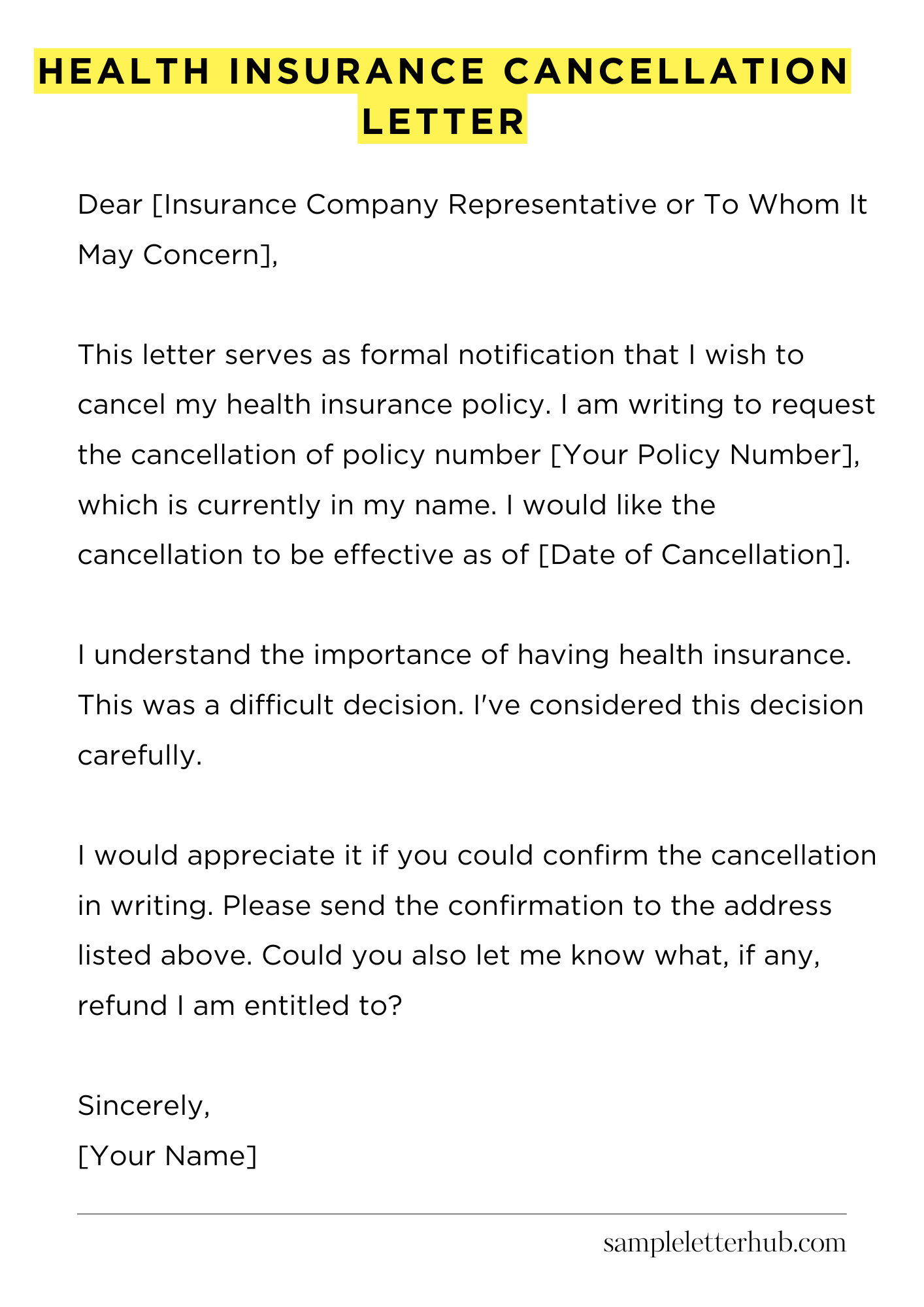
This letter serves as formal notification that I wish to cancel my health insurance policy. I am writing to request the cancellation of policy number [Your Policy Number], which is currently in my name. I would like the cancellation to be effective as of [Date of Cancellation].
I understand the importance of having health insurance. This was a difficult decision. I’ve considered this decision carefully.
I would appreciate it if you could confirm the cancellation in writing. Please send the confirmation to the address listed above. Could you also let me know what, if any, refund I am entitled to? Providing this information would be greatly appreciated.
Please confirm the cancellation date in the confirmation. I need this for my records.
Thank you for your time and attention to this matter. I look forward to receiving your prompt response.
Sincerely,
[Your Name]
How to Write a Health Insurance Cancellation Letter
1. Commence with the Foundation: The Heading and Recipient Details
Crafting a robust health insurance cancellation letter begins with precision. At the apex of the document, meticulously place your full name, current address, and contact information.
Below this, on the left side, identify the recipient. Include the insurance company’s official name, the department responsible for cancellations (typically a “Cancellation Department” or similar), and their full postal address. This initial segment acts as the epistolary framework, solidifying the letter’s legitimacy and expediting its journey to the correct administrative terminus.
2. The Salutation: A Formal Declaration
The salutation sets the tone. Use a formal greeting such as “Dear [Insurance Company Name] Cancellation Department.” Avoid casual greetings. This establishes the professional tenor of the communication. Always prioritize a respectful and clear introduction.
3. The Crux of the Matter: Expressing Your Intent
This section constitutes the nucleus of your letter. Explicitly state your unequivocal desire to terminate your health insurance policy. Include the policy number and the specific date you wish the cancellation to become effective. Be direct; ambiguities will only retard the process. Your intention must be crystalline.
4. Delving into the Details: Justification (Optional, but Recommended)
While not always mandatory, providing a concise rationale for your cancellation is often prudent. Whether it’s securing more economical coverage or a significant life change, a brief, well-articulated explanation can prevent potential bureaucratic snags.
This justification doesn’t need to be extensive, but a sentence or two provides context. This is the moment to share the *casus belli* of your policy termination.
5. The Financial Nuances: Premium Refunds and Remaining Liabilities
Inquire about the possibility of a premium refund, specifying the method you prefer to receive it (check, direct deposit, etc.). Equally important is addressing any outstanding liabilities. Ascertain the status of any pending claims and the steps required to settle them. This proactively mitigates any post-cancellation financial conundrums. Transparency in this sector prevents future entanglements.
6. The Call to Action and Complimentary Closing: The Epilogue
Conclude your letter with a clear call to action. Request confirmation of the cancellation in writing and specify how you wish to receive it. This might be through email, postal mail, or both. Use a formal closing, like “Sincerely,” or “Respectfully,” followed by your full name and signature (if sending a physical copy). Double-check every detail before concluding.
7. The Final Audit: Proofreading and Dispatch
Before dispatching your letter, subject it to a rigorous examination. Proofread the entire document for any grammatical errors, typos, or inconsistencies. Ensure all information is accurate, from your policy number to the effective cancellation date.
Make a copy for your records before sending it via certified mail with return receipt requested. This ensures verifiable proof of delivery. This is your insurance policy against potential disputes.
FAQs about Health Insurance Cancellation Letter
What is a health insurance cancellation letter, and why is it needed?
A health insurance cancellation letter is a formal written notice sent to your health insurance provider to request the termination of your health insurance policy. It’s needed to officially inform the insurer of your intent to cancel, ensuring a documented record of your request. This protects you from potential billing errors or continued coverage charges after you intend to cancel.
What information should be included in a health insurance cancellation letter?
Your cancellation letter should include essential information such as your full name, address, policy number, and the effective date of cancellation. Clearly state your intent to cancel the policy and the reason for cancellation (e.g., switching to a new plan, no longer needing coverage). It’s also wise to include your contact information for any follow-up.
How do I submit a health insurance cancellation letter?
Most insurance companies allow for various submission methods. These include sending the letter via certified mail with a return receipt requested to confirm delivery, faxing the letter, or submitting it electronically through the insurer’s online portal if available. Always retain a copy of the letter and proof of submission.
What happens after I send the cancellation letter?
After receiving your letter, the insurance company will typically process your request. They may send you a confirmation letter or email indicating the effective date of cancellation. Keep this confirmation for your records. You should also verify that your premiums have stopped being charged after the cancellation date.
Can I get a refund for unused premiums when I cancel my health insurance?
Whether you receive a refund for unused premiums depends on your policy and the circumstances of your cancellation. If you’ve paid premiums in advance, and your cancellation is effective before the end of the covered period, you may be entitled to a refund. Review your policy details and contact your insurer for clarification on their refund policy.
Related:
Resignation letter due to rude boss
Resignation letter moving to another state
Resignation letter due to illness of family member
Resignation letter due to study