

A “Head of School resignation letter” is a formal document. It is written by the Head of School. The purpose is to officially announce their departure. It informs the school board of their intent to resign. It typically includes the resignation date.
Crafting the perfect resignation letter can feel daunting. We’re here to help! We provide examples and templates. You can use them as a starting point. Our samples cover various situations.
Our goal is simple. We aim to make your task easier. Find the perfect words with our curated samples. Customize them to fit your needs. Good luck!
Head Of School Resignation Letter
Below is a sample of a Head Of School Resignation Letter:
[Your Name/Address]
[Your Phone Number]
[Your Email Address]
[Date]
[School Board/Relevant Recipient Name]
[School Name/Address]
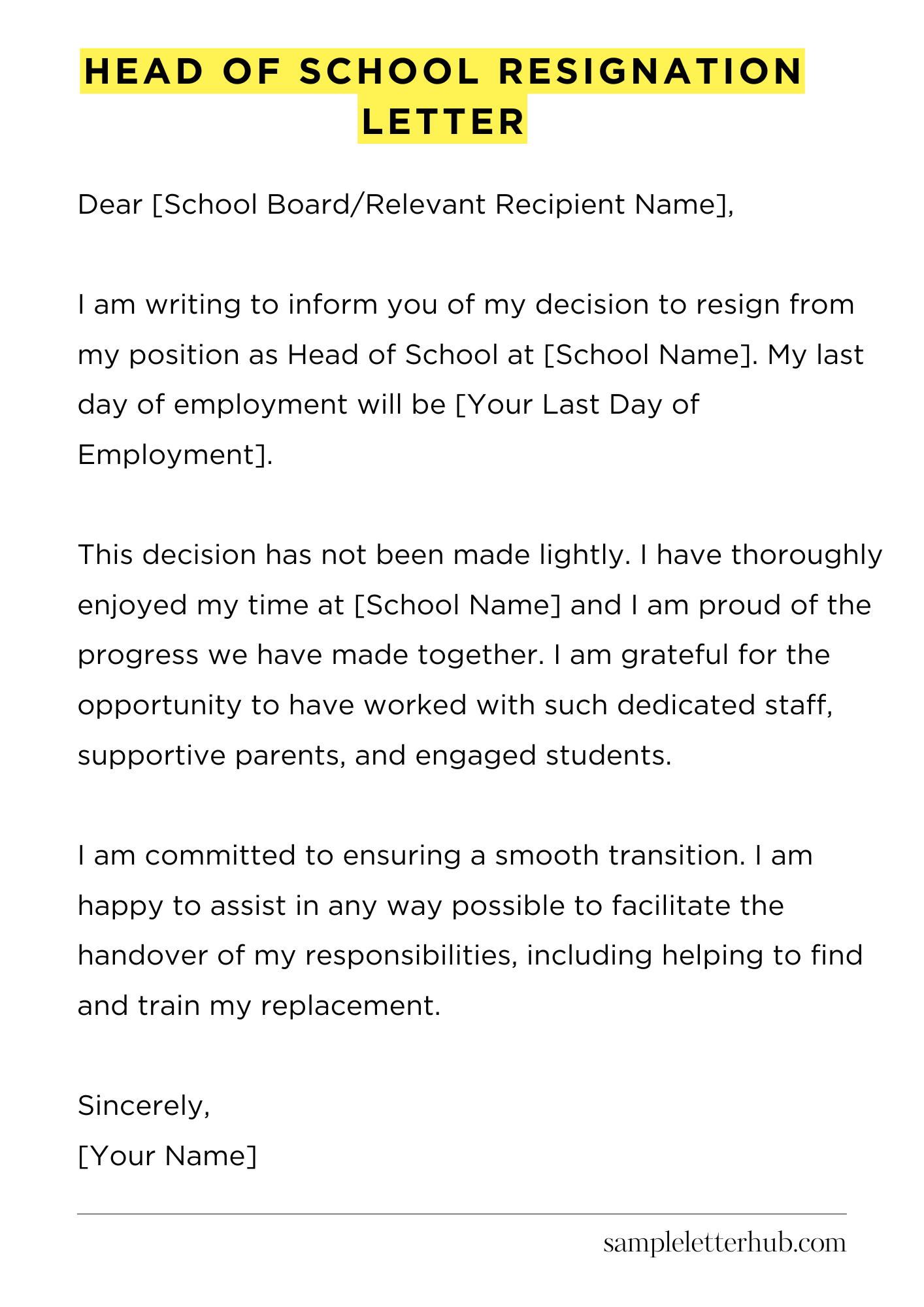
Dear [School Board/Relevant Recipient Name],
I am writing to inform you of my decision to resign from my position as Head of School at [School Name]. My last day of employment will be [Your Last Day of Employment].
This decision has not been made lightly. I have thoroughly enjoyed my time at [School Name] and I am proud of the progress we have made together. I am grateful for the opportunity to have worked with such dedicated staff, supportive parents, and engaged students.
I am committed to ensuring a smooth transition. I am happy to assist in any way possible to facilitate the handover of my responsibilities, including helping to find and train my replacement. I will do my best to complete all my current duties before my departure.
I wish [School Name] and its community continued success in the future.
Sincerely,
[Your Name]
How to Write Head of School Resignation Letter
Resigning as a Head of School is a significant decision. It’s important to approach this with professionalism and consideration. A well-crafted resignation letter is crucial. It serves not only as a formal notification, but also sets the stage for a smooth transition and preserves positive relationships.
1. Timing is Everything
First things first: think carefully about when to submit your resignation. Consider school calendars, academic year cycles, and any pre-existing agreements. Giving ample notice is vital. A standard period is usually at least a few months, allowing the Board of Trustees time to find your replacement.
This shows respect for the institution and its stakeholders. Avoid handing in your notice at the last minute; it leaves the school scrambling. This can reflect poorly on your professionalism.
2. Formatting and Tone: Keep it Professional
Your letter needs to look the part. Use formal business letter format: your address, the date, the recipient’s address (usually the Board Chair or the designated authority). Keep the tone respectful and positive. Even if you’re leaving due to dissatisfaction, avoid negativity or complaints.
This letter is a reflection of you! A concise and straightforward writing style is ideal. Be clear, direct, and avoid ambiguity. This will help prevent any misunderstandings.
3. The Core Elements: What to Include
There are key elements that every resignation letter needs. Start with a clear statement of your resignation. Explicitly state your intention to resign from your position as Head of School. Include your last day of employment.
This is essential for clarity. Then, briefly express your gratitude for the opportunity to have served the school. Acknowledge the experience you’ve gained and the relationships you’ve built.
You might mention specific achievements or initiatives you’re proud of, if applicable. Keep it brief. Offer your assistance during the transition. Offer to help with the handover process to the new Head. A graceful exit always leaves a good impression.
4. Things to Avoid: Common Pitfalls
Certain things are best left unsaid in a resignation letter. Avoid getting into lengthy explanations of your reasons for leaving. Keep it short and sweet. Refrain from making disparaging remarks about colleagues, the board, or the school itself. This is unprofessional. Don’t use the letter as a platform for complaints.
Similarly, do not include any demands or requests that might be considered inappropriate. Keep your focus on making the transition easier, not complicating it. Focus on the positive aspects of your tenure.
5. Review and Finalize: Polishing Your Letter
Once you’ve written your letter, take a step back and review it carefully. Proofread it meticulously for any typos or grammatical errors. These small things can undermine your professionalism.
Ask a trusted colleague or mentor to read it over for a second opinion. They may offer insights you hadn’t considered. Make sure your letter conveys the right message. Make sure you are satisfied and submit your letter.
FAQs about Head Of School resignation letter
How much notice should a Head of School give when resigning?
The standard practice typically involves providing a notice period of at least three to six months. However, the specific notice period should be outlined in the Head of School’s employment contract or school policy. This timeframe allows the school board adequate time to find a suitable replacement, ensure a smooth transition, and minimize disruption to the school community.
What key elements should be included in a Head of School resignation letter?
A well-crafted resignation letter should include: a formal statement of resignation, the effective date of resignation, a brief expression of gratitude for the opportunity to serve, acknowledgment of the school’s mission and values, a concise explanation for the resignation (if desired and appropriate).
Should a Head of School provide a reason for resigning in the letter?
Providing a reason for resignation is optional. While it’s generally good practice to be professional, you are not always obligated to detail the exact reasoning. If the reason is positive (e.g., pursuing a new opportunity), a brief mention is appropriate.
If personal or sensitive, it is acceptable to state that the resignation is due to personal reasons. Always be mindful of maintaining a positive and professional tone. Sometimes, a separate conversation with the board might be more appropriate for explaining the circumstances in full.
How can a Head of School assist with the transition after resigning?
A departing Head of School can support the transition by offering to assist with tasks such as: providing handover documents outlining ongoing projects and key initiatives, introducing the incoming Head of School to staff, parents, and community stakeholders, participating in the recruitment process of the next Head of School.
The level of support should be discussed and agreed upon with the school board.
Who should the Head of School resignation letter be addressed to?
The resignation letter should typically be addressed to the Chair of the Board of Trustees or the appropriate governing body. If unsure, consult the school’s policy or employment contract. Ensure the letter is delivered in a formal and respectful manner, ideally in writing and with a copy kept for the Head of School’s records.
Related:
Resignation letter due to rude boss
Resignation letter moving to another state
Resignation letter due to illness of family member
Resignation letter due to study