

Dealing with unexpected financial troubles? Need help with your insurance policy? A hardship letter for policyholder could be your solution. It’s a formal request you send to your insurance company. The goal? To explain your difficult situation. You’re asking for help with your insurance premiums or other policy-related issues.
We understand writing such a letter can feel overwhelming. That’s why we’re here. We’ve gathered helpful hardship letter examples. You’ll find templates for various scenarios. Need to address policy concerns? We have you covered.
Our goal is to make it easy. We provide hardship letter samples. Use them as a starting point. Tailor them to your specific needs. Get the assistance you deserve. Tackle your insurance hardship with confidence.
[Your Name/Insurance Company Letterhead (if applicable)]
[Your Address]
[Your City, Postal Code]
[Date]
[Policyholder’s Name]
[Policyholder’s Address]
[Policyholder’s City, Postal Code]
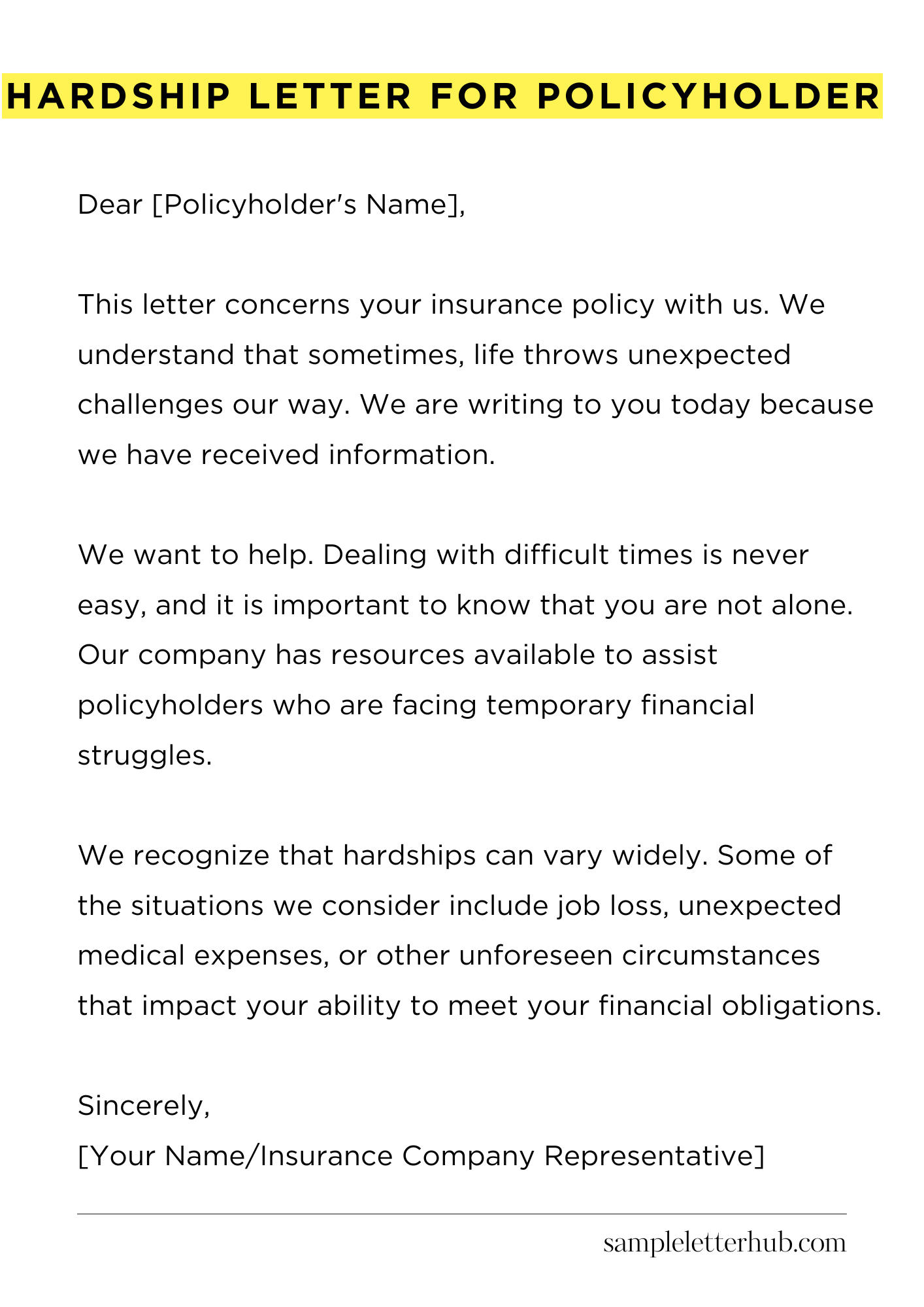
Dear [Policyholder’s Name],
This letter concerns your insurance policy with us. We understand that sometimes, life throws unexpected challenges our way. We are writing to you today because we have received information suggesting you may be experiencing some financial hardship.
We want to help. Dealing with difficult times is never easy, and it is important to know that you are not alone. Our company has resources available to assist policyholders who are facing temporary financial struggles. These resources are designed to help you maintain your insurance coverage while navigating difficult periods.
We recognize that hardships can vary widely. Some of the situations we consider include job loss, unexpected medical expenses, or other unforeseen circumstances that impact your ability to meet your financial obligations. We aim to understand the specific situation you are in.
We encourage you to contact us as soon as possible. Please call us at [Phone Number] or reply to this letter. Our team of dedicated professionals is ready and willing to discuss your situation confidentially.
We can explore various options that might be available to you. These might include payment plan adjustments, temporary premium reductions, or other possibilities. We will work with you to find a solution that fits your needs. Our goal is to work with you to ensure your coverage stays active.
We value you as a policyholder. We understand that maintaining your insurance coverage is essential for protecting yourself and your family. We are committed to providing you with the best possible service.
Sincerely,
[Your Name/Insurance Company Representative]
How to Write Hardship Letter for Policyholder
Crafting a compelling hardship letter can be a pivotal exercise in articulating a policyholder’s predicament to an insurance provider. It serves as a formal plea, a documented narrative of circumstances necessitating leniency. It’s not just a formality; it’s a critical tool for navigating challenging financial terrains.
1. Commence with a Cogent Introduction
Begin your letter with a clear and concise opening. Specifically, provide your full name, address, and policy number. State your purpose immediately: to request financial relief or consideration due to a documented hardship.
This sets the stage, ensuring the recipient understands the essence of your communication from the outset. Consider this the ‘hook’ that captivates their attention.
2. Articulate the Dire Circumstances
This is where you unearth the core of your hardship. In a perspicacious manner, describe the specific event or series of events that have inflicted financial duress. Provide meticulous details, including dates, locations, and any relevant parties involved.
Be forthright, yet composed. The goal is to paint a vivid, truthful picture of your plight, allowing the reader to fully grasp the exigency.
3. Substantiate with Corroborating Evidence
A well-written narrative is invaluable, but it needs fortification. Attach tangible proof to bolster your claims. This may encompass medical bills, layoff notices, bank statements revealing depleted resources, or any other documentation that validates your hardship.
Present this evidence in an organized, legible manner. This reinforces the credibility of your appeal and demonstrates your commitment to transparency.
4. Specify the Relief You Seek
Be unequivocal about what you need. Are you seeking a payment plan? A temporary suspension of payments? A reduction in premiums? Or perhaps a waiver of late fees? Clearly articulate your desired outcome.
This ensures there’s no ambiguity, directing the insurance provider towards a concrete resolution. Clarity is king here.
5. Demonstrate a Commitment to Remediation
Insurance companies, like any business, value reliability. Convey your commitment to rectifying the situation. If you’ve encountered a temporary setback, state your intention to resume payments once your circumstances improve. This indicates responsibility and reassures the insurer of your long-term value. Assure them of your dedication.
6. Compose a Concluding Paragraph with a Civil Tone
End your letter with a polite, respectful closing. Thank the recipient for their time and consideration. Reiterate your contact information, including your phone number and email address, and include the best time to reach you.
Express your hope for a favorable response, and sign the letter professionally. This reinforces your professionalism and leaves a lasting positive impression.
7. Proofread and Refine Your Composition
Prior to submission, meticulously review your entire letter. Check for grammatical errors, spelling mistakes, and any inconsistencies in the narrative. Ensure the tone is appropriate for a formal communication.
Have a second pair of eyes scrutinize it for clarity and impact. A polished letter demonstrates attention to detail and a commitment to precision. Consider it your final flourish.
FAQs about Hardship Letter for Policyholder
Understanding hardship letters is crucial for policyholders facing financial difficulties. Here are some of the most frequently asked questions:
What is a hardship letter for a policyholder?
A hardship letter, in the context of insurance, is a formal written request submitted by a policyholder to their insurance provider. It explains the specific financial difficulties or unforeseen circumstances the policyholder is currently facing, such as job loss, unexpected medical expenses.
The letter aims to persuade the insurer to provide temporary relief, such as a payment plan, a reduction in premiums, or a temporary suspension of coverage without cancellation.
What should be included in a hardship letter?
A comprehensive hardship letter should include: your full name and policy number, the date, a clear explanation of the financial hardship you’re experiencing, including specific details and supporting documentation (e.g., medical bills, unemployment notices), the impact of the hardship on your ability.
What types of assistance can a policyholder request in a hardship letter?
Policyholders can request various forms of assistance. Common requests include: a temporary payment plan to catch up on missed or upcoming premiums, a temporary reduction in the monthly premium amount, a temporary suspension of coverage without immediate cancellation (though it’s important to understand the implications of suspended coverage).
What supporting documentation should be included with a hardship letter?
To substantiate your claims and increase the chances of a favorable outcome, you should include relevant supporting documentation. Examples include: copies of medical bills, hospital statements, unemployment notices or proof of job loss, bank statements, divorce decrees (if applicable).
What happens after I submit a hardship letter?
After submitting a hardship letter, the insurance company will review your request and supporting documentation. They may contact you for further clarification or documentation. The insurer will then make a decision regarding your request based on their policies and the specific circumstances you outlined.
You will receive a written response detailing their decision, which may include approval of your request, a counter-offer, or a denial. If you are unsatisfied with their decision, you may be able to appeal it through the insurer’s formal appeals process.
Related:
Resignation letter due to rude boss
Resignation letter moving to another state
Resignation letter due to illness of family member
Resignation letter due to study