

A Hardship Letter for Long-Term Medical Insurance is a written explanation. It tells your insurance company about difficult financial situations. The purpose is to request special consideration. It might be for reduced premiums or extra time to pay.
Need help crafting your own Hardship Letter for Long-Term Medical Insurance? We’ve got you covered. We’ll share templates, examples, and samples. Use these to build your perfect Hardship Letter.
This guide simplifies the process. Writing this type of letter can feel overwhelming. Don’t worry, we’ll make it easier. Get ready to create a clear and effective Hardship Letter for Long-Term Medical Insurance!
[Your Name]
[Your Address]
[Your Phone Number]
[Your Email Address]
[Date]
[Insurance Company Name]
[Insurance Company Address]
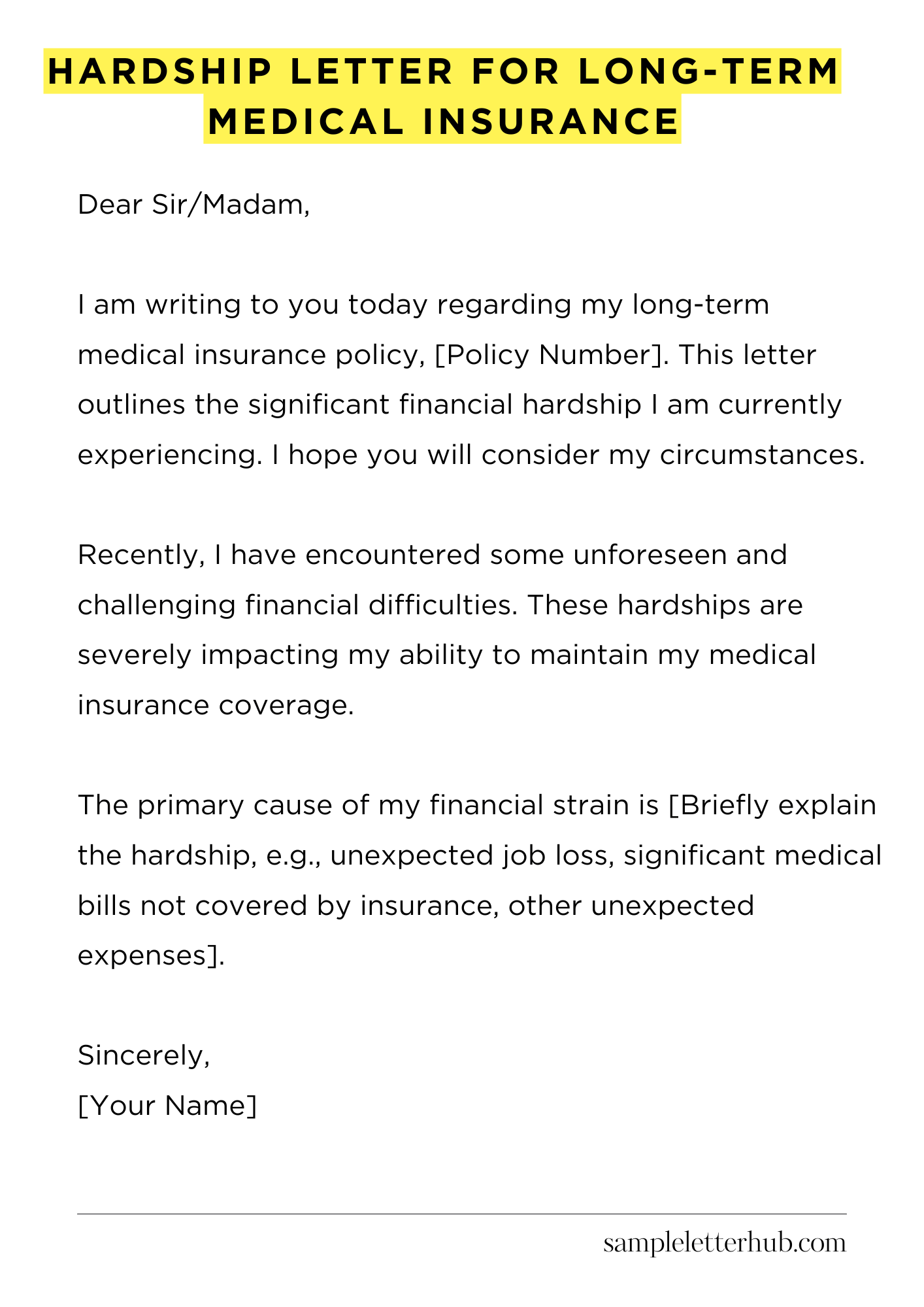
Dear Sir/Madam,
I am writing to you today regarding my long-term medical insurance policy, [Policy Number]. This letter outlines the significant financial hardship I am currently experiencing. I hope you will consider my circumstances.
Recently, I have encountered some unforeseen and challenging financial difficulties. These hardships are severely impacting my ability to maintain my medical insurance coverage. The situation has quickly evolved, making it very difficult for me to keep up with my monthly premiums.
The primary cause of my financial strain is [Briefly explain the hardship, e.g., unexpected job loss, significant medical bills not covered by insurance, other unexpected expenses]. This situation has dramatically reduced my available income. It has made managing all my expenses much more complicated than before.
Consequently, I am struggling to meet my financial obligations. The ongoing cost of medical insurance premiums is adding to my stress. Keeping this insurance is very important for my health and well-being.
I am requesting that you consider my hardship and offer me some assistance. I would be very grateful for any options to help ease my financial burden. Perhaps a temporary reduction in my premium, or a payment plan, could be put in place. These options would provide much-needed support during this difficult period.
I am committed to maintaining my medical insurance coverage. My good health requires consistent access to medical care. I am willing to provide any supporting documentation that you may require to verify my situation.
Thank you for your time and understanding in this matter. I eagerly await your response and hope to find a solution. I look forward to hearing from you soon.
Sincerely,
[Your Name]
How to Write Hardship Letter for Long-Term Medical Insurance
Navigating the labyrinthine world of long-term medical insurance can be challenging, especially when faced with financial hardship. A well-crafted hardship letter can prove pivotal in securing assistance. It can become a persuasive tool to advocate for your needs, so understanding its components is vital. Here’s a comprehensive guide to help you compose a compelling letter.
1. Understand the Premise: The Imperative of Articulation
Before you even begin, grasp the purpose. Your goal is to persuasively communicate your current financial constraints to the insurance provider. This letter should provide a meticulous chronicle of your hardships. Clear and concise articulation is the cornerstone of effective communication, enabling the insurer to fully appreciate your predicament.
2. Formatting: Structuring for Maximum Impact
Your hardship letter should adhere to a formal business letter format. Begin with your contact information (name, address, phone number, and email address) and the date. Following that, include the insurance company’s contact information. This is a critical component for ensuring the letter reaches the appropriate department. Proper formatting enhances professionalism and readability.
3. The Salutation: Setting the Tone of Recourse
Address your letter professionally. Use a formal salutation, such as “Dear Claims Department” or “To Whom It May Concern.” Avoid informal greetings. This sets a respectful tone from the outset and demonstrates your commitment to the matter.
4. The Body: Detailing the Calamity
This is the substantive core. Start by explicitly stating your request for assistance due to financial hardship. Then, detail the specific circumstances contributing to your situation.
This should be a detailed account. Include supporting documentation (e.g., medical bills, proof of income loss, bank statements). Be transparent and honest. Quantify your expenses whenever possible to illustrate the gravity of your situation. Ensure it is easily digestible.
Consider the following points in your explanation:
- The specific medical condition or event that led to the hardship.
- How your income has been affected (e.g., job loss, reduced hours).
- The medical expenses you cannot currently cover.
- Any other relevant factors, such as family responsibilities.
5. Supporting Documentation: The Indispensable Accoutrements
Never underestimate the power of evidence. Attach copies of all supporting documentation. This may include medical bills, doctor’s statements, records of income loss, bank statements, and any other relevant paperwork that substantiates your claims. Organize your documents and clearly label them for easy reference by the insurance provider.
6. The Plea and the Conclusion: Requesting Expedient Consideration
In the concluding paragraph, reiterate your request for financial assistance. Express your sincere hope for their understanding and favorable consideration.
Include your contact information again and state your willingness to provide additional information, if needed. Close the letter with a professional closing, such as “Sincerely,” or “Respectfully,” followed by your full name and signature (if sending a hard copy).
7. Proofreading and Revision: The Inherent Verification Process
Before sending your letter, proofread it meticulously. Check for grammar, spelling, and punctuation errors. It may be helpful to ask a trusted friend or family member to review the letter. This helps with identifying any ambiguities and ensuring the letter is clear, concise, and professional. Always revise as needed; perfection is the goal.
FAQs about Hardship Letter for Long-Term Medical Insurance
What exactly is a hardship letter for long-term medical insurance, and why is it needed?
A hardship letter for long-term medical insurance, often referred to simply as a hardship letter, is a formal written request submitted to an insurance provider. It details circumstances that make it difficult or impossible for an individual to maintain their current insurance coverage or to afford necessary medical care.
It is needed because it serves as documentation of the challenging financial or personal circumstances that are impacting the applicant’s ability to fulfill their insurance obligations or access crucial medical services.
What specific types of hardships typically qualify for consideration in a hardship letter?
Qualifying hardships can include, but are not limited to, significant medical expenses not covered by insurance, loss of income due to job loss or reduction in hours, a natural disaster that has affected finances, substantial debt accumulation, or a sudden and unexpected change in family circumstances, such as divorce or death of a primary wage earner.
Each insurance company may have different criteria for what is considered a hardship, so reviewing the specific policy is crucial.
What information and documentation should be included in a well-written hardship letter?
A comprehensive hardship letter should include a clear and concise explanation of the hardship, along with supporting documentation.
This typically encompasses: your full name and policy number, a detailed explanation of the hardship, a timeline of events, supporting documents (e.g., medical bills, proof of income loss, bank statements, divorce decrees), and a specific request to the insurance company (e.g., a payment plan, a temporary waiver of premiums, a reduction in coverage or a request for financial assistance). The letter should be dated, signed, and include contact information.
What are the possible outcomes after submitting a hardship letter?
The outcomes can vary. The insurance provider may approve the request, offer a modified payment plan, temporarily waive premium payments, reduce coverage to a more affordable level, or potentially offer other forms of financial assistance.
They might also deny the request if the hardship does not meet their criteria or if the provided documentation is insufficient. The insurance company will typically notify you of their decision in writing.
Are there any alternatives to a hardship letter if one is struggling with long-term medical insurance costs?
Yes. Consider exploring options such as: evaluating whether you qualify for government assistance programs, reviewing your current insurance plan to see if there are lower-cost alternatives, negotiating with healthcare providers for lower bills, contacting non-profit organizations that offer financial assistance for healthcare, or setting up a payment plan.
Consulting with a healthcare navigator can also provide personalized guidance.
Related:
Resignation letter due to rude boss
Resignation letter moving to another state
Resignation letter due to illness of family member
Resignation letter due to study