

Facing massive hospital bills? Feeling overwhelmed? A Hardship Letter for Hospital Billing is your first line of defense. It’s a formal request. You ask the hospital for financial assistance. This could include reduced costs or a payment plan. Its goal is to alleviate the financial burden.
We understand navigating hospital bills is hard. Writing a hardship letter can feel intimidating. Don’t worry, we’re here to help. This article provides hardship letter templates. We also offer hardship letter examples. You’ll find hardship letter samples. Use these to write your own letter. This will simplify the process.
Let us help you! Our examples cover various situations. You’ll find options for different financial challenges. Craft a compelling letter with ease. Hospital bill help is now within reach. Let’s get started.
[Your Name]
[Your Address]
[Your Phone Number]
[Your Email Address]
[Date]
[Hospital Billing Department Name/Address]
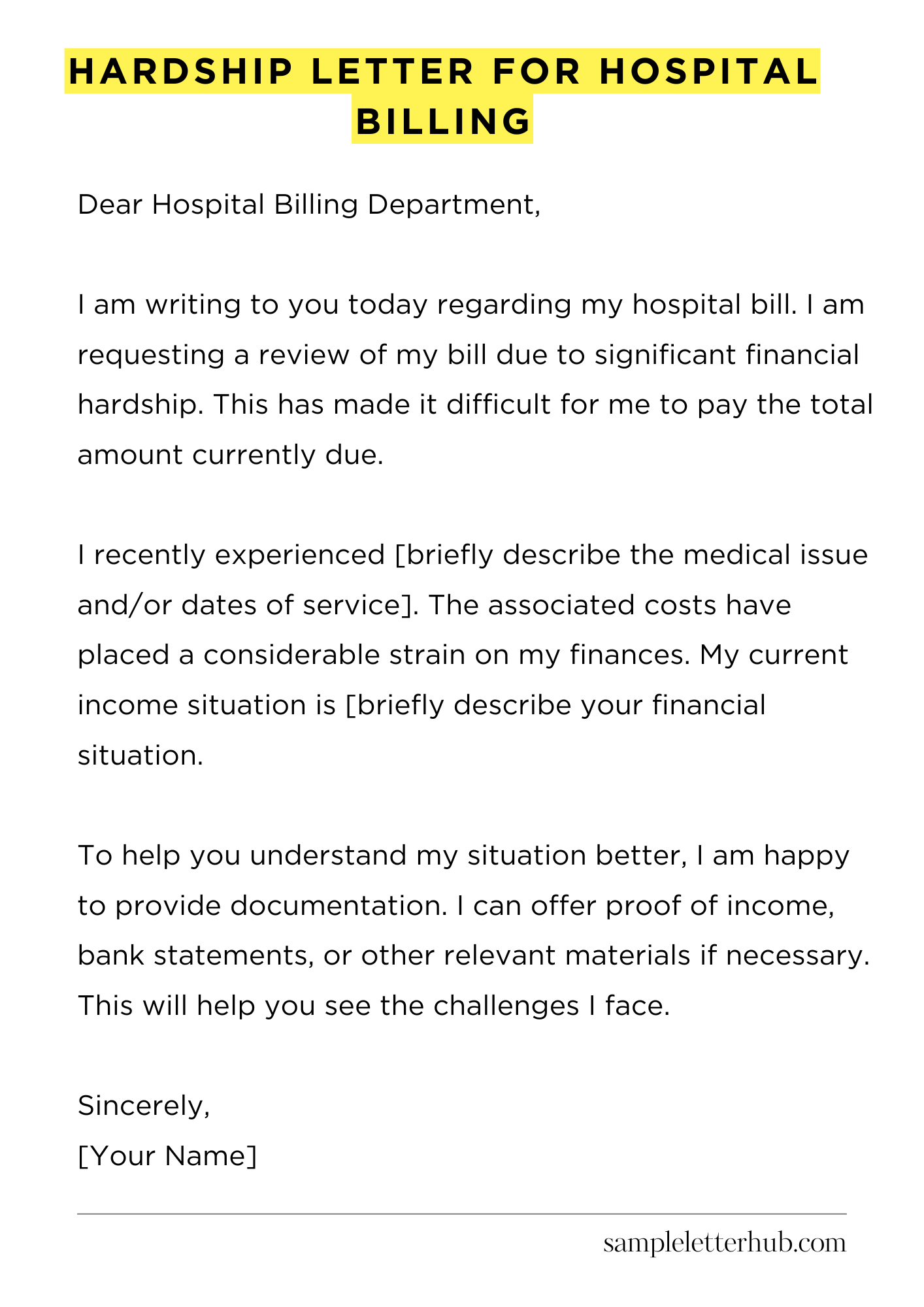
Dear Hospital Billing Department,
I am writing to you today regarding my hospital bill. I am requesting a review of my bill due to significant financial hardship. This has made it difficult for me to pay the total amount currently due.
I recently experienced [briefly describe the medical issue and/or dates of service]. The associated costs have placed a considerable strain on my finances. My current income situation is [briefly describe your financial situation – e.g., reduced due to job loss, limited due to disability, etc.].
To help you understand my situation better, I am happy to provide documentation. I can offer proof of income, bank statements, or other relevant materials if necessary. This will help you see the challenges I face.
I would be incredibly grateful if you would consider my request. I am hoping you might be able to offer some options. Possible options include a payment plan, a reduction in the bill, or assistance through the hospital’s financial aid program.
I am committed to fulfilling my financial obligations. I am eager to work with you to find a solution. Please contact me at your earliest convenience to discuss this further. I look forward to your response and hope for a positive resolution.
Thank you very much for your time and understanding.
Sincerely,
[Your Name]
How to Write a Hardship Letter for Hospital Billing
Facing insurmountable medical bills can feel like navigating a fiscal tempest. Writing a hardship letter is often the first, and sometimes the most impactful, step towards finding some fiscal respite. This missive, if crafted astutely, can illuminate your precarious financial situation and potentially persuade the hospital to offer assistance.
1. Commence with an Empathetic Salutation
Begin your letter with a professional and respectful salutation. Address it to the hospital’s billing department, or if you can, the Patient Financial Services department. Avoid generic greetings; instead, opt for something like, “To Whom It May Concern” or “Dear Hospital Billing Department.”
2. Authentically Articulate Your Circumstances
This is where you unearth the core of your narrative. Detail the specific circumstances that have plunged you into financial straits. Be explicit. Include details about your medical condition and treatments, ensuring accuracy.
If a job loss, unexpected illness, or other event precipitated your present financial hardship, delineate these events chronologically and with candor.
3. Substantiate Your Claims with Supporting Documentation
Paperwork is your ally. Include copies of any documents that buttress your claims. Think pay stubs, bank statements, tax returns, and records of unemployment benefits.
For medical expenses, include itemized bills and insurance explanations of benefits (EOBs). Highlight the relevant information to facilitate comprehension by the recipient. These documents are proof, not just prose.
4. Enumerate Your Financial Burdens
Go beyond a general lament. Provide a clear and concise breakdown of your current financial situation. List your monthly income, and itemize your expenses, including housing, utilities, food, and other essential expenditures.
This financial disclosure provides the hospital with the context necessary to evaluate your ability to meet your financial obligations. Leave no expense unaccounted for.
5. Propose a Pragmatic Solution
Rather than merely requesting assistance, consider formulating specific proposals. Suggest a payment plan, a reduction in the bill, or even complete forgiveness. Research the hospital’s financial assistance policies beforehand to ascertain potential relief. Demonstrate your willingness to collaborate and your commitment to resolving the debt. This suggests proactivity.
6. Conclude with a Courteous and Confident Closing
Reiterate your appreciation for their consideration. Use a professional closing, such as “Sincerely,” or “Respectfully.” Include your full name, contact information (phone number and email address), and account number. Be absolutely certain to keep a copy of the letter and all supporting documentation for your records.
7. Proofread and Refine Your Composition
Before dispatching your letter, subject it to a rigorous proofreading session. Check for grammatical errors, spelling inaccuracies, and factual inconsistencies. It must be polished and free of errors. A well-written letter exudes professionalism and indicates that you have taken the matter seriously. Ensure the letter is easy to read. Clarity is a virtue.
FAQs about Hardship Letter for Hospital Billing
What is a hardship letter for hospital billing and why is it needed?
A hardship letter is a formal written request sent to a hospital’s billing department, outlining a patient’s financial difficulties and requesting a reduction or waiver of medical bills. It explains the circumstances preventing full payment, such as job loss, high medical expenses, low income, or other significant financial burdens.
The letter serves as an appeal for financial assistance, hoping to negotiate a more manageable payment plan or a complete forgiveness of the debt.
What information should be included in a hardship letter?
A comprehensive hardship letter should include: the patient’s full name, account number, and contact information; a clear explanation of the financial hardship being experienced (e.g., loss of job, unexpected medical expenses, etc.); supporting documentation such as income statements, bank statements, tax returns, unemployment benefits information.
What supporting documentation is typically required with a hardship letter?
Hospitals typically require documentation to verify the financial hardship claimed in the letter. Common supporting documents include pay stubs, W-2 forms or tax returns, bank statements, proof of unemployment benefits, documentation of other debts (e.g., credit card bills, loans), and proof of income from other sources (e.g., disability benefits).
Providing comprehensive documentation strengthens the case and increases the likelihood of a positive outcome.
How do I submit a hardship letter, and to whom should it be addressed?
The hardship letter should be submitted to the hospital’s billing department or patient financial services department. It’s often best to address the letter to a specific person if possible, such as the Patient Financial Counselor or a billing manager, and you can usually find the contact information on your bill or on the hospital’s website.
Submit the letter via certified mail with a return receipt requested to provide proof of delivery, and keep a copy for your records. Some hospitals may also accept hardship letters electronically.
What are the possible outcomes after submitting a hardship letter?
The outcome of a hardship letter can vary. Possible outcomes include: a complete write-off of the debt, a significant reduction in the bill, a payment plan with reduced monthly payments, or no change to the bill.
The hospital will review the letter and supporting documentation and assess the patient’s financial situation. It is important to remember that hospitals have various financial assistance programs. If the initial outcome is not satisfactory, consider asking about the hospital’s financial assistance policies and if you qualify.
It is important to follow up with the hospital if you do not receive a response within a reasonable timeframe, to clarify the status of the request.
Related:
Resignation letter due to rude boss
Resignation letter moving to another state
Resignation letter due to illness of family member
Resignation letter due to study