

Need urgent cash? Facing a financial crisis? A hardship letter for emergency financial assistance can help. It’s a formal request for financial aid. The letter explains your situation. It outlines your need for help. The goal is to convince the recipient to provide assistance.
We understand writing this can be difficult. That’s why we’re here to help. This article provides hardship letter examples. We also have hardship letter templates. Use our sample hardship letters to guide you. Make writing easier with our free resources.
Get ready to draft your letter quickly. We’ll give you different formats. Find the right words with ease. These hardship letter samples are designed to assist. Get the emergency help you deserve. Let’s start writing your letter now!
[Your Name]
[Your Address]
[Your Phone Number]
[Your Email Address]
[Date]
[Name of Organization/Person]
[Organization/Person Address]
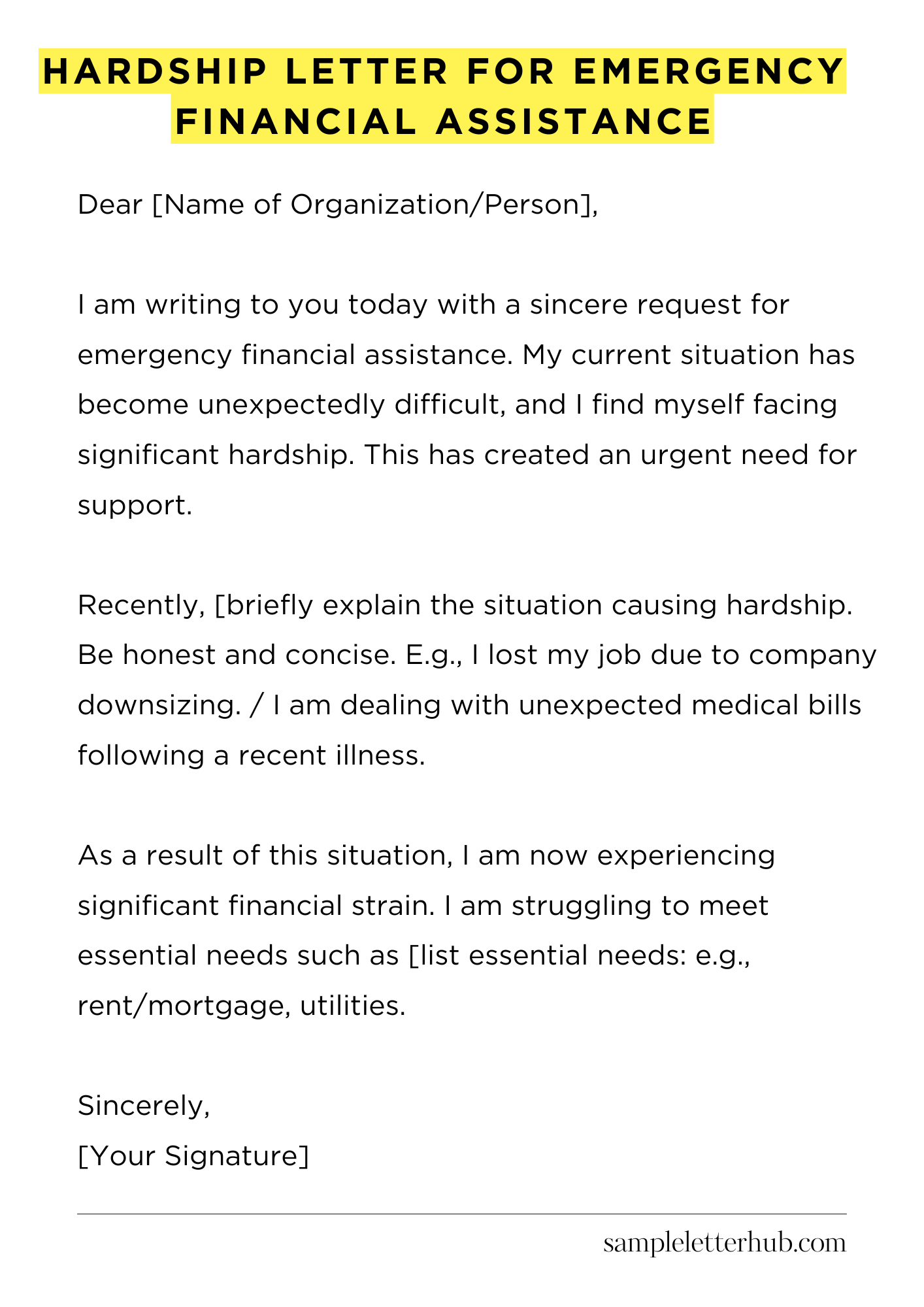
Dear [Name of Organization/Person],
I am writing to you today with a sincere request for emergency financial assistance. My current situation has become unexpectedly difficult, and I find myself facing significant hardship. This has created an urgent need for support.
Recently, [briefly explain the situation causing hardship. Be honest and concise. E.g., I lost my job due to company downsizing. / I am dealing with unexpected medical bills following a recent illness. / My car broke down unexpectedly, and I need it to get to work.]. It’s been a real struggle.
As a result of this situation, I am now experiencing significant financial strain. I am struggling to meet essential needs such as [list essential needs: e.g., rent/mortgage, utilities, food, medical expenses]. It’s tough to manage everything.
I have explored all available resources and options, including [mention any steps taken to address the situation: e.g., contacting local charities, applying for unemployment benefits, seeking help from family]. Unfortunately, these avenues have not provided sufficient relief to overcome the current challenges. I have tried my best.
I am requesting your assistance to help me cover [specify the amount of assistance needed and what it will be used for, e.g., a portion of my rent, covering urgent medical costs, etc.]. Specifically, I am requesting [state the amount] to help with [explain how the funds will be used]. Every little bit would help tremendously right now.
I am confident that with your support, I can navigate this difficult period and regain financial stability. I am committed to working hard to get back on my feet and I am actively seeking [mention any actions being taken to improve the situation: e.g., new employment opportunities, seeking financial counseling]. This is important for me.
I have attached [list any supporting documents: e.g., copies of bills, proof of income, bank statements] to provide further context and verification of my situation. They are included with this letter.
Thank you for considering my request and for your compassion. I am extremely grateful for any help you can offer. I eagerly await your response.
Sincerely,
[Your Signature]
How to Write Hardship Letter for Emergency Financial Assistance
Facing unexpected financial straits can be a harrowing experience. It’s a situation that requires tact, and clarity. Crafting a compelling hardship letter is often the first step in seeking emergency financial aid. This guide provides a comprehensive approach, empowering you to effectively communicate your predicament and increase your chances of securing assistance.
1. Understanding the Core Purpose
A hardship letter is essentially a formal plea for help. You need to present your case in a manner that is both transparent and persuasive. The underlying goal is to unequivocally demonstrate the specific circumstances that have plunged you into financial difficulty.
This clarity ensures the recipient understands the gravity of your situation and the urgent need for assistance. Consider this document your advocate; it needs to effectively articulate the crux of your predicament.
2. Pre-Letter Introspection and Research
Before putting pen to paper (or fingers to keyboard), engage in critical introspection. Accurately pinpoint the root cause of your financial hardship. Was it a sudden job loss? Unexpected medical bills? A natural disaster?
This initial assessment forms the bedrock of your letter. Simultaneously, research the specific aid program or organization you’re approaching. Comprehend their eligibility criteria, their guidelines, and the type of information they require. Such knowledge allows you to tailor your letter to align with their specific needs, boosting its efficacy.
3. Crafting a Compelling Salutation and Introduction
The commencement of your letter is crucial. Address the recipient appropriately, using their correct title and name. A simple “Dear Mr./Ms. [Last Name]” is generally sufficient. The introduction should be concise, yet impactful.
Begin by clearly stating the purpose of your letter: “I am writing to request emergency financial assistance due to…” Immediately, specify the source of your distress. Briefly state the nature of your financial emergency to seize the reader’s attention and pave the path for a comprehensive explanation of your circumstances.
4. Detailing Your Hardship: The Heart of the Matter
This is where you meticulously explain your predicament. Provide a detailed, chronological account of the events leading to your financial hardship. Be truthful and precise, including dates, figures, and relevant documentation. Avoid hyperbole or embellishment. Instead, opt for a factual, objective tone.
Include specific examples illustrating the impact of your hardship, such as inability to pay rent, afford essential medication, or maintain utilities. Supporting documentation, such as medical bills, bank statements, or layoff notices, should be explicitly mentioned and attached.
5. Presenting Your Financial Position
Honesty is the best policy. Clearly outline your current financial standing. Include a summary of your income, expenses, assets, and debts. This could be written as a simplified budget. Specify the amount of assistance you require and how it will be used. Indicate a clear plan on how you intend to repay the funds, if required.
Transparency about your financial state provides reassurance to the aid provider. It shows you’re organized, responsible, and capable of managing the situation.
6. The Concluding Summation and Call to Action
Conclude your letter by reiterating your need for assistance and expressing your gratitude for their consideration. A simple but sincere closing works well.
Reiterate the urgency of your request, and clarify how they can contact you (phone number, email address, mailing address). Include a statement of commitment to following up, if you deem necessary. End with a professional closing, such as “Sincerely” or “Respectfully.”
7. Polishing and Proofreading for Perfection
The final stage is critical. Thoroughly review your letter for grammar, spelling, and clarity. Make sure your tone is professional, respectful, and not demanding. It’s often helpful to have someone else read your letter for a fresh perspective. Correct any errors and ensure that your letter is easy to read.
A well-written, error-free letter reflects your respect for the recipient and increases the likelihood that your plea will be taken seriously. This is the last step that can enhance your chances of success.
FAQs about Hardship Letter for Emergency Financial Assistance
What is a hardship letter for emergency financial assistance?
A hardship letter is a formal document written by an individual to request financial aid or assistance from an organization, lender, or program.
The letter explains the specific financial difficulties the individual is facing, the reasons behind the hardship, and the amount of assistance needed. It serves as a plea for help and is often submitted along with supporting documentation, such as proof of income, expenses, and debts.
What should be included in a hardship letter?
A comprehensive hardship letter typically includes a clear and concise explanation of the financial hardship experienced, supported by facts and details. It should specify the date and type of hardship, its effect on your financial stability, and the specific amount of financial assistance requested.
Furthermore, it should explain why you are unable to resolve the financial issues on your own, provide documentation to verify your claims, and clearly state what you plan to do once the assistance is granted. It is crucial to be honest, respectful, and professional in your writing.
Who can I send a hardship letter to?
You can send a hardship letter to various entities, including lenders (mortgage companies, banks, credit card companies), government assistance programs, charitable organizations, or even individual donors. The specific recipient will depend on the nature of the financial assistance needed.
For example, if you are struggling to make mortgage payments, you would send the letter to your mortgage lender. If you require assistance with utility bills, you might contact a local charity or government program. Researching and identifying the appropriate organizations or individuals to target your letter is crucial.
What kind of documentation should I include with my hardship letter?
Supporting documentation is essential to substantiate the claims made in your hardship letter. This documentation can include proof of income (pay stubs, tax returns), proof of expenses (utility bills, medical bills), bank statements, and any other relevant documents that demonstrate your financial situation and the hardship you are experiencing.
The specific documents required will vary depending on the assistance you are seeking and the guidelines of the organization or individual you are contacting. Including as much relevant documentation as possible is always advisable.
How can I increase my chances of getting approved for emergency financial assistance?
Several factors can increase the likelihood of your hardship letter being approved. Ensure the letter is well-written, clear, and concise. Be honest and transparent about your situation and provide all necessary supporting documentation.
Research the specific requirements and guidelines of the organization or program you are applying to and tailor your letter accordingly. Clearly state the amount of assistance you need and how it will be used. Maintain a positive and respectful tone throughout the letter. Finally, follow up with the recipient if you do not hear back within a reasonable timeframe.
Related:
Resignation letter due to rude boss
Resignation letter moving to another state
Resignation letter due to illness of family member
Resignation letter due to study