

A handyman resignation letter is a formal notice. It tells your employer you are leaving your job. The purpose is to officially communicate your departure. It also helps maintain a professional relationship.
Planning your exit can feel overwhelming. We understand. You need to write a good letter. We are here to help.
We’ve gathered a collection of handy templates. You can use them to create your own letter. Each example offers different styles and situations. Pick what works best for you!
Handyman Resignation Letter
Below is a sample of a Handyman Resignation Letter:
[Your Name]
[Your Address]
[Your Phone Number]
[Your Email Address]
[Date]
[Employer’s Name]
[Company Name]
[Company Address]
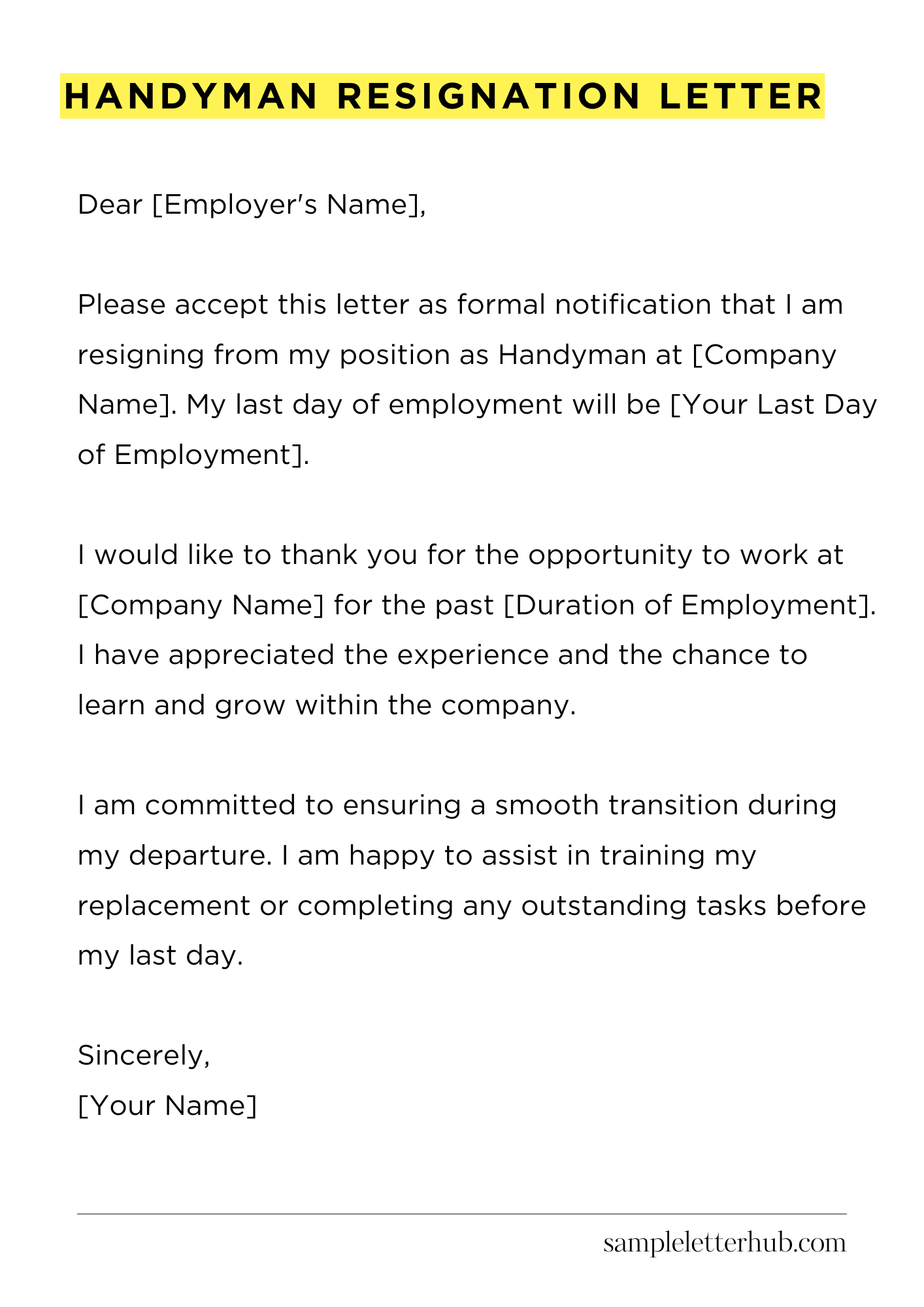
Dear [Employer’s Name],
Please accept this letter as formal notification that I am resigning from my position as Handyman at [Company Name]. My last day of employment will be [Your Last Day of Employment].
I would like to thank you for the opportunity to work at [Company Name] for the past [Duration of Employment]. I have appreciated the experience and the chance to learn and grow within the company.
I am committed to ensuring a smooth transition during my departure. I am happy to assist in training my replacement or completing any outstanding tasks before my last day.
I wish you and [Company Name] all the best in the future.
Sincerely,
[Your Name]
How to Write a Handyman Resignation Letter
So, you’re ready to move on. You’ve decided to leave your handyman gig, and now it’s time to craft that all-important resignation letter. Don’t worry; it’s a straightforward process. A well-written letter is essential for maintaining a professional relationship, even as you depart. Let’s break down how to do it right.
1. Get Started Right: The Essentials
First things first, make sure you include the necessary information. Begin with your full name, address, and the date at the top. This sets the stage and provides all the details. Next, address the letter to your direct supervisor or the appropriate contact within the company. A proper salutation is vital. Use “Dear [Supervisor’s Name],” or something similar, for a professional touch.
Your goal is to clearly and concisely state your intention to resign. Keep it direct. Don’t beat around the bush. State explicitly that you are resigning from your position. Include the date your resignation is effective. That’s a crucial piece of information. This should align with your notice period, usually two weeks, as specified in your employment agreement. This is basic, but necessary.
2. Briefly Explain Yourself (But Not Too Much)
You’re not obligated to provide a detailed explanation. However, a brief, professional reason for leaving can be helpful. Keep it concise. Maybe you’re pursuing a different opportunity, or perhaps you’re relocating. Whatever the reason, keep it brief and positive.
Avoid any negativity or complaints about your job, colleagues, or employer. This is a moment for moving forward, not for rehashing past issues. You want to leave on a positive note. Maintain a professional tone. It is important to be respectful.
3. The Thank You Matters: Express Your Gratitude
Always express your gratitude. Thank your employer for the opportunity to work there. Mentioning anything you learned or valued during your time is a nice touch. Show your appreciation for the experiences you had. You can acknowledge any support or training received. This leaves a lasting impression. This shows respect, and is simply good etiquette.
4. Wrap it Up: Next Steps & Offers
Offer your assistance during the transition period. State your willingness to help train a replacement or complete any ongoing projects. This demonstrates professionalism and a commitment to ensuring a smooth handover. This is how you show you’re a team player. Finally, end with a polite closing, such as “Sincerely,” or “Respectfully,” followed by your name and signature.
Proofread the letter carefully before submitting it. Check for any errors in grammar or spelling. Ensure all the information is correct. Make a final check. Sending a polished letter shows respect for your employer and yourself. Now you’re ready to move on.
5. Delivery & Follow-Up: Getting it Done
Deliver your resignation letter to the appropriate person, as outlined above. It is recommended to hand deliver it or send it via email (as a PDF). Consider requesting a confirmation receipt.
This provides proof that your letter was received. Keep a copy of your letter for your records. If you hand in the letter, and the supervisor is unavailable, get it in writing. After your resignation is accepted, follow up to confirm the details, such as final pay and benefits. That’s all there is to it. Best of luck in your future endeavors!
FAQs about Handyman resignation letter
How do I write a Handyman resignation letter?
A handyman resignation letter should be professional and concise. Start by formally stating your resignation, including the effective date. Express your gratitude for the opportunity to have worked as a handyman.
Briefly state your reason for leaving, if you wish, but it’s not always required. Keep it positive and end with a thank you, and offer to help with the transition if possible. Be sure to include your name and contact information.
What should I include in my Handyman resignation letter?
Your letter should include: your formal notification of resignation, the effective date of your last day of employment, a brief expression of gratitude for the opportunity, an optional and brief reason for leaving, a polite offer to assist with the handover process if you’re able, and your name and contact information.
What is the proper format for a Handyman resignation letter?
The format should be business-like. Start with your name and contact information, followed by the date, and then the employer’s information. Address the letter to your supervisor or the appropriate person. Use clear and concise language, and maintain a professional tone throughout. Use standard business letter format, single-spaced with a formal closing.
Can I provide a reason for resigning in the letter?
Yes, you can provide a reason. However, it’s not mandatory. If you choose to, keep it brief and professional. You can simply state that you are pursuing another opportunity or that it’s due to personal reasons. Avoid negative statements or complaints. It’s often best to keep the reason straightforward.
How much notice should I give in my Handyman resignation letter?
The standard practice is to give two weeks’ notice. However, this may vary depending on your employment agreement or local laws. Review your employment contract or company policy to determine the required notice period. Adhering to the required notice period is crucial to ensure a smooth transition and maintain a positive relationship with your employer.
Related:
Resignation letter due to rude boss
Resignation letter moving to another state
Resignation letter due to illness of family member
Resignation letter due to study