

Navigating a job change, especially at a senior level, involves several crucial steps. One of the most significant is drafting a resignation letter. A Group Financial Controller resignation letter formally announces your departure from the company. It serves as a professional record and outlines your final day of employment.
This article provides valuable resources. We understand crafting the perfect resignation letter can be daunting. You will find different templates and examples. These samples are designed to help you. They will guide you in expressing your decision clearly.
Our goal is to make the process smoother for you. We aim to help you communicate your resignation with professionalism and grace. You can easily adapt these samples. You can customize them to suit your unique situation.
Group Financial Controller Resignation Letter
Below is a sample of a Group Financial Controller Resignation Letter:
[Your Name]
[Your Address]
[Your Phone Number]
[Your Email Address]
[Date]
[Recipient’s Name]
[Recipient’s Title]
[Company Name]
[Company Address]
Dear [Recipient’s Name],
Please accept this letter as formal notification that I am resigning from my position as Group Financial Controller at [Company Name]. My last day of employment will be [Your Last Day of Employment].
I have enjoyed my time at [Company Name] and appreciate the opportunities I have been given during my tenure. I am grateful for the experience and knowledge I have gained.
I will do everything I can to ensure a smooth transition during my departure. I am available to assist in training my replacement and completing any necessary handover tasks. Please let me know how I can be of assistance in this process.
I wish [Company Name] continued success in the future.
Sincerely,
[Your Name]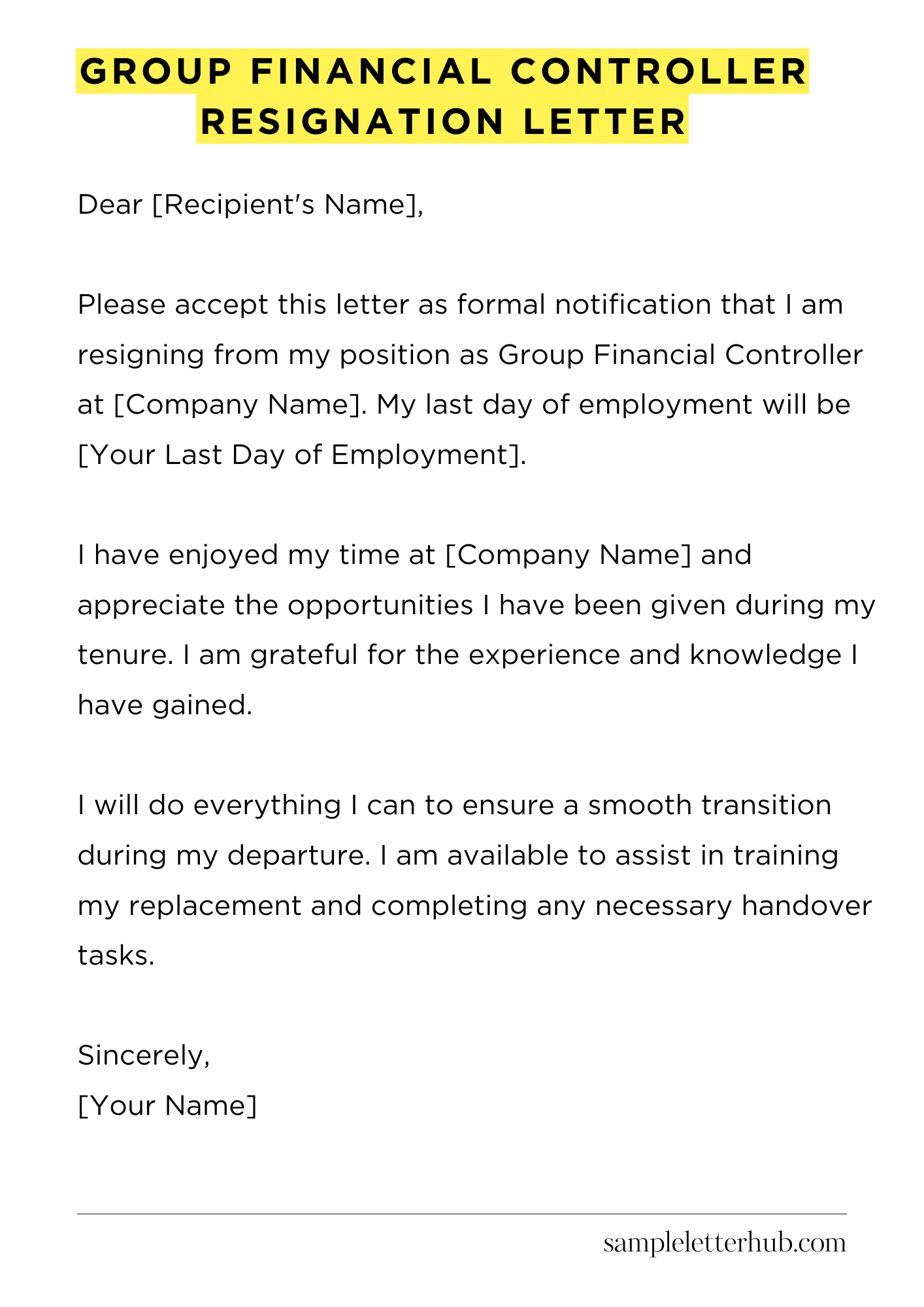
How to Write a Group Financial Controller Resignation Letter
1. Preparation is Key: Before You Start Writing
So, you’ve made the decision. You’re moving on from your role as Group Financial Controller. Now comes the often-dreaded task: writing your resignation letter. Take a deep breath. This is a chance to leave a lasting professional impression. Before putting pen to paper (or fingers to keyboard), there are some things you need to do.
Firstly, understand your company’s policy. Are there specific protocols you need to follow? Check your employment contract and/or the company handbook. This could involve submitting your letter to a particular person or department. Secondly, figure out your last day. This is crucial. Ensure you factor in any notice period required by your contract.
Finally, and very importantly, prepare to have a conversation. Inform your immediate supervisor of your decision in person, if at all possible. This is simply a matter of respect. Doing so first sets the stage for a smooth transition.
2. The Essential Components: What to Include
Now, let’s get to the meat of the matter: writing the letter itself. Keep it concise. This isn’t a novel; it’s a professional communication. There are a few core elements that are non-negotiable.
Start with a clear statement of your intention. State, in the first paragraph, that you are resigning from your position as Group Financial Controller. Specify your last day of employment. Next, express your gratitude. Acknowledge the opportunities you’ve been given and the experiences you’ve gained during your time at the company.
This shows professionalism. Then, consider a brief sentence or two explaining your reason for leaving. This is optional, but it’s often helpful. You don’t need to go into excessive detail, but a simple statement like, “I am pursuing a new opportunity,” is perfectly acceptable. Finally, offer assistance with the transition.
Express your willingness to help train a replacement or complete any ongoing projects. This adds a nice touch of professionalism.
3. Crafting the Perfect Tone: Professionalism is Paramount
The tone of your resignation letter is incredibly important. You want to strike the right balance between sincere and professional. Avoid negativity at all costs. Steer clear of complaints, grievances, or personal attacks. Even if your experience wasn’t entirely positive, this isn’t the place to air your issues.
Use a respectful and appreciative tone. Thank your employer for the opportunity. Keep your language formal and polite. Focus on the positive aspects of your employment, even if they were few and far between.
Proofread carefully. Spelling and grammar errors can undermine your credibility. It also shows a lack of attention to detail and professionalism. Before you send, read it aloud. This will often help you catch any awkward phrasing or grammatical errors.
4. Sample Structure: A Template to Guide You
Sometimes, seeing a template can be really useful. It provides a framework upon which to build your own letter. Here’s a basic structure you can adapt:
[Your Name]
[Your Address]
[Your Phone Number]
[Your Email Address]
[Date]
[Recipient’s Name]
[Recipient’s Title]
[Company Name]
[Company Address]
Dear [Recipient’s Name],
Please accept this letter as formal notification that I am resigning from my position as Group Financial Controller at [Company Name]. My last day of employment will be [Your Last Day].
I am grateful for the opportunities I have been given during my time here. I have learned a great deal and appreciate the experience I have gained.
[Optional: Briefly state your reason for leaving].
I am happy to assist with the transition in any way possible, including training my replacement or completing any ongoing projects. Please let me know how I can be of help.
I wish you and [Company Name] all the best in the future.
Sincerely,
[Your Signature]
[Your Typed Name]
Remember to tailor this template to your specific situation and personalize it.
5. After the Letter: Handling the Aftermath
You’ve written the letter, and you’ve submitted it. The process doesn’t end there, of course. Be prepared for a response. Your supervisor will likely want to discuss your resignation. Be prepared to answer any questions calmly and professionally. Stick to the points you’ve already covered in your letter. Resist the urge to engage in gossip or negativity.
Prepare for the transition period. If you offered assistance, be ready to provide it. Follow through on your commitments. Maintain a positive attitude during your remaining time at the company. Keep your work ethic at its peak.
Finally, keep in mind your goal: to leave on good terms. You never know when your paths may cross again. A professional and positive departure can open doors in the future. Good luck!
FAQs about Group Financial Controller resignation letter
How much notice should a Group Financial Controller provide in their resignation letter?
The standard notice period for a Group Financial Controller typically aligns with their employment contract and local labor laws. This period often ranges from one to three months, reflecting the seniority and the complexity of the role. It is crucial to review the employment contract to determine the exact notice requirements.
Providing the proper notice is essential for a smooth transition and maintaining a professional relationship with the employer.
What key information should be included in a Group Financial Controller’s resignation letter?
The resignation letter should clearly state the intention to resign, the effective date of resignation, and a concise statement expressing gratitude for the opportunity. It is advisable to briefly acknowledge the experiences gained and any specific achievements during their tenure.
Additionally, offering assistance with the transition process and reiterating commitment to a smooth handover is viewed favorably. Personal details like the new role should be avoided to maintain a professional approach.
How should a Group Financial Controller address concerns about ongoing projects or deadlines in the resignation letter?
The resignation letter should mention the commitment to completing tasks. The letter could offer support to ensure a seamless handover. Offer to cooperate with the employer on a handover plan or transition to minimize any disruption caused by the departure.
Proposing to offer support where needed, especially in relation to the current projects is important. Specific solutions, like outlining key responsibilities or tasks needing to be completed before the exit date, are very important.
Can a Group Financial Controller mention the reason for leaving in their resignation letter?
While not mandatory, a Group Financial Controller can briefly state the reason for leaving. This is especially true if there’s a requirement from the employer.
Common reasons mentioned include pursuing other career opportunities or personal reasons. However, it’s essential to keep the explanation brief, positive, and professional. Avoid any negative comments or criticisms about the company or colleagues, and focus on the future.
Who should the resignation letter of a Group Financial Controller be addressed to?
The resignation letter should typically be addressed to the immediate supervisor or the person who hired the Group Financial Controller, such as the Chief Financial Officer (CFO), the CEO, or the Board of Directors if appropriate.
If there is a designated human resources representative, it might also be proper to send a copy to them. Ensure the letter reaches the appropriate individual to ensure that it is formally recorded.
Related:
Resignation letter due to rude boss
Resignation letter moving to another state
Resignation letter due to illness of family member
Resignation letter due to study