

You’re starting a new chapter. A “Graduate Engineer Trainee resignation letter” is your formal farewell. It officially informs your employer of your departure. This document is a crucial step in ending your employment professionally.
Preparing your own can seem daunting. We understand. That’s why we’ve crafted this guide. We’re providing you with several letter examples. You can adapt them to your specific situation.
These sample letters will provide a great foundation. You can easily customize them. Whether you are seeking a new opportunity or changing your career, these letters will help you bid adieu.
Graduate Engineer Trainee Resignation Letter
Below is a sample of a Graduate Engineer Trainee Resignation Letter:
[Your Name]
[Your Address]
[Your Phone Number]
[Your Email Address]
[Date]
[Hiring Manager Name] (If known, otherwise use title)
[Hiring Manager Title]
[Company Name]
[Company Address]
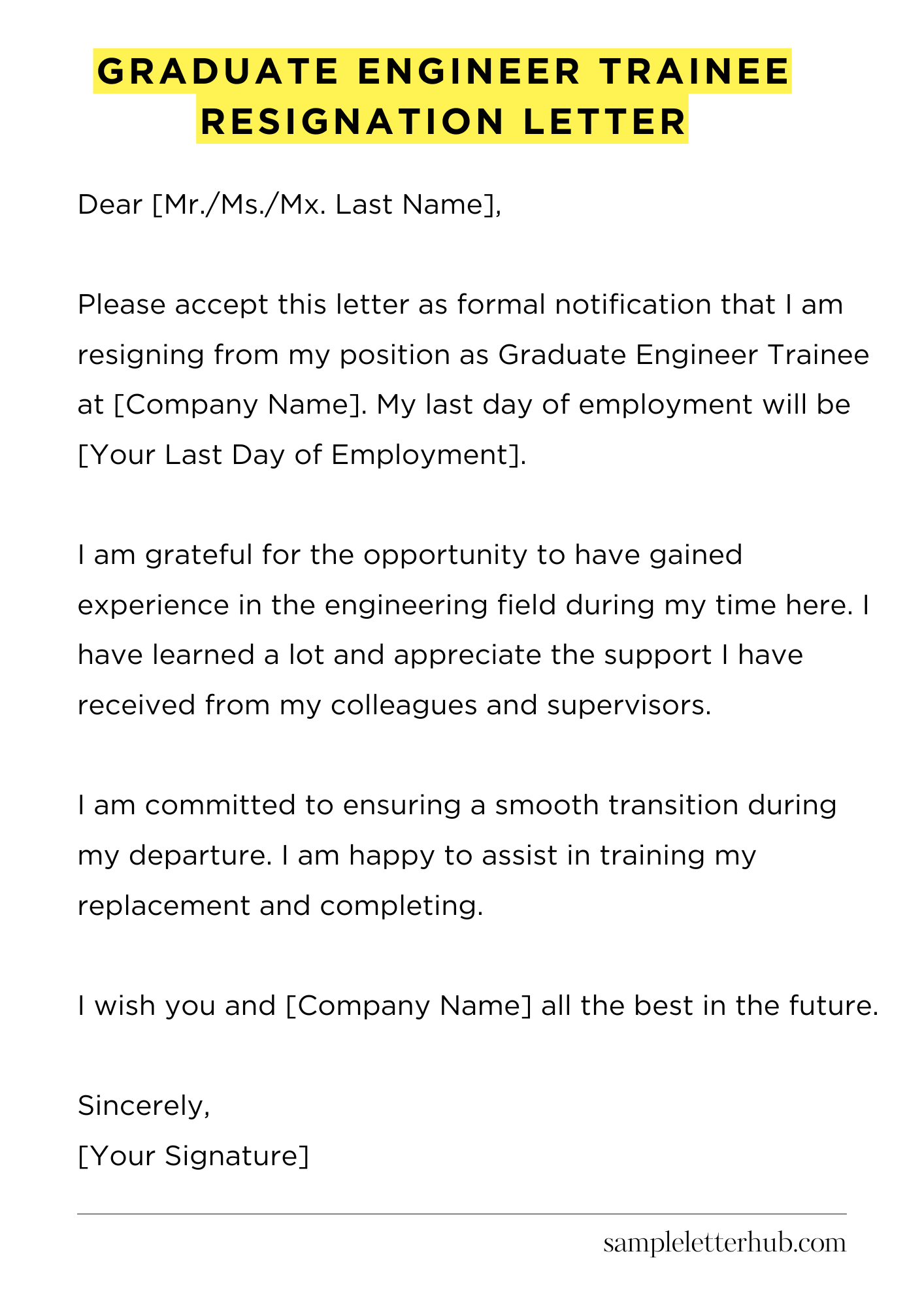
Dear [Mr./Ms./Mx. Last Name],
Please accept this letter as formal notification that I am resigning from my position as Graduate Engineer Trainee at [Company Name]. My last day of employment will be [Your Last Day of Employment].
I am grateful for the opportunity to have gained experience in the engineering field during my time here. I have learned a lot and appreciate the support I have received from my colleagues and supervisors.
I am committed to ensuring a smooth transition during my departure. I am happy to assist in training my replacement and completing any outstanding tasks before my last day.
I wish you and [Company Name] all the best in the future.
Sincerely,
[Your Signature]
How to Write a Graduate Engineer Trainee Resignation Letter
1. Why Resign? Reasons and Considerations
So, you’re thinking about moving on from your Graduate Engineer Trainee role. Understandable! Life happens, and sometimes a change is necessary. Before you even think about putting pen to paper (or fingers to keyboard), take a moment to reflect on your reasons.
Are you seeking better compensation, a different role, or a more engaging work environment? Perhaps there are personal factors at play. Regardless of your rationale, it’s crucial to have a clear understanding of why you are resigning. This clarity will help you articulate your reasons professionally in your letter.
Consider the timing too. Have you fulfilled any contractual obligations? Do you have any ongoing projects you need to wrap up? Planning your departure thoughtfully will not only ensure a smoother transition for you but also reflect well on your professionalism.
2. Essential Elements: What Your Letter Needs
Your resignation letter is a formal document. It should be concise, clear, and professional. It needs to convey important information effectively.
- Date: Always include the date you’re writing the letter.
- Formal Salutation: Start with a proper greeting. “Dear [Manager’s Name],” is generally the best approach.
- Clear Statement of Resignation: Explicitly state that you are resigning from your position as a Graduate Engineer Trainee. Use a straightforward sentence like, “Please accept this letter as formal notification that I am resigning from my position as Graduate Engineer Trainee, effective [Your Last Day of Employment].”
- Reasoning (Optional, but Recommended): Briefly state your reason for leaving. This can be as simple as, “I am pursuing other opportunities” or “I am seeking to advance my career in [specific field].” Keeping it brief and positive is often the best approach.
- Gratitude: Express your appreciation for the opportunity. Thank your employer for the experience and any training or development you received.
- Offer of Assistance: Offer to assist with the transition. You can say something like, “I am willing to assist in the handover of my responsibilities to ensure a smooth transition.”
- Formal Closing: End with a professional closing, such as “Sincerely,” or “Respectfully,” followed by your full name.
- Your Signature: Don’t forget to sign the letter manually if you’re submitting a hard copy.
3. Crafting the Perfect Letter: Structure and Tone
Now, let’s assemble the pieces. Structure is key. Begin with your letterhead if your company provides one. Otherwise, start with your contact information (name, address, phone number, email address) and the date. Then, address your manager directly.
The tone is crucial. Maintain a professional and respectful tone throughout the letter, even if you’ve had negative experiences. Avoid negativity and focus on the positive aspects of your employment, or simply state your reason for leaving in a neutral way. Keep the language polite and formal.
Proofread everything carefully! Check for grammar, spelling, and punctuation errors. These errors can undermine the professionalism you’re trying to project.
4. Examples and Templates: Ready-to-Use Resignation Letters
Need a little help getting started? Here is a sample:
[Your Name]
[Your Address]
[Your Phone Number]
[Your Email]
[Date]
[Manager’s Name]
[Manager’s Title]
[Company Name]
[Company Address]
Dear [Manager’s Name],
Please accept this letter as formal notification that I am resigning from my position as Graduate Engineer Trainee at [Company Name], effective [Your Last Day of Employment].
I am pursuing other opportunities to advance my career.
I am grateful for the experience and training I have received during my time here. I especially appreciate [mention something specific you learned or experienced]. I am willing to assist in the handover of my responsibilities to ensure a smooth transition.
Thank you again for the opportunity. I wish you and [Company Name] all the best in the future.
Sincerely,
[Your Signature (if sending a hard copy)]
[Your Typed Name]
Remember to tailor this template to your specific situation and add details that reflect your experience and relationship with your employer.
5. After the Letter: Handing In, Feedback, and Next Steps
Once your letter is ready, make sure you know the proper channels for submission. Usually, you’ll hand it directly to your manager. Follow any specific company protocols for submitting your letter, whether it’s through email or a hard copy. Get a digital or physical receipt from your manager as a token of confirmation that they have received the letter.
Be prepared for a conversation. Your manager might want to discuss your resignation or attempt to retain you. Maintain professionalism and remain firm in your decision, if you are certain about it.
Use this as a chance to get some feedback. You can ask your manager for constructive criticism of your performance. They will be happy to assist you here. Reflect on your experience. Then, start focusing on the next chapter of your professional journey.
Your resignation letter is more than just a formality; it’s a statement of professionalism. Writing a well-crafted letter can leave a positive lasting impression and open doors for future opportunities. Take the time to do it right!
FAQs about Graduate Engineer Trainee resignation letter
How much notice should a Graduate Engineer Trainee give when resigning?
Generally, a Graduate Engineer Trainee should adhere to the notice period specified in their employment contract. This is typically two to four weeks. Review your contract carefully for the exact duration. Giving adequate notice allows for a smooth handover of responsibilities and maintains a professional relationship with the employer.
What should be included in a Graduate Engineer Trainee resignation letter?
A resignation letter should include a clear statement of resignation, the date of your last day of employment (accounting for the notice period), a concise statement of gratitude for the opportunity, and possibly a brief explanation (optional) for leaving. Avoid including negative comments about the company or colleagues. Be professional and positive in tone.
Should a Graduate Engineer Trainee state the reason for resigning in the letter?
It is generally not mandatory to provide a detailed reason for resigning. However, you can briefly state a reason if you wish, such as “to pursue a new opportunity” or “to further my career goals.” Keep the reason concise and professional. If you are leaving for a specific opportunity or offer, you do not need to share those details.
What is the proper format for a Graduate Engineer Trainee resignation letter?
The letter should be professional in its format. Include your name, contact information, the date, and the recipient’s name and title. Use a formal salutation (e.g., “Dear [Manager’s Name]”). Keep the body of the letter concise and to the point. End with a professional closing (e.g., “Sincerely” or “Regards”) and your signature. If sending electronically, a typed signature is acceptable.
Is it necessary to hand in the resignation letter in person as a Graduate Engineer Trainee?
While handing in the letter in person is often considered professional, it may not always be practical or required. Confirm company policy or ask your direct supervisor how they prefer to receive it. You can typically email the letter to your manager and HR, especially if you work remotely. Ensure you keep a copy for your records.
Related:
Resignation letter due to rude boss
Resignation letter moving to another state
Resignation letter due to illness of family member
Resignation letter due to study