

A General Laborer resignation letter is a formal document. Its purpose is to officially inform your employer that you are leaving your job. This letter states your intent to resign. It also typically includes your last day of employment.
Ready to move on to the next chapter? Writing a resignation letter can feel tricky. Don’t worry, we’re here to help you navigate this process smoothly. We’ve got you covered with a range of templates.
We’ll share several easy-to-adapt examples. Each one suits different situations. You can customize them. This way you’ll create a professional letter. Make sure it reflects your needs.
General Laborer Resignation Letter
Below is a sample of a General Laborer Resignation Letter:
[Your Name]
[Your Address]
[Your Phone Number]
[Your Email Address]
[Date]
[Employer’s Name]
[Company Name]
[Company Address]
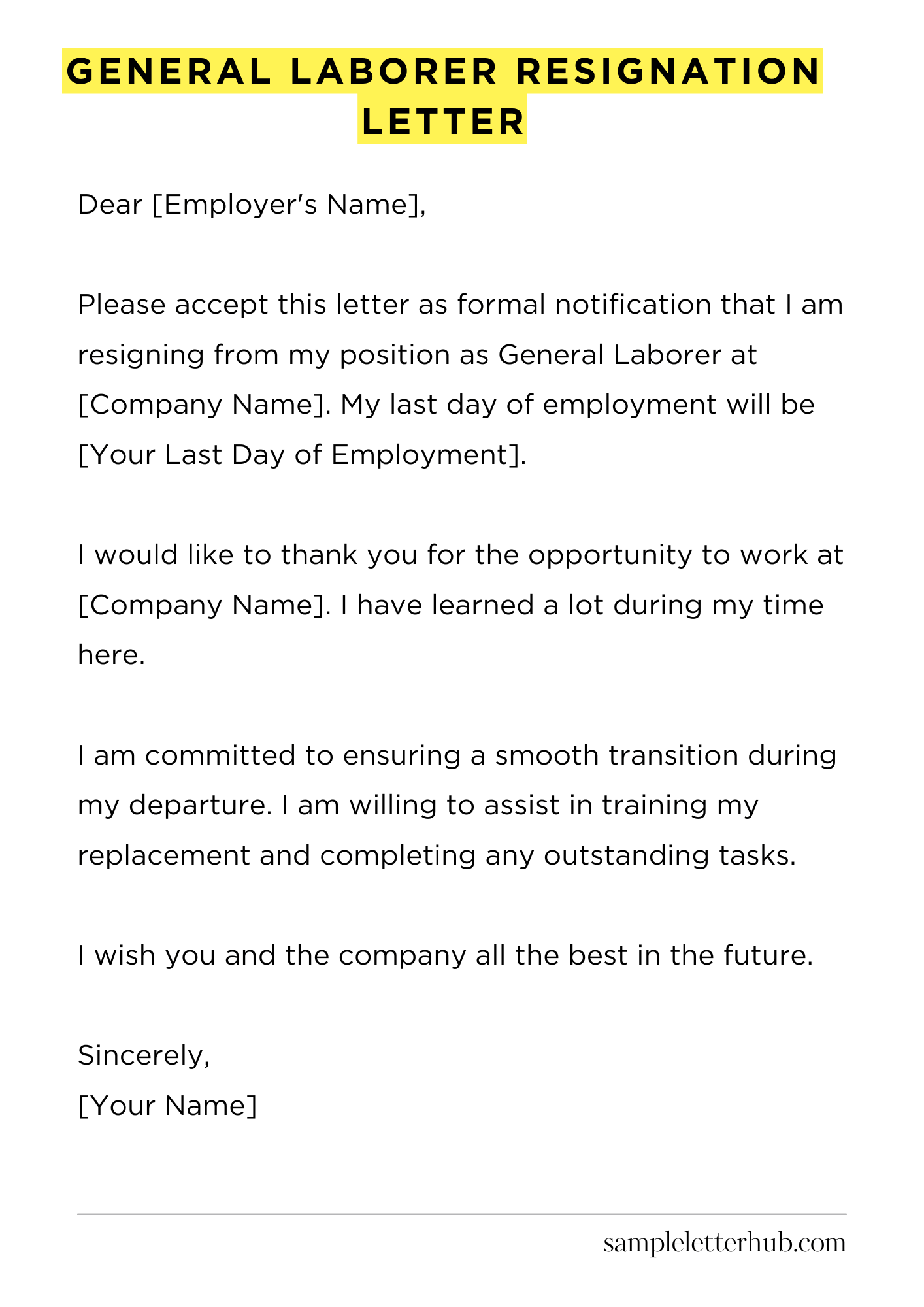
Dear [Employer’s Name],
Please accept this letter as formal notification that I am resigning from my position as General Laborer at [Company Name]. My last day of employment will be [Your Last Day of Employment].
I would like to thank you for the opportunity to work at [Company Name]. I have learned a lot during my time here.
I am committed to ensuring a smooth transition during my departure. I am willing to assist in training my replacement and completing any outstanding tasks.
I wish you and the company all the best in the future.
Sincerely,
[Your Name]
How to Write a General Laborer Resignation Letter
1. Getting Started: The Basics You Absolutely Need
Resigning from any job, even as a general laborer, is a big deal. You are ending a working relationship. It’s important to do it professionally. The most crucial part? You need a letter! Don’t just tell your boss face-to-face, though that’s fine as a courtesy. Always follow it up with a written document.
Your letter should be clear, concise, and respectful. Think of it as a formal goodbye. Avoid using slang or overly casual language. Keep it brief. You need to include your name, the date you’re writing the letter, and the date of your last day of employment. This is non-negotiable.
2. Structure is Key: Formatting Your Letter Properly
Let’s get down to the structure, shall we? Proper formatting is a must. This adds professionalism. Start with your contact information at the top left. Then, below that, on the right side, include the date.
Next, list your employer’s contact information. That is the recipient’s name, their job title, and the company address. Use standard business letter format. Don’t go crazy with fonts or fancy designs. Keep it simple and easy to read. This isn’t the time to be creative with fonts.
3. The Meat and Potatoes: What to Include in Your Letter
Now, let’s look at what actually goes into the letter. Begin with a formal salutation, like “Dear [Boss’s Name]”. Then, state your intention clearly in the first paragraph. Something along the lines of, “Please accept this letter as formal notification that I am resigning from my position as General Laborer at [Company Name].”
Next, state your last day of employment. Be sure to confirm this with your employer beforehand if you can. Then, add a brief, positive statement. Expressing gratitude for the opportunity is good practice.
Perhaps, “I appreciate the experience I’ve gained while working here.” Avoid negativity. Do not list reasons for leaving unless you are specifically asked to do so by the employer. Finally, include a professional closing. “Sincerely,” or “Respectfully,” is perfect. Finish with your typed name and a space for your signature.
4. Keeping it Clean: Avoiding Common Mistakes
Avoid any unnecessary drama. Keep the tone of your letter professional and respectful. Steer clear of bad-mouthing your employer or co-workers. Remember that this letter could be kept on file.
Don’t be vague about your last day of employment. Be very clear and accurate. Avoid spelling and grammatical errors. Proofread your letter carefully. Ask someone else to look it over before you submit it. The little things matter!
5. Fine-Tuning and Delivery: Getting Your Letter Across
Before you send it, proofread again. Check the date, your name, the company name. Make sure everything is correct. Once you’re certain, print a hard copy. Then, give it to your boss. Hand-delivering it is better than emailing. This lets your boss know you are serious. Always be polite. Keep a copy for your records.
Remember, a well-written resignation letter leaves a positive final impression. It can make future references go smoothly. Doing things correctly will leave them in a better position to remember you and the quality of your work.
FAQs about General Laborer Resignation Letter
What is the purpose of a General Laborer resignation letter?
The primary purpose of a General Laborer resignation letter is to formally notify your employer of your intention to leave your position. It serves as an official record of your departure, providing a clear date of your last day of employment and helping to ensure a smooth transition.
It also allows you to express your gratitude and provide any necessary details regarding your departure.
What should I include in a General Laborer resignation letter?
A typical General Laborer resignation letter should include: your name and contact information, the date, the employer’s name and address, a clear statement of your resignation, your last day of employment, a brief expression of gratitude (optional), and your signature. It’s also advisable to state the reason for your resignation, if you wish to, but it’s not compulsory.
How much notice should I give my employer in a General Laborer resignation letter?
The amount of notice you should give depends on your employment contract, company policy, and local labor laws. Typically, a minimum of two weeks’ notice is standard practice in many regions.
However, it’s always best to review your employment agreement to determine the required notice period. Giving more notice is often appreciated and can help maintain a positive relationship with your employer.
Can I provide a reason for resigning in my General Laborer resignation letter?
Yes, you can provide a reason for your resignation, but it’s not mandatory. If you choose to, you can keep it brief and professional. Some common reasons include seeking new opportunities, personal reasons, or dissatisfaction with the current role.
You might not want to disclose any sensitive personal information, but stating something general like “pursuing a new career path” or “relocating” is acceptable.
Should I submit my General Laborer resignation letter electronically or in hard copy?
The preferred method of submission can vary by company. Generally, it’s a good idea to inquire about the preferred method (email or hard copy) with your supervisor or HR department. Regardless of the method, ensure the letter is well-formatted, professional, and easy to read. It’s often best to keep a copy for your records.
Related:
Resignation letter due to rude boss
Resignation letter moving to another state
Resignation letter due to illness of family member
Resignation letter due to study