

Sometimes, Functional Consultants need to move on. A “Functional Consultant resignation letter” is a formal document. It informs an employer about the intent to leave the company. The purpose is to officially announce the departure. It also helps to establish a smooth transition.
Preparing to resign can be daunting. Where do you even begin? We understand it’s a big step. Don’t worry, we’re here to help.
This article offers several templates. Find examples tailored for various scenarios. Customize them to fit your situation. Writing your resignation letter just got easier!
Functional Consultant Resignation Letter
Below is a sample of a Functional Consultant Resignation Letter:
[Your Name]
[Your Address]
[Your Phone Number]
[Your Email Address]
[Date]
[Hiring Manager Name] (If known, otherwise use title)
[Hiring Manager Title]
[Company Name]
[Company Address]
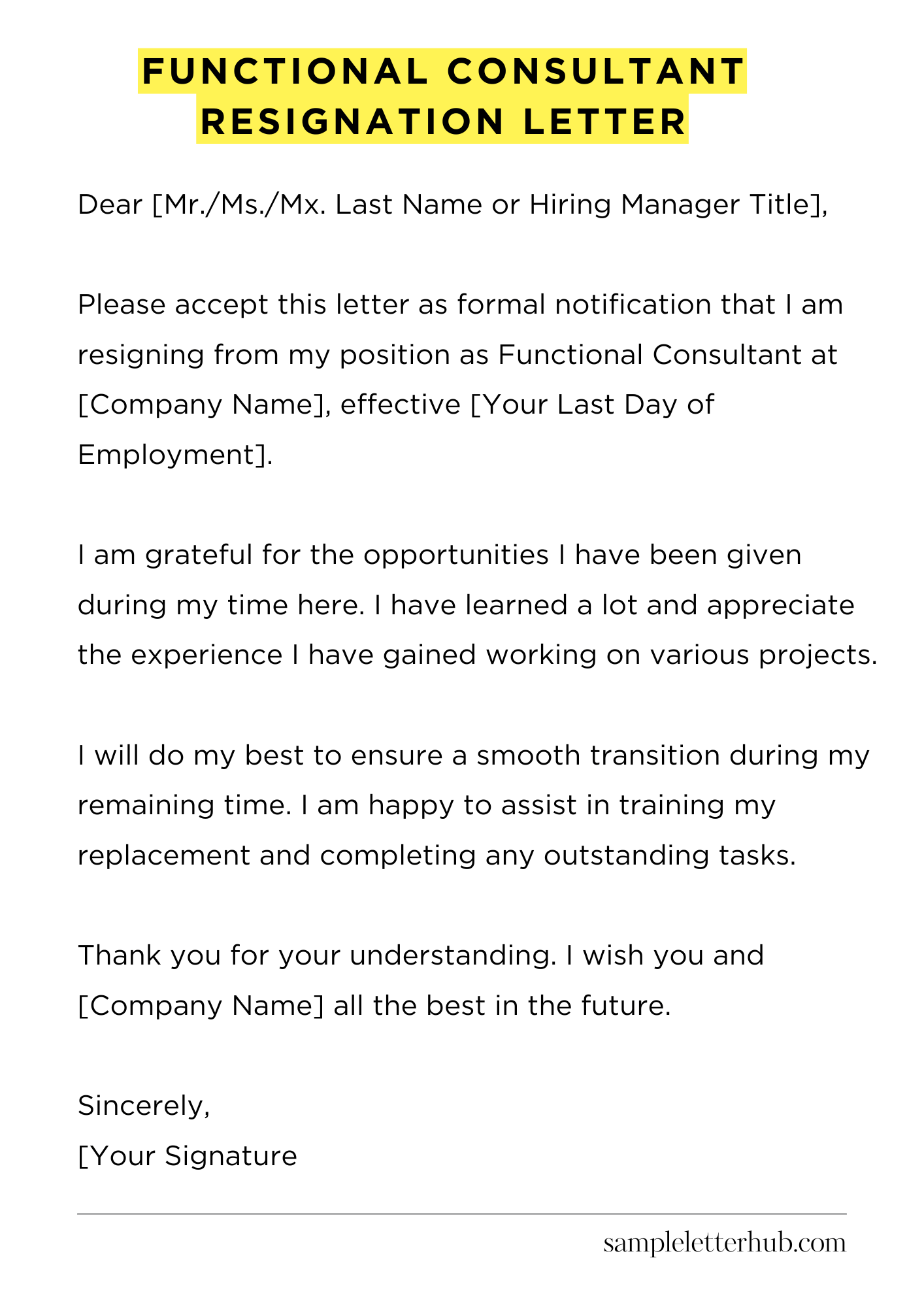
Dear [Mr./Ms./Mx. Last Name or Hiring Manager Title],
Please accept this letter as formal notification that I am resigning from my position as Functional Consultant at [Company Name], effective [Your Last Day of Employment].
I am grateful for the opportunities I have been given during my time here. I have learned a lot and appreciate the experience I have gained working on various projects.
I will do my best to ensure a smooth transition during my remaining time. I am happy to assist in training my replacement and completing any outstanding tasks.
Thank you for your understanding. I wish you and [Company Name] all the best in the future.
Sincerely,
[Your Signature
How to Write a Functional Consultant Resignation Letter
So, you’re moving on! Becoming a functional consultant is a great career path. However, at some point, you may decide to pursue other opportunities.
That means writing a resignation letter. This isn’t always fun, but it’s a necessary step. Writing a clear and professional resignation letter is key to maintaining a positive relationship with your current employer, even as you embark on a new chapter. Let’s break down how to do it right.
1. Keep it Concise and Clear
Your resignation letter is not the place to write a novel. It’s meant to be a formal notification. Get straight to the point. State your intent to resign, and specify your last day of employment.
This clarity avoids any confusion and makes sure everyone is on the same page from the start.
A simple sentence like, “Please accept this letter as formal notification that I am resigning from my position as Functional Consultant, effective [Your Last Day of Employment]” works perfectly. Remember, brevity is a virtue here; avoid overly flowery language or unnecessary details.
2. Show Gratitude (But Don’t Overdo It)
While you want to be professional, also demonstrate some courtesy. Thank your employer for the opportunity and the experiences you’ve gained. Mentioning a specific project or skill you developed can be a nice touch. A short acknowledgment of the positive aspects of your time at the company shows respect.
However, avoid going overboard. Keep the gratitude sincere but brief. A simple statement such as, “I am grateful for the opportunities I have been given during my time here” is usually sufficient. Remember, the focus is on your departure, not an extended thank-you speech.
3. Provide a Smooth Transition (if possible)
Whenever possible, offer assistance with the transition. This includes things like training your replacement, completing outstanding tasks, or documenting your processes.
This gesture demonstrates your professionalism and your commitment to a positive exit. It leaves a good impression and can be a huge asset to you if you intend to rejoin that same company in the future.
You could include something like, “I am happy to assist with the handover of my responsibilities to ensure a smooth transition.” Showing you’re willing to help makes you look really good.
4. Address Any Outstanding Issues (Briefly)
If there are any unresolved issues like unused vacation time, pending reimbursements, or outstanding benefits, it’s best to mention them in your letter. Keep it factual and brief.
Do not make it look like a complaint, rather, a reminder. You want to make sure you get everything you’re entitled to. For example, you could write, “Please let me know how I should proceed regarding my outstanding vacation time” or “I would appreciate information on the process for receiving my final paycheck and benefits.” Always remain calm and professional.
You do not want to end on a sour note.
5. Proofread and Proofread Again
This is crucial. Before you send your resignation letter, proofread it multiple times. Check for any grammatical errors, spelling mistakes, or typos. This helps in maintaining a professional image.
Having a colleague review it can be a good idea, as they might catch things you miss. A well-written letter speaks volumes about your attention to detail and your professionalism. Make a good impression, and then send it confidently. Your future is waiting!
FAQs about Functional Consultant resignation letter
How do I write a Functional Consultant resignation letter?
When drafting a resignation letter as a Functional Consultant, it’s essential to be professional and concise. Start by formally stating your resignation, including the effective date. Briefly express gratitude for the opportunity and mention any specific positive experiences.
Avoid negative comments about the company or colleagues. Offer to assist with the transition of your duties and provide your contact information for any follow-up questions. Proofread carefully before sending.
What should be included in a Functional Consultant resignation letter?
A Functional Consultant resignation letter should include: a clear statement of resignation, the date of your last day of employment, a brief expression of gratitude to the company, any specific teams or people.
You can optionally mention positive experiences or skills gained. A willingness to assist with the transition of your responsibilities, and your contact information are key to include. Avoid unnecessary details or negativity.
What is the typical notice period for a Functional Consultant resignation?
The typical notice period for a Functional Consultant’s resignation varies. It’s usually outlined in your employment contract or company policy. Common notice periods are two weeks or one month.
Always refer to your contract to ensure compliance. If the contract is unclear, and in the absence of a contractual agreement, a two-week notice period is often considered standard practice.
Can I provide a reason for leaving in my Functional Consultant resignation letter?
While optional, providing a brief reason for leaving in your resignation letter is acceptable. Keep it concise and professional. You can state that you are pursuing other opportunities or exploring career advancement options.
Avoid going into excessive detail or criticizing the company. If you prefer not to disclose the reason, it’s perfectly acceptable to simply state that you are resigning.
How should I handle outstanding projects in my Functional Consultant resignation letter?
In your resignation letter, address any outstanding projects by offering to assist with the transition. Specifically, mention your willingness to provide support to ensure a smooth handover of your responsibilities.
Outline any relevant documentation you will provide or steps you can take to make the transition easier for your colleagues. If possible, offer to help train your replacement, if one is appointed.
Related:
Resignation letter due to rude boss
Resignation letter moving to another state
Resignation letter due to illness of family member
Resignation letter due to study