

A Front Desk resignation letter is a formal document. It informs your employer of your intent to leave your job. The letter officially marks the end of your employment.
Writing this letter can seem daunting. It doesn’t have to be. We’ve got you covered. This article offers several templates.
Choose one that best fits your situation. We have examples for various reasons for leaving. Use these samples to create your perfect resignation letter.
Front Desk Resignation Letter
Below is a sample of a Front Desk Resignation Letter:
[Your Name]
[Your Address]
[Your Phone Number]
[Your Email Address]
[Date]
[Employer’s Name]
[Company Name]
[Company Address]
Dear [Employer’s Name],
Please accept this letter as formal notification that I am resigning from my position as Front Desk Associate at [Company Name]. My last day of employment will be [Your Last Day of Employment].
I would like to thank you for the opportunity to work here. I have learned a lot during my time at [Company Name].
I am committed to ensuring a smooth transition during my departure. I am happy to help train a replacement and complete any necessary tasks before I leave.
I wish you and the company all the best in the future.
Sincerely,
[Your Name]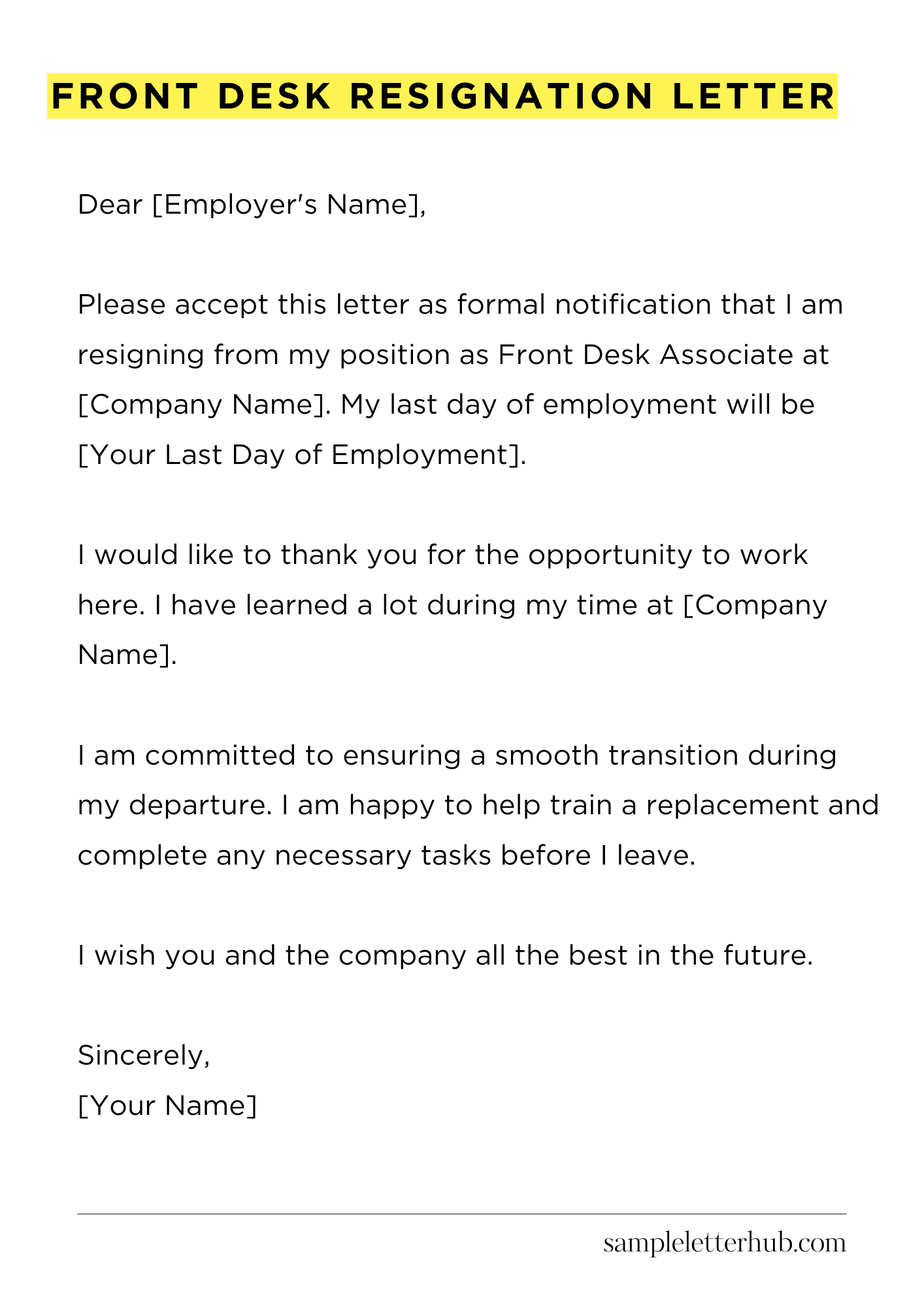
How to Write a Front Desk Resignation Letter
1. Getting Started: The Basics You Need
Leaving a job requires professionalism. You need a well-written resignation letter. This is especially true for front desk positions, where you are the first point of contact.
Start with the basics. Include your full name, the date, and the recipient’s name and title. Address the letter to your direct supervisor or the human resources department.
Use a professional font like Times New Roman or Arial. Keep it clean and easy to read. Proofread it carefully before sending it.
Always remember the goal: to provide clear and concise information.
2. Stating Your Intentions: The Core of the Matter
This is where you clearly state your intention to resign. Be direct and avoid beating around the bush. Something like, “Please accept this letter as formal notification that I am resigning from my position as Front Desk Associate” works well.
Be sure to include the effective date of your resignation. This is the last day you will be working. Give your employer adequate notice, typically two weeks.
For example: “My last day of employment will be [Date].” This allows them to prepare for your departure and minimizes disruption.
Don’t leave any room for misinterpretation.
3. Expressing Gratitude: The Power of Politeness
This is a great opportunity to show your appreciation. Briefly acknowledge the experience you’ve gained and the opportunities you’ve had.
Thank your employer for the chance to work there. Mention anything specific you enjoyed, even if the job wasn’t a perfect fit.
For example: “I am grateful for the experience I’ve gained at [Company Name] and for the opportunities I’ve been given.” This will leave a positive impression.
A little kindness can go a long way.
4. Handling the Transition: Being Helpful
Offer assistance with the transition. This shows your commitment to ensuring a smooth handover.
Suggest a willingness to train your replacement or complete any unfinished tasks. It is thoughtful to show your willingness to help.
You might write: “I am happy to assist in training my replacement during my remaining time here.” This demonstrates professionalism and a good work ethic.
Make the transition easier for your colleagues.
5. Closing and Next Steps: Wrapping it Up Right
Conclude your letter with a polite closing, such as “Sincerely” or “Respectfully.” Sign your name above your typed name. This personal touch is important.
Consider including your contact information (phone number or personal email address) if you are comfortable with it. Your supervisor may need to contact you with further questions.
Before submitting, review and proofread it thoroughly. Make sure there are no spelling or grammatical errors.
Finally, keep a copy for your records and send it to your supervisor. Good luck on your next adventure!
FAQs about Front Desk resignation letter
Here are some of the most frequently asked questions concerning front desk resignation letters. Understanding these can help you navigate the process smoothly.
What should I include in my Front Desk resignation letter?
Your Front Desk resignation letter should include a clear statement of your intent to resign, your last day of employment, a brief expression of gratitude for the opportunity, and any necessary information for a smooth transition. Consider including a willingness to assist with the handover process if possible.
How much notice should I give when resigning from a Front Desk position?
The standard notice period for most positions, including Front Desk roles, is typically two weeks. However, it’s best to check your employment contract or company policy for the specific requirements. Giving more notice is always appreciated and can help maintain a positive relationship with your employer.
Should I explain the reason for my resignation in my Front Desk resignation letter?
You are not obligated to provide a detailed explanation for your resignation. A brief and professional statement, such as “for personal reasons” or “to pursue another opportunity,” is often sufficient. If you have positive feedback or want to express gratitude for specific experiences, you can include those too.
How should I format a Front Desk resignation letter?
Your letter should be professionally formatted. Use a clear and concise style with a business letter format. Include your contact information, the date, the recipient’s information (usually your supervisor or HR), a formal salutation (e.g., “Dear [Manager’s Name]”), the body of your letter, a closing (e.g., “Sincerely”), and your typed name. Consider using a template as a starting point.
Can I hand in my Front Desk resignation letter in person or should I email it?
Both methods are acceptable, but it’s generally recommended to submit a physical copy to your manager. You can deliver it in person and follow up with an email for record-keeping. Always keep a copy for your records as well. Confirming receipt is essential, especially with an email.
Related:
Resignation letter due to rude boss
Resignation letter moving to another state
Resignation letter due to illness of family member
Resignation letter due to study