

A freelance translator resignation letter is a formal notice. It informs a client of your decision to end your working relationship. This letter serves as a professional record. It communicates your departure clearly and respectfully.
Sometimes, saying goodbye is hard. Don’t worry, we are here to help. This article provides helpful examples. You’ll find templates and samples of freelance translator resignation letters. These examples cover different scenarios.
We’ve got you covered with various formats. Choose the best one for your situation. These templates can be adapted. Customize them to fit your specific needs. Writing a professional resignation letter is easier now.
Freelance Translator Resignation Letter
Below is a sample of a Freelance Translator Resignation Letter:
[Your Name]
[Your Address]
[Your Phone Number]
[Your Email Address]
[Date]
[Client/Company Name]
[Client/Company Address]
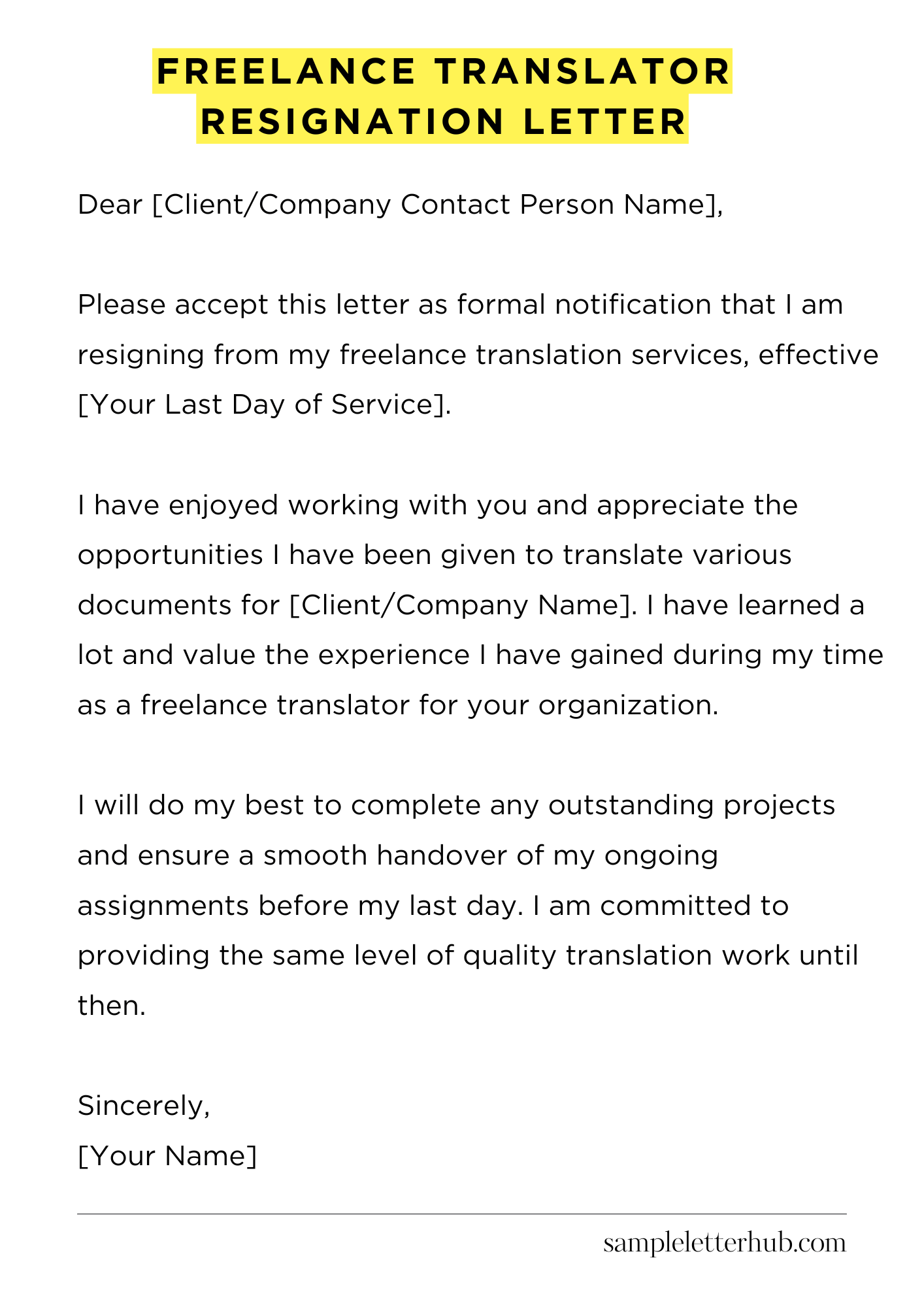
Dear [Client/Company Contact Person Name],
Please accept this letter as formal notification that I am resigning from my freelance translation services, effective [Your Last Day of Service].
I have enjoyed working with you and appreciate the opportunities I have been given to translate various documents for [Client/Company Name]. I have learned a lot and value the experience I have gained during my time as a freelance translator for your organization.
I will do my best to complete any outstanding projects and ensure a smooth handover of my ongoing assignments before my last day. I am committed to providing the same level of quality translation work until then. Please let me know if there is anything I can do to help with the transition.
Thank you again for the experience. I wish you and [Client/Company Name] continued success.
Sincerely,
[Your Name]
How to Write Freelance Translator Resignation Letter
So, you’re ready to move on. Freelance translating, while rewarding, isn’t always a perfect fit forever. You’ve found a new opportunity, or maybe you’re simply needing a change of pace.
Whatever the reason, crafting a professional resignation letter is a crucial step. It’s your official goodbye and a chance to leave a positive lasting impression. Here’s a breakdown on how to do it right.
1. Keep It Concise and Clear
Don’t overcomplicate things. Your resignation letter shouldn’t be a novel. Get straight to the point. The primary purpose is to inform your client or agency that you’re leaving. You also need to state your last day of work. A brief, polite tone is always the best way to go.
Start with a simple statement: “Please accept this email as formal notification that I am resigning from my freelance translation services, effective [Your Last Day].” Following this first sentence is key. This clarity eliminates any ambiguity.
2. Express Your Gratitude (and Be Genuine)
Even if the relationship wasn’t perfect, showing appreciation is a good practice. Thank your client or agency for the opportunities they provided. Highlight any specific projects or experiences you valued. A few well-chosen words of thanks can go a long way. This builds and solidifies a positive legacy.
For example, you could write: “I am grateful for the opportunities you’ve provided me over the past [duration]. I especially appreciated working on the [specific project] project.” It’s respectful and professional.
3. Offer Assistance with Transition
Leaving on good terms opens doors for future referrals or recommendations. Offer your assistance in the transition. This might involve finishing current projects, helping to train a replacement, or providing resources. This shows professionalism and a commitment to helping the client. This can be as simple as.
You can say, “I’m happy to assist in any way possible during the transition. I am available to finish the current project.” Be specific about what you’re willing to do.
4. Provide Necessary Contact Information and Details
Include your contact information in the letter. Make it easy for your client to reach you. Double-check all details such as your phone number, and personal email. You might also want to mention how you can be contacted if the need be.
You may also include information about any outstanding invoices or payments. Clarify how these will be handled to avoid confusion. Transparency is crucial here.
5. Proofread, Proofread, Proofread!
This is extremely important. Before sending the letter, carefully proofread it. Check for grammatical errors, spelling mistakes, and typos. Errors reflect poorly on your professionalism. Read the letter aloud or have a friend or colleague review it.
Make sure the tone is appropriate and that your message is clear. Finally, ensure the formatting is neat and easy to read. A well-written, error-free resignation letter is the perfect way to conclude your freelance translating relationship. The small details matter.
FAQs about Freelance Translator resignation letter
What is the primary purpose of a freelance translator resignation letter?
The primary purpose of a freelance translator resignation letter is to formally notify a client or agency of the translator’s decision to end their working relationship. It serves as a written record of the resignation, clarifies the last date of work, and allows for a professional and amicable closure of the partnership.
What key elements should be included in a freelance translator resignation letter?
A well-crafted freelance translator resignation letter typically includes the following: a clear statement of resignation, the effective date of the resignation (last day of work), any outstanding projects the translator will complete, an expression of gratitude for the opportunities provided.
How much notice should a freelance translator provide when resigning?
The amount of notice a freelance translator should provide depends on the terms of their contract or agreement with the client or agency. In the absence of a specific agreement, a reasonable notice period is generally considered to be two to four weeks.
Reviewing any existing contracts is crucial to ensure compliance with the agreed-upon notice period and avoid potential disputes.
Should a freelance translator explain the reason for their resignation in the letter?
While not mandatory, a freelance translator can choose to briefly state the reason for their resignation. However, it’s essential to keep the explanation concise and professional.
Common reasons include accepting a full-time position, a change in career goals, or a need for a different work environment. Avoid negative comments about the client or agency.
How should a freelance translator handle outstanding projects or deadlines when resigning?
When resigning, a freelance translator should address outstanding projects and deadlines in their resignation letter.
This includes explicitly stating which projects they will complete before their last day, establishing clear deadlines for these projects, and communicating any potential handover procedures. This proactive approach ensures a smooth transition and demonstrates professionalism.
Related:
Resignation letter due to rude boss
Resignation letter moving to another state
Resignation letter due to illness of family member
Resignation letter due to study