

Navigating the freelance world often involves saying goodbye to clients. A freelance resignation letter is your official notice. It informs the client of your departure. This document helps ensure a smooth transition.
This article offers practical support. We will share templates for your use. These are examples you can adapt. You’ll find options for various situations.
Writing a resignation letter can be daunting. We aim to simplify the process. Use these samples to create your own. Make it easy to communicate your decisions.
Free Lance Resignation Letter
Below is a sample of a Free Lance Resignation Letter:
[Your Name]
[Your Address]
[Your Phone Number]
[Your Email Address]
[Date]
[Client Name]
[Client Address]
Subject: Resignation from Freelance Services
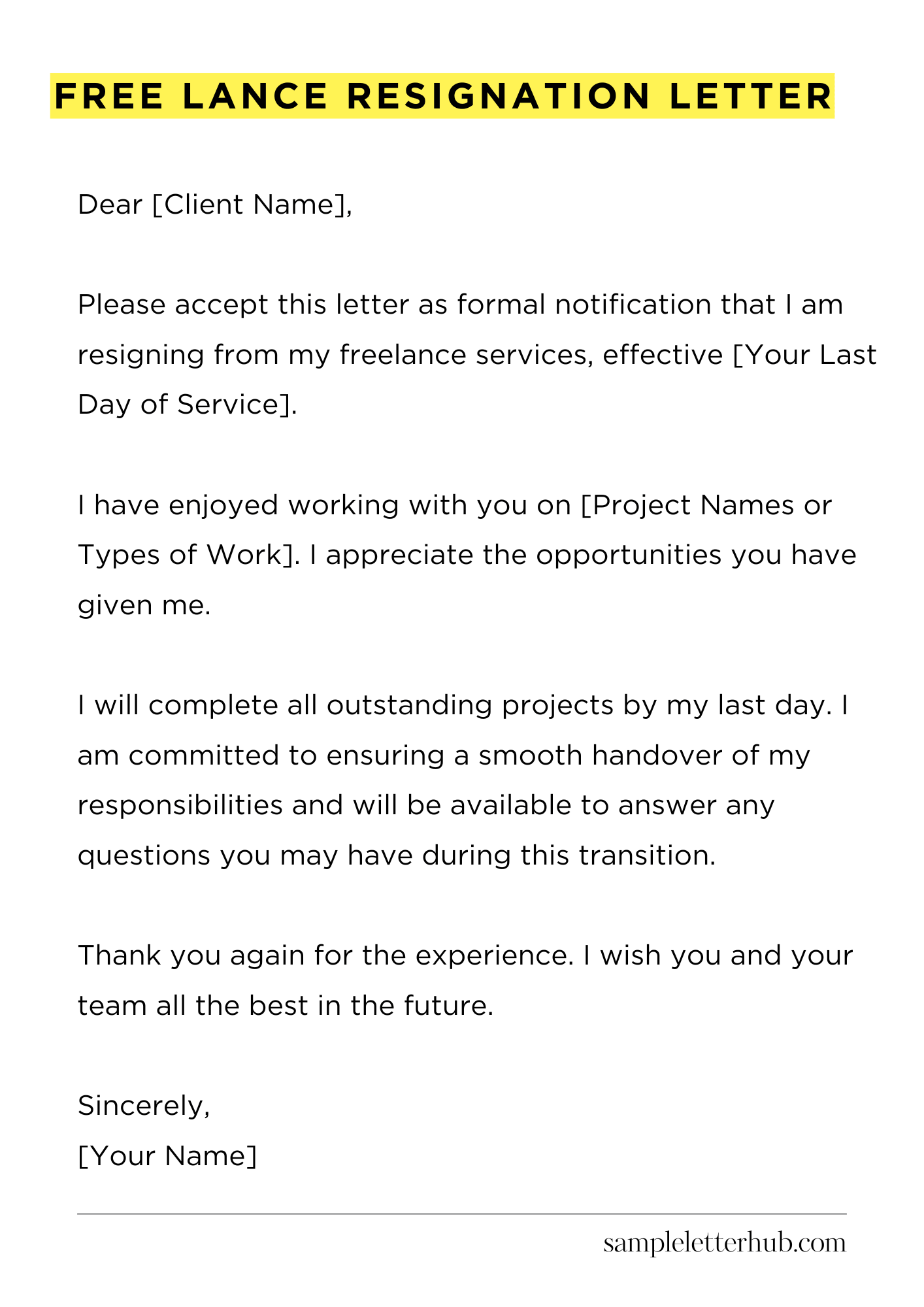
Dear [Client Name],
Please accept this letter as formal notification that I am resigning from my freelance services, effective [Your Last Day of Service].
I have enjoyed working with you on [Project Names or Types of Work]. I appreciate the opportunities you have given me.
I will complete all outstanding projects by my last day. I am committed to ensuring a smooth handover of my responsibilities and will be available to answer any questions you may have during this transition.
Thank you again for the experience. I wish you and your team all the best in the future.
Sincerely,
[Your Name]
How to Write a Freelance Resignation Letter
So, you’re ready to move on. Freelancing can be fantastic, offering flexibility and autonomy. However, sometimes it’s time to seek new opportunities or simply move in a different direction. Whatever the reason, crafting a professional freelance resignation letter is crucial. It’s the final impression you make, and you want to leave on good terms. Let’s look at how to do this effectively.
1. Subject Line: Make it Clear
Don’t bury the lead! The subject line of your email or letter should be clear and concise. This helps your client or the hiring manager instantly understand the purpose of the communication.
For instance, consider using subject lines like: “Resignation – [Your Name] – [Project/Client Name]” or “Freelance Resignation – [Date] – [Your Name]”. This immediately flags the email as important. It is always better to be straightforward.
2. The Core of Your Letter: Key Elements
Your letter needs to include some essential components. First, state your intention to resign. Be direct. “Please accept this email as formal notification that I am resigning from my freelance services…” works perfectly.
Next, clearly state your last day of service. This is vital to provide your client with a transition period. Then, express your gratitude. Acknowledge the opportunity you were given. You can say something like, “I am grateful for the opportunity to have worked on…” or “Thank you for the chance to contribute to…”
Following this, offer assistance with the transition. This shows professionalism and respect. You could offer to: “I am happy to assist in the transition process and will do everything I can to ensure a smooth handover of my projects.”
Briefly, mention what you can do to help. Finally, close with a positive and professional tone. Keep it short and sweet. “I wish you continued success.” is a great closing line.
3. Keeping It Professional: Tone and Style
Maintain a professional tone throughout your letter. Avoid personal grievances or overly emotional language. Stick to the facts. The language used reflects on you.
Use clear, concise language and avoid slang or jargon, unless you’re absolutely certain the client understands it. Proofread your letter carefully for any typos or grammatical errors. A polished letter shows attention to detail and respect for the recipient.
Keep your letter relatively brief. Your goal is to inform, not to over-explain. Brevity is often appreciated in business communications. Get to the point. State your intent, and express your appreciation. A well-written letter makes a lasting impression.
4. Customization is Key: Tailoring Your Letter
While there’s a basic template, customize your letter to fit the specific client and project. Mention specific projects you worked on, or highlight positive experiences. This shows you’re not just sending a generic letter. Addressing the project directly shows you remember the work you did.
If you’re leaving due to a specific reason (e.g., pursuing other opportunities), you can briefly mention it. However, avoid going into excessive detail. Focus on the positive aspects of the working relationship. Tailoring your letter to the individual client shows you value the relationship, even as it comes to an end.
5. Delivery and Follow-Up: The Final Steps
If possible, deliver your letter via email. It’s the standard communication method for most freelance work. Make sure to send it to the appropriate contact person. If you’re unsure, ask your client for the best point of contact.
After sending your letter, be prepared to answer any questions your client might have. Respond promptly and professionally. This reinforces your commitment to a smooth transition. Following these steps ensures you leave on a positive note. Good luck with your future endeavors!
FAQs about Free Lance resignation letter
How much notice should I give in my freelance resignation letter?
The notice period depends on your contract with the client. Review your agreement for specific requirements. If no notice period is specified, a general guideline is to provide notice that is reasonable based on the project’s complexity and your relationship with the client.
Giving two weeks’ notice is a common practice, but a longer period may be necessary for large, ongoing projects to allow for a smooth handover of responsibilities.
What should I include in my freelance resignation letter?
Your letter should include a clear statement of your resignation, the effective date of your departure, a thank you for the opportunity, and any necessary information for a smooth transition. It’s often helpful to offer assistance in transitioning your work, such as by detailing how to transfer any ongoing projects or introducing your replacement.
How should I deliver my freelance resignation letter?
Delivering your resignation letter can vary depending on your relationship with the client and your contract. A professional approach often involves a formal written letter delivered via email.
However, depending on your relationship, you might also want to inform your client verbally before sending the written notification. Always maintain a professional tone and ensure you have proof of delivery, such as a read receipt for emails.
What if I have an outstanding contract or project when I resign?
Address any outstanding contracts or projects directly in your resignation letter. Offer to complete your existing obligations, if possible, within your notice period. If completion is not feasible, clearly communicate any handover plans, identify what needs to be done, who will finish it, and how you will provide assistance to ensure a seamless transition.
Can I provide a reason for my resignation in the letter?
While not mandatory, you may briefly and professionally mention the reason for your resignation. Keep the explanation concise and positive.
For example, you might state that you are pursuing other opportunities or changing your career direction. Avoid negative comments about the client or the project. However, if the cause of your departure involves a contractual breach from the other end, then it should be stated.
Related:
Resignation letter due to rude boss
Resignation letter moving to another state
Resignation letter due to illness of family member
Resignation letter due to study