

A “Founding Member resignation letter” is a formal document. It is used to announce your departure. You are leaving a company or organization you helped start. The letter officially ends your role.
Deciding to resign is tough. Writing the resignation letter can be even harder. This article helps make it easier. We will share templates and examples. They are designed to fit many situations.
Need to say goodbye to a company you built? We’ve got you covered. Consider these samples your starting point. You can adapt them to your specific needs. Hopefully, these will provide you with a good start.
Founding Member Resignation Letter
Below is a sample of a Founding Member Resignation Letter:
[Your Name]
[Your Address]
[Your Phone Number]
[Your Email Address]
[Date]
[Recipient Name] (If known, otherwise use title)
[Recipient Title]
[Organization Name]
[Organization Address]
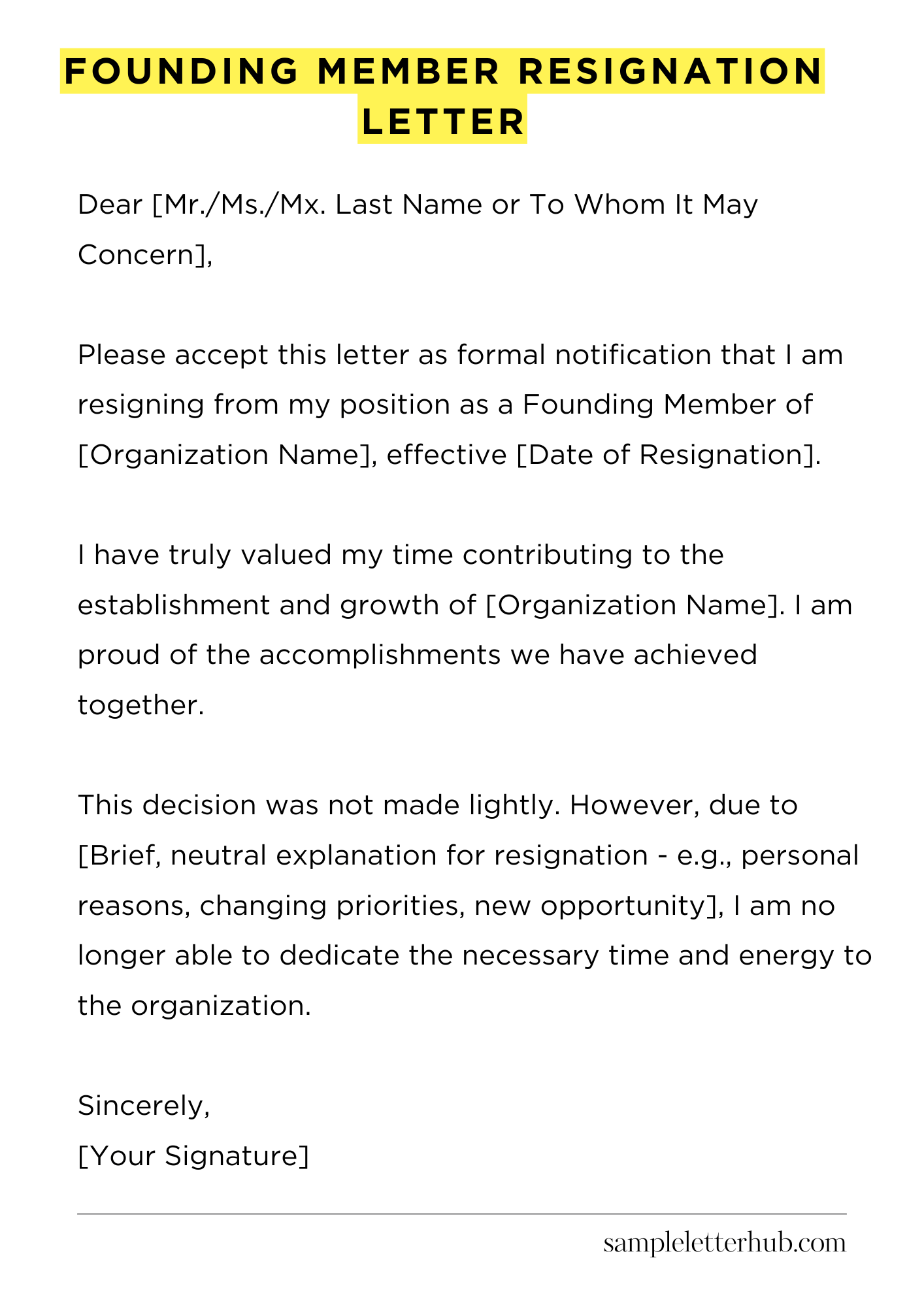
Dear [Mr./Ms./Mx. Last Name or To Whom It May Concern],
Please accept this letter as formal notification that I am resigning from my position as a Founding Member of [Organization Name], effective [Date of Resignation].
I have truly valued my time contributing to the establishment and growth of [Organization Name]. I am proud of the accomplishments we have achieved together.
This decision was not made lightly. However, due to [Brief, neutral explanation for resignation – e.g., personal reasons, changing priorities, new opportunity], I am no longer able to dedicate the necessary time and energy to the organization.
I am committed to ensuring a smooth transition. I am happy to assist in any way possible to transfer my responsibilities and knowledge. Please let me know how I can be of help during this period.
I wish [Organization Name] continued success in the future.
Sincerely,
[Your Signature]
How to Write a Founding Member Resignation Letter
Resigning from a founding member position is a big deal. It signifies a significant shift and requires careful planning and execution. This is not just quitting a job; it’s stepping away from something you helped build. Therefore, your resignation letter needs to be handled with professionalism and consideration. Failing to do so can have repercussions.
1. Start with a Clear and Direct Statement
Your opening paragraph needs to be crystal clear. Don’t beat around the bush. State your intention to resign from your position as a founding member immediately. This should be concise and unambiguous.
You want to make your purpose absolutely obvious right from the start. Something like, “Please accept this letter as formal notification that I am resigning from my position as a Founding Member of [Company Name], effective [Date].” Keep it simple, but professional.
2. Briefly Explain Your Reason for Leaving
While you don’t need to provide a novel, offering a brief explanation for your departure is customary and helpful. Be honest, but focus on the positive aspects of your reason. Were your goals and priorities changing? Perhaps you have a new professional opportunity? Keep your response succinct.
Consider this: “After careful consideration, I have decided to pursue [brief explanation]. This decision was not made lightly…” You can even keep it as short as, “Due to personal reasons, I have decided to resign from my role…” Remember, brevity is a virtue here.
3. Express Gratitude and Acknowledge Contributions
This is where you show your appreciation. Acknowledge the hard work and collaboration that built the company. Thank the other founding members for the opportunity to work alongside them.
Mention any specific achievements or milestones you’re proud of. Doing so reflects well on your character and fosters a positive impression. Consider this: “I am incredibly grateful for the opportunity to have been a part of [Company Name]’s journey.
I am particularly proud of [mention a specific achievement or contribution]. Thank you for your hard work and dedication.” Think of it as a fond farewell.
4. Offer Assistance with Transition
Demonstrate your commitment to a smooth handover. Offer your help to ensure a seamless transition of your responsibilities. This is crucial for maintaining a professional relationship.
Include your willingness to assist the transition process in your letter. Consider this statement: “I am committed to ensuring a smooth transition. I am available to assist in any way possible, including [mention specific tasks, e.g., training my replacement, documenting processes, etc.]” This indicates a high level of responsibility.
5. Maintain a Professional Tone and Format
Your tone and format are key. Use a professional business letter format, including your contact information, the date, and the recipient’s information. Proofread your letter meticulously for any errors in grammar or spelling.
Use a polite and respectful tone throughout the letter. It is extremely important that you are very courteous. Avoid any negativity or criticism of the company or its members. Keep your letter concise, and to the point. Remember, this letter is a reflection of your character.
FAQs about Founding Member resignation letter
What is the primary purpose of a Founding Member resignation letter?
The primary purpose of a Founding Member resignation letter is to formally communicate a decision to leave the company. It serves as an official record of the departure, outlining the effective date of resignation and acknowledging the end of the founding member’s association with the organization.
Additionally, it can be used to express gratitude, provide context for the departure, and facilitate a smooth transition.
What key elements should be included in a Founding Member resignation letter?
A well-crafted Founding Member resignation letter typically includes: a clear statement of resignation, the effective date of departure, a brief expression of gratitude for the opportunity, an acknowledgment of past contributions, and an offer to assist with the transition process (if applicable).
It should also include any relevant information regarding outstanding equity, shares, or ongoing responsibilities, and an address to the board of directors or relevant parties. The letter should maintain a professional and respectful tone.
How should a Founding Member address the issue of equity or shares in their resignation letter?
The resignation letter should clearly address any outstanding equity or share-related matters. It’s crucial to state the current status of the equity, any vested or unvested shares, and any agreements regarding their disposition.
It may reference the company’s bylaws, the shareholders’ agreement, or any other pertinent documents that govern these matters. It’s often recommended to seek legal counsel to ensure that the letter accurately reflects the terms of any equity agreement and protects the founding member’s rights.
Should a Founding Member explain the reason for their resignation in the letter?
While not mandatory, providing a brief explanation for the resignation can be beneficial, particularly to maintain positive relationships with the remaining team.
The level of detail depends on individual circumstances and the founder’s comfort level.
The explanation can range from a simple statement about pursuing other opportunities to a more detailed rationale, but it should remain professional and avoid negativity or personal attacks. It’s important to focus on the future and express a positive outlook for the company’s continued success.
How can a Founding Member ensure a smooth transition after resigning?
To facilitate a smooth transition, a Founding Member can take several steps. This includes offering to assist with the handover of responsibilities, providing documentation, and training to new or existing staff.
This could include arranging a timeline for the tasks or a list of contacts. They can also participate in knowledge transfer sessions and be available for any follow-up questions from the company.
The goal is to leave the company in a good position and reduce disruption during the transition period. A professional and cooperative approach helps the Founding Member preserve a positive image.
Related:
Resignation letter due to rude boss
Resignation letter moving to another state
Resignation letter due to illness of family member
Resignation letter due to study