

So, you’re moving on from your food running gig? A “Food Runner resignation letter” is your official goodbye. It’s a simple, professional way to inform your employer that you’re leaving. The letter clarifies your last day of employment. It also helps you depart on good terms.
Writing this letter can seem daunting. No worries! We’ve got you covered. We’ll show you examples. Consider them your creative blueprints. They’ll help you craft your own perfect farewell.
Need a quick exit strategy? We will provide templates. They are here for your convenience. You can adapt them to your specific situation. Consider it a friendly nudge in the right direction.
Food Runner Resignation Letter
Below is a sample of a Food Runner Resignation Letter:
[Your Name]
[Your Address]
[Your Phone Number]
[Your Email Address]
[Date]
[Restaurant Manager Name]
[Restaurant Name]
[Restaurant Address]
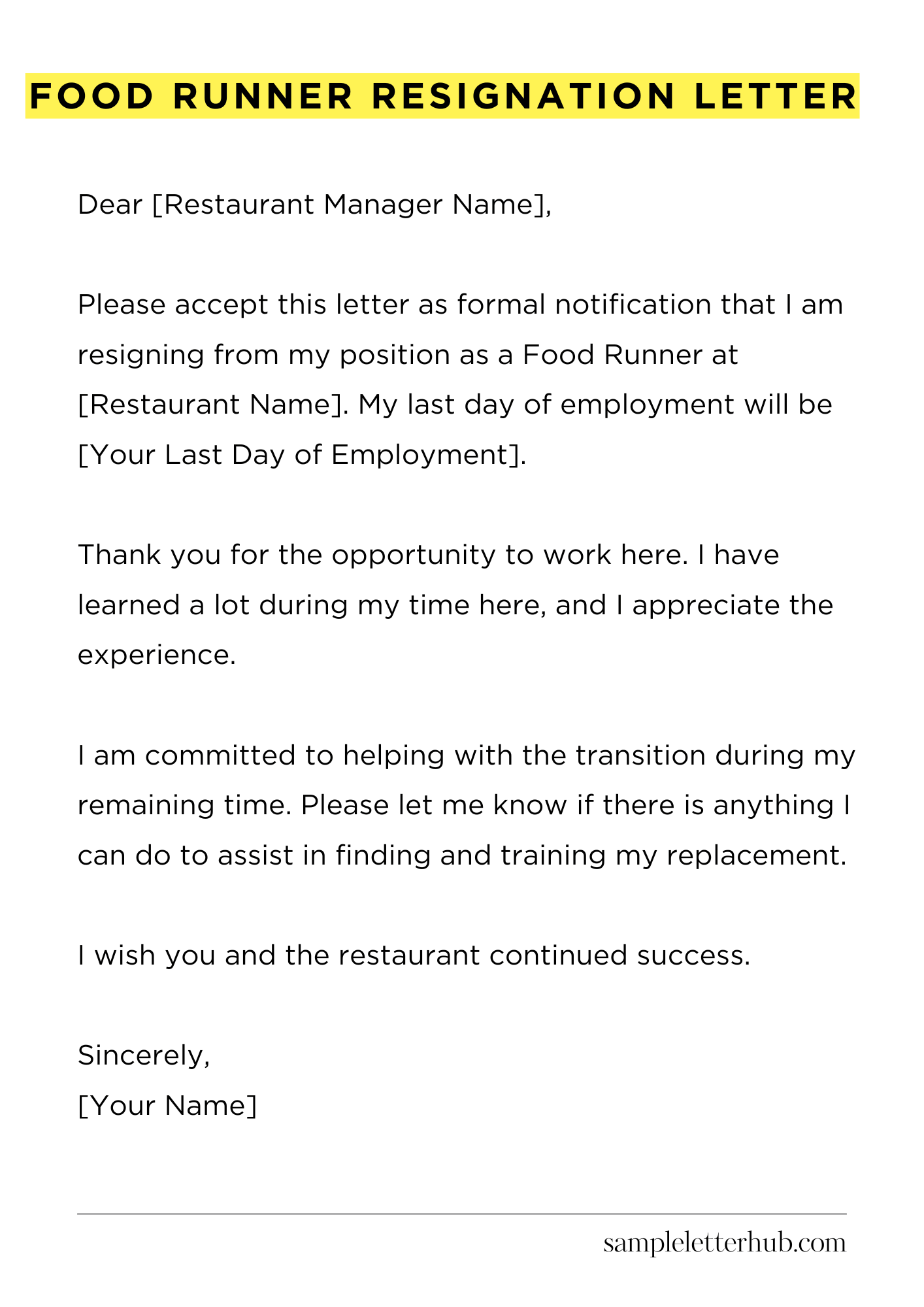
Dear [Restaurant Manager Name],
Please accept this letter as formal notification that I am resigning from my position as a Food Runner at [Restaurant Name]. My last day of employment will be [Your Last Day of Employment].
Thank you for the opportunity to work here. I have learned a lot during my time here, and I appreciate the experience.
I am committed to helping with the transition during my remaining time. Please let me know if there is anything I can do to assist in finding and training my replacement.
I wish you and the restaurant continued success.
Sincerely,
[Your Name]
How to Write a Food Runner Resignation Letter
Knowing When It’s Time to Go
Working as a food runner can be challenging. It’s fast-paced, demanding, and often involves long hours on your feet. There are moments of high stress. Sometimes, you may feel you have reached your limit. Deciding to resign is a big decision; you must be sure of it. Before taking the leap, make sure you’ve weighed the pros and cons of the job.
Consider whether you’ve explored alternative solutions, such as discussing your concerns with your supervisor. Once you’re certain about your decision, then it’s time to start writing your resignation letter.
Key Elements of Your Letter
The most important part of your resignation letter is to keep it clear and professional. You want to leave a good impression, even as you depart. Start with a formal salutation like “Dear [Manager’s Name]”. State your intention to resign clearly in the first paragraph. Specify your last day of employment. This is crucial for your employer’s planning purposes.
You should also briefly express your gratitude for the opportunity. While you do not have to give a reason, it is always a good idea to say something positive about your experience. Keep the body concise. Be polite, and avoid negativity.
Crafting the Right Tone
Maintaining a professional tone throughout your letter is critical. This should be a formal business document. Even if you’re upset or frustrated with your job, your letter is not the place to vent. Your words should be polite and respectful. This will allow you to maintain a positive relationship with your previous employers.
Avoid including any overly informal language, slang, or emojis. Proofread the letter carefully to make sure there are no typos or grammatical errors. A well-written letter shows that you are serious and respectful.
Structuring Your Resignation Letter
Here is a basic structure for your food runner resignation letter: First, begin with your contact information. Include your name, address, phone number, and email. Next, add the date, and the recipient’s information. Now, start with the salutation (“Dear [Manager’s Name]”).
Then, state your intention to resign and your last day. In the body paragraphs, you can briefly express your gratitude and any positive takeaways from your experience. Finally, close with a professional closing (e.g., “Sincerely”) and your signature.
Delivering Your Resignation
Once you’ve finalized your letter, it’s time to deliver it. The best way is to hand it directly to your manager. This allows you to have a face-to-face conversation. Give your manager enough notice. Two weeks is usually the standard, but check your employment agreement for the requirements.
Be prepared to answer any questions your manager may have. Try to leave your job on good terms. Your reputation matters. Always show professionalism and offer to help with the transition. Good luck with your next endeavor!
FAQs about Food Runner Resignation Letter
Understanding the proper etiquette and essential elements of a food runner resignation letter is crucial for maintaining a professional relationship with your employer. Below are some of the most frequently asked questions to guide you through the process.
How do I start a food runner resignation letter?
Begin your letter with a formal salutation, such as “Dear [Manager’s Name]”. Clearly state your intention to resign from your position as a Food Runner in the opening paragraph. Mention the specific date of your last day of employment. Be direct and concise.
What should I include in the body of my resignation letter?
The body of your letter should briefly state your reason for leaving (optional, but can be as simple as “pursuing other opportunities”). Express gratitude for the opportunity to work at the establishment. Offer to assist with the transition, such as training your replacement. Keep the tone positive and professional.
What is the proper format for a food runner resignation letter?
Use a standard business letter format. Include your contact information (name, address, email, and phone number) at the top, followed by the date. Address the letter to your manager or the appropriate person in the management structure. Use a clear and easy-to-read font, such as Times New Roman or Arial. Keep the letter concise, ideally one page.
How much notice should I give when resigning as a food runner?
The standard notice period is typically two weeks. However, check your employment contract or employee handbook for any specific requirements. Providing more than two weeks’ notice is considered professional and can leave a positive impression, but it’s not always necessary.
Do I need to explain the reason for my resignation in the letter?
While not mandatory, it’s generally good practice to briefly state your reason for leaving. You can keep it general (e.g., “pursuing other opportunities,” “seeking a new challenge”). Avoid negativity or complaints. If you have a positive reason, like starting a new job or school, you can mention it briefly.
Related:
Resignation letter due to rude boss
Resignation letter moving to another state
Resignation letter due to illness of family member
Resignation letter due to study