

So, you’re a First Officer, and it’s time to move on? A “First Officer resignation letter” is your official way of saying goodbye. This letter formally informs your airline of your decision to resign. It’s a crucial step in the process of leaving your current job.
You need to write this letter with care. It helps ensure a smooth transition. Don’t worry. We’ve got you covered. We’ll share ready-to-use templates.
These templates can be your starting point. Tailor them to fit your specific needs. Get ready to draft your own impactful letter. Let’s make this process simple and stress-free.
First Officer Resignation Letter
Below is a sample of a First Officer Resignation Letter:
[Your Name]
[Your Address]
[Your Phone Number]
[Your Email Address]
[Date]
[Hiring Manager Name] (If known, otherwise use title)
[Hiring Manager Title]
[Airline Name]
[Airline Address]
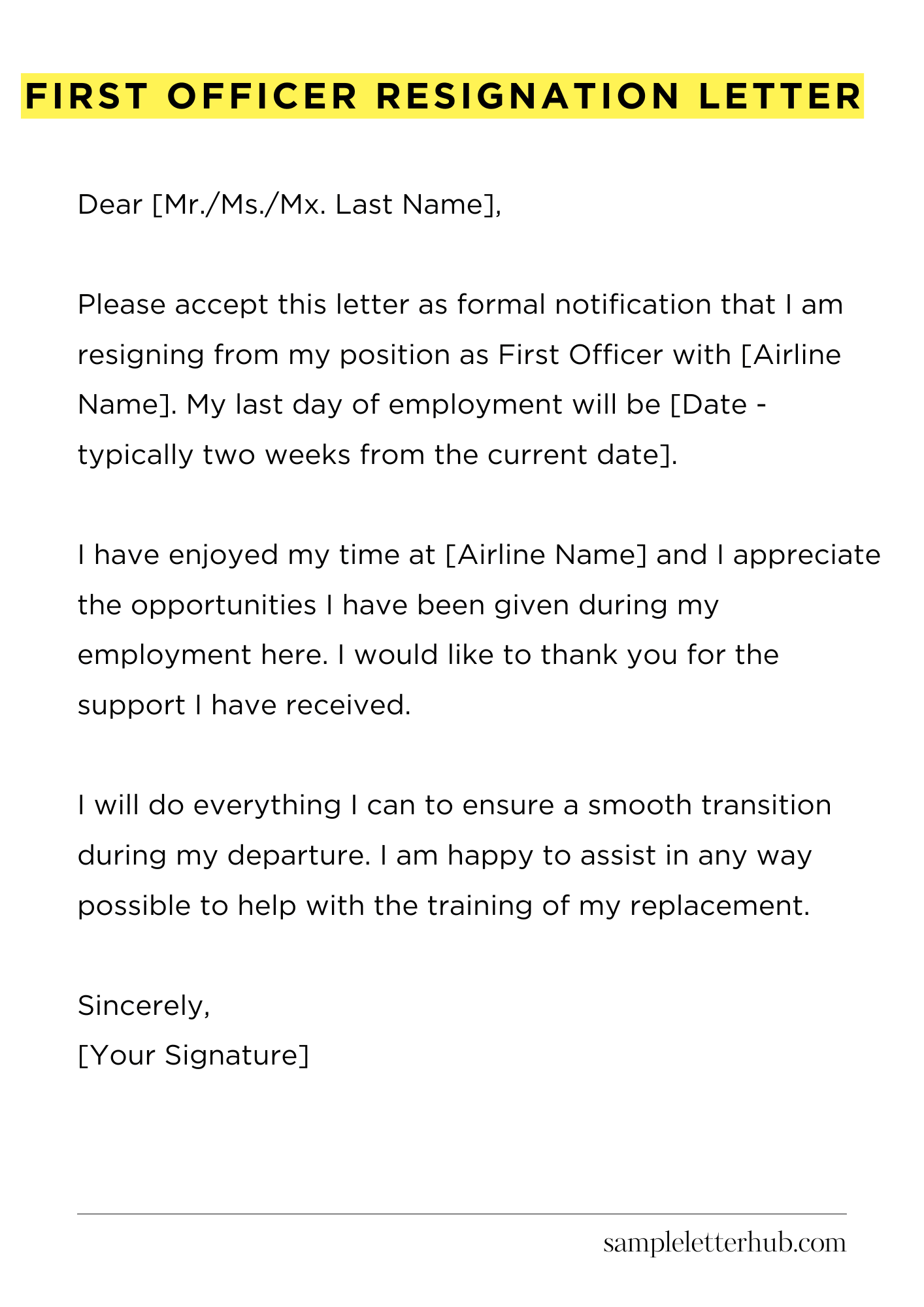
Dear [Mr./Ms./Mx. Last Name],
Please accept this letter as formal notification that I am resigning from my position as First Officer with [Airline Name]. My last day of employment will be [Date – typically two weeks from the current date].
I have enjoyed my time at [Airline Name] and I appreciate the opportunities I have been given during my employment here. I would like to thank you for the support I have received.
I will do everything I can to ensure a smooth transition during my departure. I am happy to assist in any way possible to help with the training of my replacement.
I wish [Airline Name] continued success in the future.
Sincerely,
[Your Signature]
How to Write a First Officer Resignation Letter
So, you’ve made the decision. You’re ready to move on from your First Officer role. That’s a big step. A good resignation letter is crucial. It’s the official goodbye. You’ll want to ensure you leave on a positive note, regardless of your reasons. You’ll likely need this letter in the official format.
1. Start with the Basics: Your Contact Information and the Date
First things first. You need to identify yourself. Start at the top left corner of the letter. Include your full name, address, phone number, and email address. Below this, on the right side, add the date you are writing the letter. This provides the company with immediate details. Correct formatting is always professional.
For example:
[Your Name]
[Your Address]
[Your Phone Number]
[Your Email Address]
[Date]
2. Addressing the Letter and Stating Your Intentions
Next, address the letter correctly. You should address it to your direct supervisor or the appropriate person in the company’s HR department. You can usually find this information in your employment handbook or by asking a colleague.
Clearly state your intention to resign from your position as First Officer. Be direct and concise. You should mention your last day of employment. This is essential for the company to begin planning. This simple statement starts the process.
For example:
[Recipient’s Name/Title]
[Company Name]
[Company Address]
Dear [Recipient’s Name],
Please accept this letter as formal notification that I am resigning from my position as First Officer at [Company Name]. My last day of employment will be [Your Last Day of Employment].
3. Expressing Gratitude (Optional, but Recommended)
While not mandatory, showing gratitude is almost always a good move. Acknowledge the experience you gained during your time in the position. Mention any positive aspects of your employment, like colleagues or training opportunities. This makes the tone much friendlier. Remember, you might need to use these people as a reference in the future.
For example:
I am grateful for the opportunities I have been given at [Company Name] and for the experiences I have gained during my time here. I would like to express my gratitude for my colleagues.
4. Handling the Logistics: Handover and Future Contact
This is where you show responsibility. Offer your assistance in the transition process. This includes offering to train your replacement or help with the handover of your duties. Provide your contact details for future communication. Being helpful can leave a lasting positive impression. This demonstrates professionalism.
For example:
I am committed to ensuring a smooth transition during my departure. I am available to assist in training my replacement and completing any necessary handover tasks. Please do not hesitate to contact me at [Your Phone Number] or [Your Email Address] if you require my assistance.
5. Closing the Letter and Your Signature
End the letter professionally. Use a formal closing, like “Sincerely,” or “Respectfully.” Sign your name above your typed name. This confirms you have read it. A well-written letter makes a strong, final impression. Then, your resignation is complete.
For example:
Sincerely,
[Your Signature]
[Your Typed Name]
“`
“`html
FAQs about First Officer Resignation Letter
What information should I include in my First Officer resignation letter?
Your resignation letter should include your formal resignation, stating your intent to leave your position as First Officer. Be sure to include the date you’re submitting the letter and the last day of your employment. It’s also important to include your contact information for future correspondence. While not mandatory, it is often beneficial to express gratitude for the opportunities you’ve been given. Avoid negative comments about your employer, and be sure to proofread the letter carefully.
How much notice should I give when resigning as a First Officer?
The amount of notice you’re required to give is typically determined by your employment contract or company policy. However, two weeks is a standard notice period in many industries. It’s crucial to review your contract or consult with your HR department to confirm the specific notice period required by your employer. Providing the correct notice helps maintain professionalism and allows for a smooth transition.
Should I provide a reason for resigning in my First Officer resignation letter?
While it’s not mandatory to provide a reason for your resignation, it can be beneficial to briefly state your reason, especially if it’s related to a new opportunity or a personal reason. Keep the explanation brief and professional. If you prefer to keep the reason private, you can simply state that you are resigning to pursue other opportunities or for personal reasons.
Can my resignation letter be used against me in the future?
Generally, your resignation letter is a formal record of your departure and should not be used against you in the future if you keep it professional and factual. Avoid including any negative or potentially damaging information about your employer or colleagues. The primary purpose of the letter is to inform your employer of your decision to leave, not to detail any grievances.
What should I do after submitting my First Officer resignation letter?
After submitting your resignation letter, follow up with your supervisor or HR department to confirm receipt and discuss the transition process. Cooperate fully with any requests for information or assistance during your remaining time. You should also return any company property, complete any necessary exit procedures, and make sure your contact information is updated with the employer. Finally, stay professional until your last day of employment.
“`