

A Financial Advisor resignation letter is a formal document. Its purpose is to officially inform an employer about leaving a job. It signifies the end of employment. It needs to be clear and professional.
Are you a Financial Advisor looking to move on? We get it. Sometimes, a change is needed. Drafting the right resignation letter can be tough. We’ve got you covered.
Here, we’ll give you ready-made samples. Choose the one that suits your needs. Need inspiration? Get ideas for your specific situation. This article makes your letter writing simple.
Financial Advisor Resignation Letter
Below is a sample of a Financial Advisor Resignation Letter:
[Your Name]
[Your Address]
[Your Phone Number]
[Your Email Address]
[Date]
[Employer’s Name]
[Company Name]
[Company Address]
Dear [Employer’s Name],
Please accept this letter as formal notification that I am resigning from my position as Financial Advisor at [Company Name]. My last day of employment will be [Your Last Day of Employment].
I would like to thank you for the opportunity to work at [Company Name]. I have learned a great deal during my time here and appreciate the experiences I have gained.
I am committed to ensuring a smooth transition during my departure. I am happy to assist in any way possible to transfer my responsibilities and complete any outstanding tasks. Please let me know how I can best support this process.
I wish you and [Company Name] all the best for the future.
Sincerely,
[Your Name]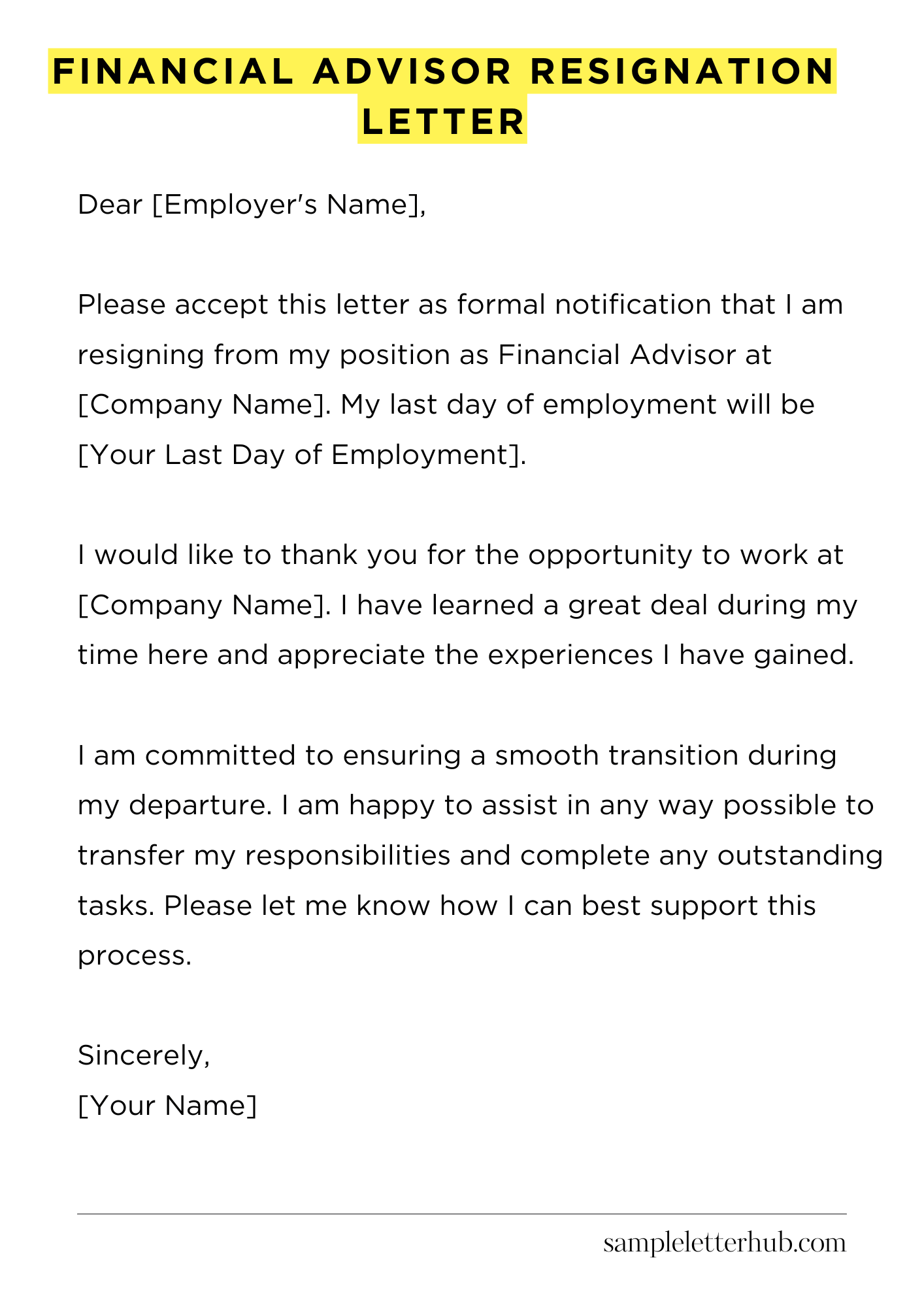
How to Write a Financial Advisor Resignation Letter
1. Crafting the Initial Impact: Your Opening Statement
Resigning from any job can be a big step, but it’s especially important for financial advisors. Your resignation letter sets the tone for your departure and can influence future relationships. Your opening must be clear and direct. Start by stating your intent to resign, and the effective date of your departure. Keep it concise.
For example, you could write: “Please accept this letter as formal notification that I am resigning from my position as Financial Advisor, effective [Date].” Simple, right? Absolutely. Avoid unnecessary details or emotional language at this stage. You want to be professional from the get-go. This section is all about getting straight to the point.
2. Expressing Gratitude: A Touch of Professionalism
Even if you’re leaving due to negative circumstances, it’s always wise to express gratitude. This shows professionalism and respect. Acknowledge your time with the firm.
Mention any positive experiences you may have had, or opportunities you were given. Consider statements like, “I am grateful for the opportunities I’ve had to grow professionally during my time here,” or “I appreciate the support and training I’ve received.”
Keeping your tone positive (or neutral) is always smart. Remember, you might need references later on, and leaving on good terms opens doors. Think about the relationships you’ve built. A brief, heartfelt acknowledgement of their importance can go a long way.
3. Handling Client Transition: What to Include
The most crucial part of your letter concerns client transition. It is the core of your job. It’s vital to address the clients and the handover of their portfolios. Ensure the firm has a plan to manage your clients’ accounts. You might suggest a meeting to facilitate a smooth transition. Indicate your willingness to cooperate during this period.
Consider a sentence such as, “I am committed to ensuring a smooth transition for my clients, and I am available to assist in any way possible during the handover process.” Do not divulge confidential information. This should be a collaborative effort, not a source of conflict. Your professionalism here shows that you care about your clients, and the firm.
4. Formalities: Necessary Details and Closing
Don’t forget the necessary formal details. Include your name, title, and contact information. Confirm the effective date of your resignation again. Review the employment contract to confirm any clauses.
This includes non-compete agreements. Add the standard, “Sincerely,” or “Respectfully,” followed by your signature (typed is acceptable, but a wet signature is more formal and professional).
Proofread your letter meticulously before sending it. Errors can undermine your credibility. A well-written, error-free letter is a sign of respect and professionalism. Make sure all the facts are correct and the formatting is consistent. Always keep a copy for your records.
5. The Aftermath: Sending and Follow-Up
Once your letter is drafted, make a copy, and send the original letter to the appropriate person, usually your direct supervisor, or HR. It’s smart to send it via certified mail or hand deliver it. This way you’ll have a record of delivery. Follow up a day or two later. Verify they have received it and have all they need.
Be prepared for a conversation, and stay composed. Maintain a professional attitude throughout this process. You are setting the foundation for your next step, and your reputation is on the line. After all, you have to protect your career.
FAQs about Financial Advisor resignation letter
How much notice should a Financial Advisor give when resigning?
The standard notice period for a financial advisor typically ranges from two weeks to one month. However, the exact duration is usually specified in the employment contract. It’s crucial to review the contract to determine the agreed-upon notice period and adhere to it to avoid any potential legal or professional repercussions.
What should be included in a Financial Advisor resignation letter?
A well-crafted resignation letter should include: a formal statement of resignation, the effective date of departure, a brief expression of gratitude for the opportunity to work with the firm (optional but recommended), and any necessary information regarding the handover of client files or ongoing projects. You may also want to offer assistance with the transition process.
Can a Financial Advisor resign immediately?
While immediate resignation is possible, it’s generally not advisable unless there are extraordinary circumstances, such as a hostile work environment or a breach of contract by the employer. Resigning without proper notice could lead to legal issues or damage professional reputation. Always consider the potential consequences before taking such action.
How should a Financial Advisor handle client communication after resigning?
It’s crucial to follow company policies regarding client communication. Generally, the firm will handle the formal notification to clients. The resigning advisor might assist in the transition by providing contact information and relevant details about the clients’ portfolios, as well as providing insights to the new advisor.
Advisors should always act in the clients’ best interests and adhere to industry regulations.
Are there any legal or ethical considerations for a Financial Advisor resigning?
Yes, several legal and ethical considerations exist. These include: adherence to non-compete agreements (if applicable), protecting client confidentiality, properly transferring client files, and ensuring the smooth transition of client accounts.
Financial advisors must also adhere to all relevant industry regulations and ethical codes of conduct, such as those established by FINRA or the CFP Board.
Related:
Resignation letter due to rude boss
Resignation letter moving to another state
Resignation letter due to illness of family member
Resignation letter due to study