

A Finance Executive resignation letter is a formal document. It announces your departure from a financial leadership role. Its purpose is to officially inform your employer of your intention to leave. It also helps to establish a clear end date and offers a professional record of your exit.
So, you’re ready to move on? We get it. Sometimes, it’s time for a change. That’s why we’ve prepared a collection of Finance Executive resignation letter examples. You can use these to create your own. It should make the whole process easier.
These sample letters cover various situations. You might need to make it personal. Use these templates as your starting point. You’ll be crafting a professional and respectful resignation letter in no time.
Finance Executive Resignation Letter
Below is a sample of a Finance Executive Resignation Letter:
[Your Name]
[Your Address]
[Your Phone Number]
[Your Email Address]
[Date]
[Hiring Manager Name] (If known, otherwise use title)
[Hiring Manager Title]
[Company Name]
[Company Address]
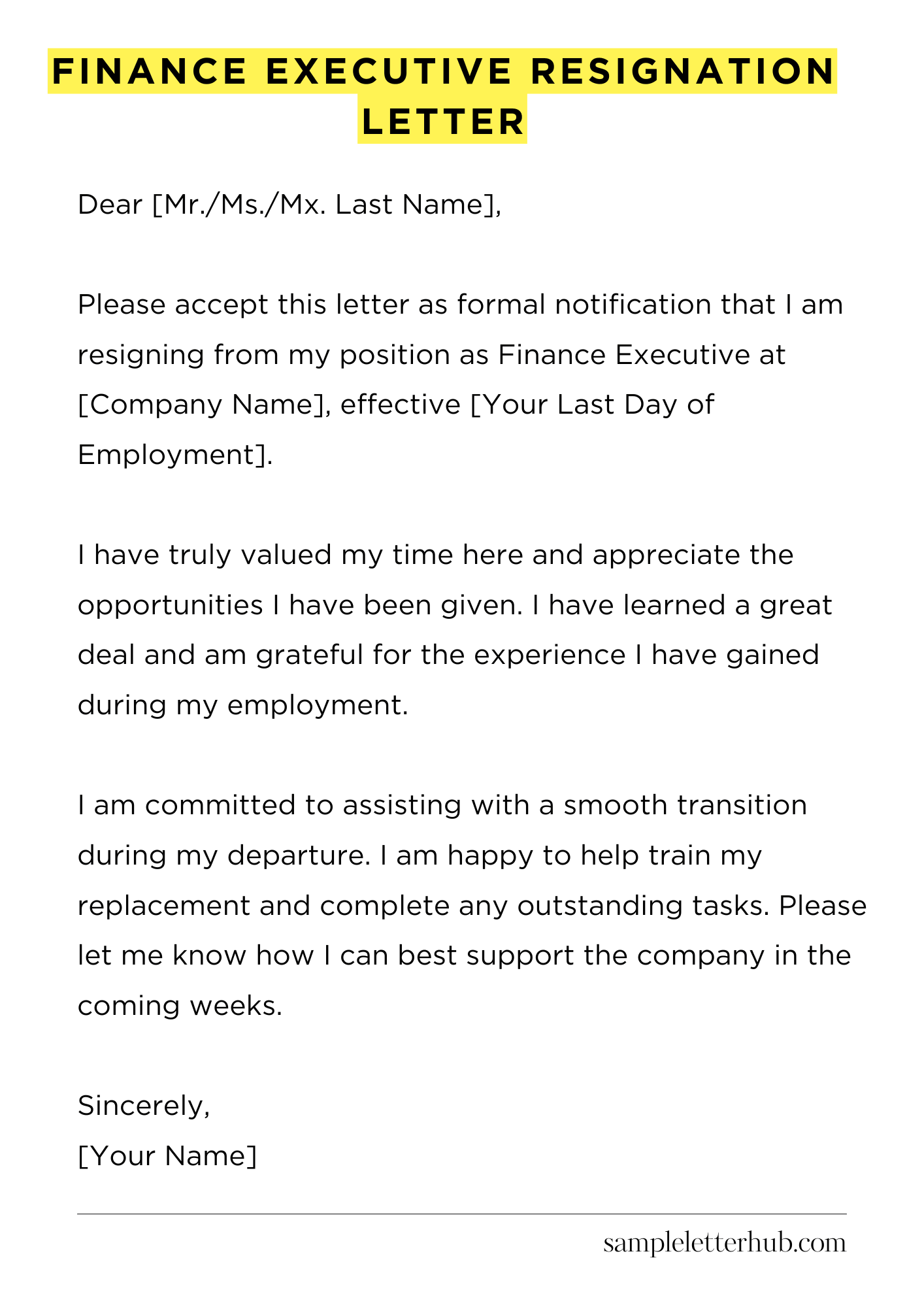
Dear [Mr./Ms./Mx. Last Name],
Please accept this letter as formal notification that I am resigning from my position as Finance Executive at [Company Name], effective [Your Last Day of Employment].
I have truly valued my time here and appreciate the opportunities I have been given. I have learned a great deal and am grateful for the experience I have gained during my employment.
I am committed to assisting with a smooth transition during my departure. I am happy to help train my replacement and complete any outstanding tasks. Please let me know how I can best support the company in the coming weeks.
I wish you and [Company Name] all the best in the future.
Sincerely,
[Your Name]
How to Write a Finance Executive Resignation Letter
Start with the Basics
Resigning from a high-level position like a Finance Executive requires a delicate balance of professionalism and clarity. The foundation of a good resignation letter is simple: state your intention to leave, and state it clearly.
This is not the time for ambiguity or beating around the bush. You’re making a formal statement, so let’s get down to the basics. Remember, this letter is a legal document.
Begin with a formal salutation. Address your letter to the appropriate person, usually your direct supervisor, and use their full title. Then, unequivocally state that you are resigning from your position. Include the effective date of your resignation.
This date is when your employment officially ends. A typical notice period is two weeks, but for executive roles, a longer period (perhaps a month or more) is often expected. Always follow your employment contract’s stipulations regarding notice.
Expressing Gratitude and Professionalism
Even if you’re leaving due to dissatisfaction, it’s generally best to maintain a positive and professional tone. This is crucial for maintaining your reputation and building positive networking.
Show appreciation for the opportunities you’ve been given. Briefly acknowledge the experience you gained or the relationships you built during your time with the company. Keep the language polite and respectful.
You can mention anything you have learned. Do not provide extensive reasons for your departure. This isn’t the place for a laundry list of grievances. Keep it brief and focused on the positive aspects of your tenure.
Remember, you want to leave a good impression, as you may need to rely on the company in the future. Perhaps they can be a reference in your next job.
Providing a Smooth Transition
A responsible Finance Executive will want to facilitate a smooth transition. This demonstrates your commitment and professionalism. Offer your assistance in the handover process.
This might involve training your replacement, documenting key processes, or providing guidance on ongoing projects. Detail your availability for these activities. Be as helpful as possible without overcommitting.
If you have any particularly critical ongoing projects, outline a plan to ensure their completion or handover. This will greatly help your replacement. This is especially true for financial matters. Also, address any outstanding matters, such as pending reports or tasks, so you can clearly communicate their status.
Finalizing and Reviewing
Before submitting your letter, carefully review it. Check for any grammatical errors or typos. Double-check the dates and the recipient’s name and title. Ensure you’ve followed all the steps as mentioned before. Then, proofread your letter for a professional tone. This letter is a reflection of you and your brand.
Consider having a trusted colleague or mentor review the letter before you send it. A fresh pair of eyes can often catch mistakes you might miss.
Consider your relationship with the person that the letter is going to. The more formal you are, the less likely it is to be misconstrued. Once you are certain the letter is perfect, sign it. Also, consider sending the letter both physically and electronically. Keep a copy for your records.
Beyond the Letter: Next Steps
Your resignation letter is just the first step. After sending the letter, prepare for the next steps in your departure. This will require some level of personal preparation. Schedule a meeting with your supervisor to discuss your resignation in person. Be prepared to answer questions and discuss the transition plan.
Begin organizing your personal files and preparing to hand over any company property. Remember to stay professional and keep communication lines open with your colleagues.
The goal is to leave on good terms and preserve your reputation. Ultimately, your departure should be as professional and seamless as possible.
FAQs about Finance Executive Resignation Letter
What is the primary purpose of a Finance Executive resignation letter?
The primary purpose is to formally notify the employer of the intent to leave the position. It serves as a legal document, communicating the decision, the effective date of departure, and sometimes offering context for the resignation. It is a crucial step in ensuring a smooth transition and maintaining a professional relationship.
What key information should a Finance Executive resignation letter include?
The letter should include the date, the recipient’s name and title, a clear statement of resignation, the effective date of resignation, and a brief expression of gratitude for the opportunity. It may also include a statement regarding the willingness to assist with the transition and contact information.
How much notice should a Finance Executive give when resigning?
The notice period depends on the employment contract and company policy. As a general rule, a Finance Executive should provide a minimum of two to four weeks’ notice. However, it is always recommended to review the employment agreement to adhere to any contractual obligations.
Should a Finance Executive include the reason for resignation in the letter?
While not mandatory, it’s advisable to keep the letter concise and professional. You are not obligated to explain the reason for leaving in detail. A brief, neutral statement, such as “pursuing other opportunities,” is generally sufficient. If the reason involves sensitive information, it might be discussed separately with the appropriate individuals.
What are the best practices for delivering a Finance Executive resignation letter?
The letter should be delivered in person, if possible, followed by an email copy for the record. Ensure the letter is well-written, professional, and free of any negativity or complaints. Be prepared to discuss your departure with your supervisor and potentially the HR department.
Related:
Resignation letter due to rude boss
Resignation letter moving to another state
Resignation letter due to illness of family member
Resignation letter due to study