

A finance consultant resignation letter is a formal document. It informs your employer of your intention to leave. This letter initiates the official departure process. It outlines your last day of employment.
Writing a resignation letter can be tricky. You want to be professional and clear. The goal is a smooth transition. Don’t worry, we’re here to help.
This article provides helpful templates. We’ll show you various examples. They cover different scenarios. Craft your own letter with ease.
Finance Consultant Resignation Letter
Below is a sample of a Finance Consultant Resignation Letter:
[Your Name]
[Your Address]
[Your Phone Number]
[Your Email Address]
[Date]
[Recipient Name]
[Recipient Title]
[Company Name]
[Company Address]
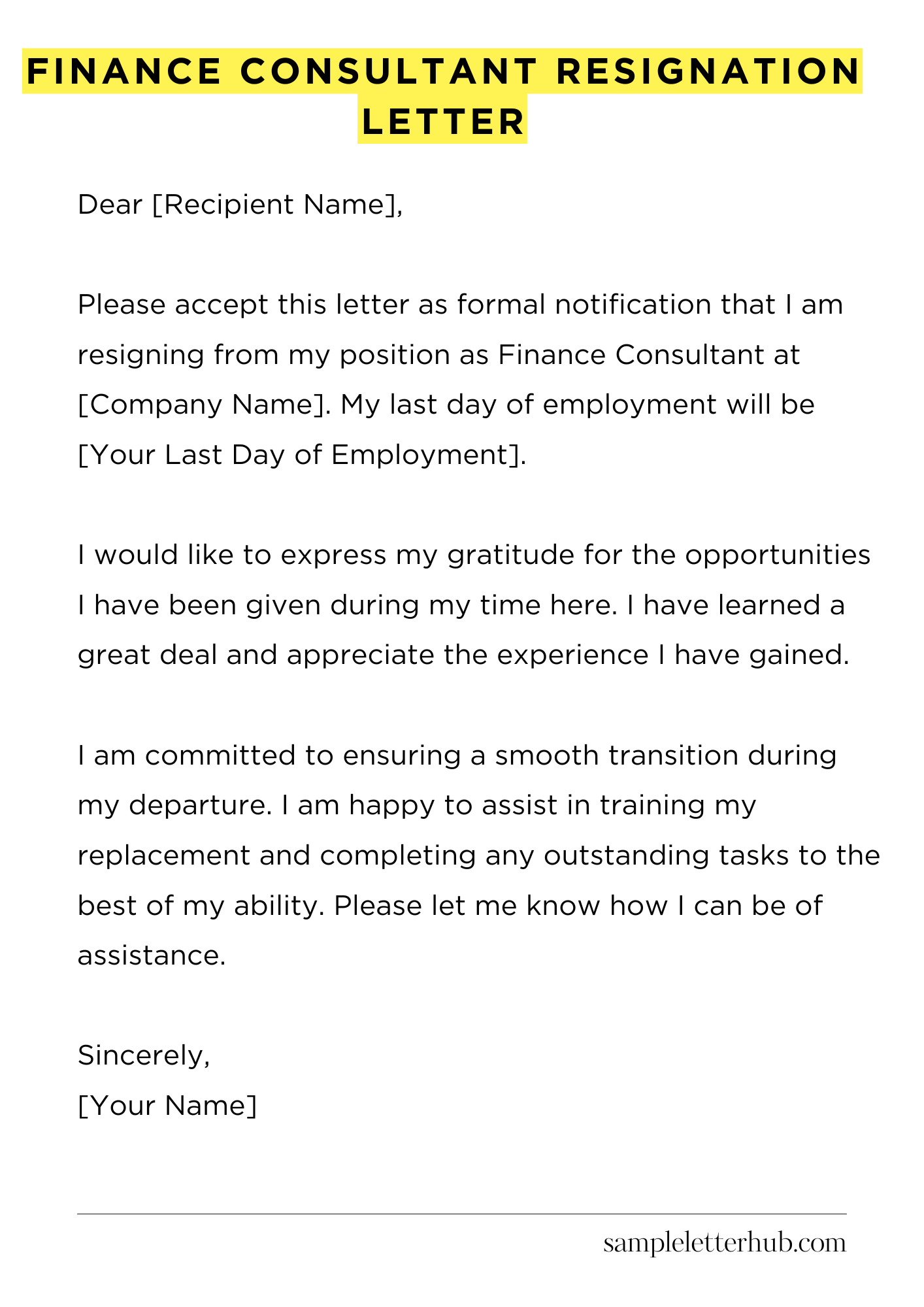
Dear [Recipient Name],
Please accept this letter as formal notification that I am resigning from my position as Finance Consultant at [Company Name]. My last day of employment will be [Your Last Day of Employment].
I would like to express my gratitude for the opportunities I have been given during my time here. I have learned a great deal and appreciate the experience I have gained.
I am committed to ensuring a smooth transition during my departure. I am happy to assist in training my replacement and completing any outstanding tasks to the best of my ability. Please let me know how I can be of assistance.
I wish you and [Company Name] all the best in the future.
Sincerely,
[Your Name]
How to Write a Finance Consultant Resignation Letter
Understanding the Importance of a Well-Crafted Resignation
Leaving your job is a big deal. You’ve probably put in a lot of time and effort. As a Finance Consultant, professionalism is key, and your resignation letter is a direct reflection of that.
This isn’t just about saying “I quit.” It’s your last official communication. It should be polite, concise, and leave a positive lasting impression. Think of it as a final piece of work, demonstrating your skills and integrity.
A well-written letter can open doors in the future. You never know when you might need a reference or want to reconnect with former colleagues. Conversely, a poorly written letter can burn bridges. It’s also crucial for protecting yourself and ensuring a smooth transition.
Essential Elements: What to Include
So, what exactly goes into this important document? There are a few non-negotiable elements. First, you’ll need the date. Then, state your intention clearly – you are resigning. Your letter should clearly state your last day of employment. Be sure to confirm this with your employer beforehand.
Next, express your gratitude. Acknowledge the opportunities you’ve had and any valuable experiences. Mentioning specific colleagues or projects, if appropriate, shows genuine appreciation.
Briefly explain your reason for leaving. A general statement, such as “to pursue other opportunities,” is often sufficient. Avoid negative comments or detailed explanations. Finally, offer assistance with the transition. This simple gesture demonstrates your commitment to a smooth handover.
Structuring Your Letter: A Practical Guide
Let’s look at the actual layout. Begin with a formal salutation, like “Dear [Manager’s Name]”. Keep it professional. State your intention to resign in the first paragraph. Provide the date. The next paragraph should express your thanks for the opportunity. This might include mentioning the skills you’ve gained or the projects you’ve enjoyed working on.
In the third paragraph, you can briefly explain your reason for leaving. Keep it brief and positive. Then, offer your help with the transition. Provide contact information if you’re comfortable. Finally, end with a professional closing, such as “Sincerely” or “Best regards”, followed by your typed name.
Common Mistakes to Avoid
Some things should be completely avoided. Don’t be negative. Venting about your job, the company, or your colleagues is never a good idea. This is not the time to air grievances. Avoid overly casual language, slang, or emojis. Remember, you’re writing a formal business document.
Don’t be vague. Be clear about your last day of employment. Misunderstandings can create problems. Proofread carefully. Spelling and grammatical errors can damage your credibility. Before you submit, double-check everything. Consider having a trusted colleague read it over as well.
Final Steps: Before You Submit
Once you’ve written your letter, review it thoroughly. Make sure the tone is professional, the language is clear, and the content is accurate. Confirm your resignation date with your manager and HR. Always keep a copy of your resignation letter for your records.
Delivery is also important. Usually, you will need to submit this in paper format. Following the correct procedures shows respect and makes for a professional conclusion. By following these guidelines, you can ensure your resignation letter reflects positively on you and allows for a successful transition to your next endeavor.
FAQs about Finance Consultant resignation letter
How do I start my Finance Consultant resignation letter?
Begin your letter with a clear and concise statement of your intent to resign from your position as a Finance Consultant. Include your name, the date, and the recipient’s name (usually your direct supervisor or HR).
What essential information should be included in a Finance Consultant resignation letter?
The letter must state your last day of employment, and it’s best to include a brief, professional note expressing gratitude for the opportunities you’ve been given. It’s also helpful to offer assistance with the transition period, such as training your replacement or completing any unfinished tasks.
Should I provide a reason for my resignation in the letter?
While not mandatory, you can briefly mention your reason for leaving, if you wish. Keep it professional and positive. For example, you might state that you are pursuing another opportunity or that you’re seeking a different career path. Avoid negative comments about your current employer or colleagues.
What is the proper format for a Finance Consultant resignation letter?
Use a professional business letter format. Include your contact information (name, address, phone number, and email) at the top. Address the letter to your supervisor or HR manager. Use a formal salutation (e.g., “Dear [Name]”). Keep the letter concise and focused, and close with a professional closing (e.g., “Sincerely,” or “Regards,”). Sign the letter.
Can I use a template for my Finance Consultant resignation letter?
Yes, using a template can be a good starting point. Many templates are available online. However, always customize the template to fit your specific situation and add your personal details, ensuring it accurately reflects your situation. Double-check all details before submitting.
Related:
Resignation letter due to rude boss
Resignation letter moving to another state
Resignation letter due to illness of family member
Resignation letter due to study