


A faculty resignation letter is a formal document. It is written by a professor or teacher. The purpose is to officially inform a school or university of their departure. This letter signals the end of their employment.
Leaving a teaching position can be tricky. It requires professionalism. You need a well-crafted letter. We’ve got you covered.
We’ve compiled helpful samples. You will find different templates. Use these to create your own letter. Writing your resignation will be easy.
Faculty Resignation Letter
Below is a sample of a Faculty Resignation Letter:
[Your Name]
[Your Address]
[Your Phone Number]
[Your Email Address]
[Date]
[Recipient’s Name]
[Recipient’s Title]
[Department Name]
[University/Institution Name]
[University/Institution Address]
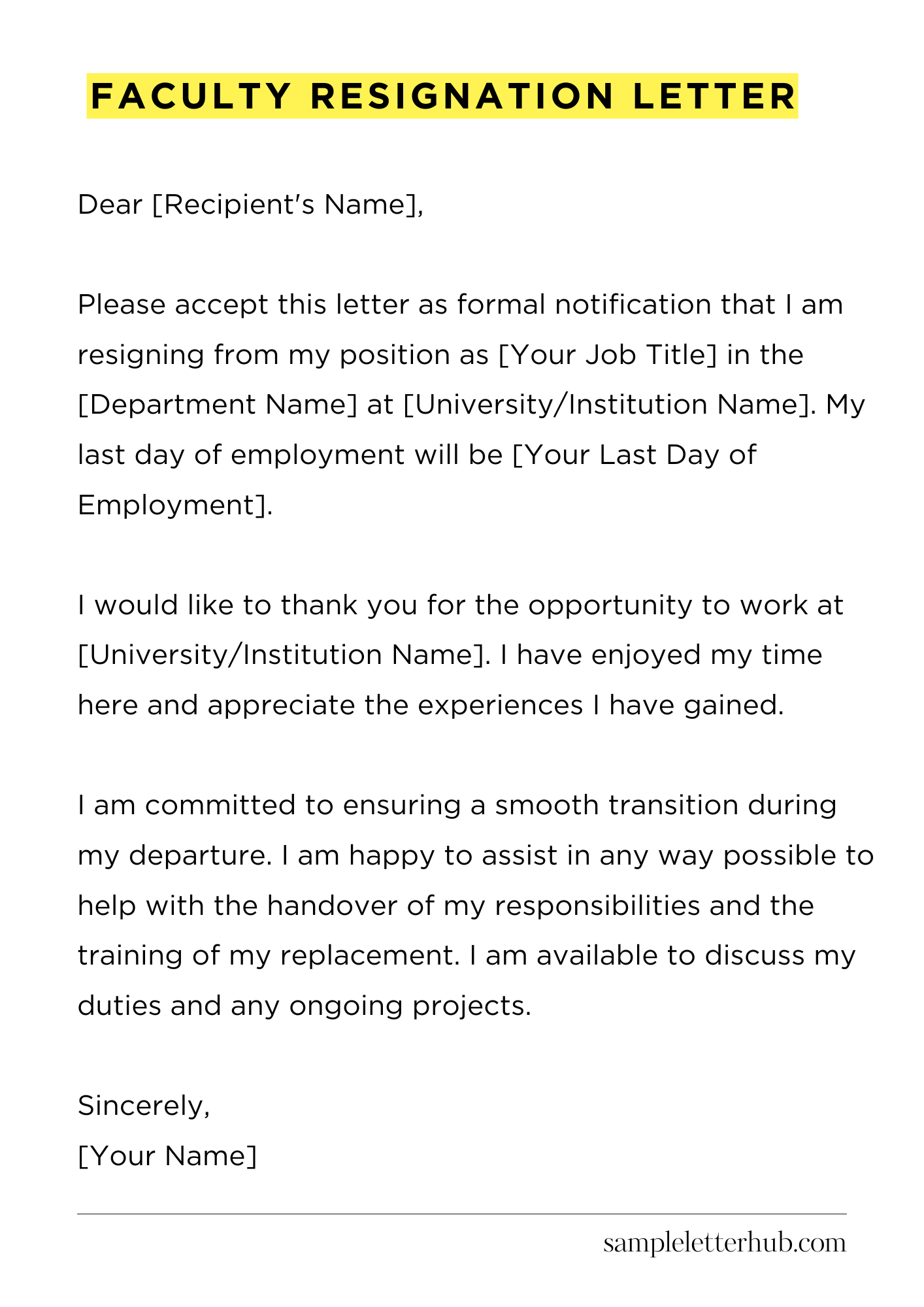
Dear [Recipient’s Name],
Please accept this letter as formal notification that I am resigning from my position as [Your Job Title] in the [Department Name] at [University/Institution Name]. My last day of employment will be [Your Last Day of Employment].
I would like to thank you for the opportunity to work at [University/Institution Name]. I have enjoyed my time here and appreciate the experiences I have gained.
I am committed to ensuring a smooth transition during my departure. I am happy to assist in any way possible to help with the handover of my responsibilities and the training of my replacement. I am available to discuss my duties and any ongoing projects.
I wish you and the university all the best in the future.
Sincerely,
[Your Name]
How to Write a Faculty Resignation Letter
Know Your Reason
Before you even think about penning your resignation letter, you need to understand why you’re leaving. This is crucial. Are you moving for a better opportunity, or are there personal reasons? This understanding will influence the tone and content of your letter. Your reasons need to be clear in your mind. This helps you write the best and most appropriate response.
Be honest with yourself and make sure you’re ready to make this significant change in your career.
Crafting the Core Components
The core of your resignation letter needs to be direct, polite, and professional. It’s a formal document, after all! Start by clearly stating your intention to resign. Include your name, department, and the specific date your resignation will be effective. This is non-negotiable.
For example: “Please accept this letter as formal notification that I am resigning from my position as Professor of History, effective August 15, 2024.” Keep it simple. Avoid lengthy explanations in this section.
Express Gratitude and Professionalism
Even if you’re leaving due to negative experiences, maintain a professional tone. Expressing gratitude is always a good move. You can acknowledge the opportunities you’ve been given or thank specific people who have supported your career. This shows that you are a gracious and composed individual.
Something like: “I am grateful for the opportunities I’ve had during my time at [University Name]. I have learned a lot and appreciate the support I have received from the department.” Remember, you are building relationships, not burning bridges.
Address the Transition Plan
Consider the impact your departure will have on your students and colleagues. It is important to demonstrate your awareness. Your letter should address your willingness to assist with the transition. This includes things like: offering to train a replacement, providing guidance to your students, and completing any outstanding projects.
This is where you can further bolster your reputation. You might say: “I am committed to making this transition as smooth as possible. I am happy to assist in any way I can, including helping to find a replacement and providing information about my current projects.” This kind of language is essential.
Proofread and Get Feedback
Before you submit your letter, proofread it carefully. Check for any grammatical errors, spelling mistakes, and ensure the tone is appropriate. Read it aloud to catch any awkward phrasing. Have a trusted friend, mentor, or colleague review it too.
A second pair of eyes is invaluable. Make sure everything is clear, concise, and professional. This step is crucial. This final review will increase the impact of your letter and your future as a professional.
FAQs about Faculty Resignation Letter
What is the primary purpose of a faculty resignation letter?
The primary purpose of a faculty resignation letter is to formally notify the employing institution of the faculty member’s intent to leave their position. It serves as a written record of the resignation, the effective date, and often includes a statement of gratitude or a brief reason for leaving.
What key information should be included in a faculty resignation letter?
A faculty resignation letter should include the faculty member’s name, the department or college they belong to, the official title, a clear statement of resignation, the specific effective date of the resignation, and a professional closing. It may also include a brief expression of gratitude for the opportunity and, optionally, a reason for leaving.
How far in advance should a faculty resignation letter be submitted?
The timeframe for submitting a faculty resignation letter is typically governed by the institution’s policies or the employment contract. Generally, it’s advisable to provide at least one month’s notice, or as stipulated by the institution’s guidelines, to allow sufficient time for the transition process, including the search for a replacement and the handover of responsibilities.
Can a faculty resignation letter be rescinded or changed?
While it’s possible, rescinding or changing a resignation letter depends on the institution’s policies and willingness to negotiate. It is advisable to consult the institution’s guidelines. It’s best to discuss this with the department head or relevant administrator immediately. The original resignation letter usually stands unless there is an explicit agreement to the contrary.
What are some common considerations for handling responsibilities after submitting a resignation letter?
After submitting the resignation letter, faculty members should prepare for an orderly transition. They should collaborate with the department to transfer responsibilities, complete pending tasks, and assist in the search for a successor. This includes providing necessary documents, materials, or information to ensure a smooth handover and reduce any disruption.
Related:
Resignation letter due to rude boss
Resignation letter moving to another state
Resignation letter due to illness of family member
Resignation letter due to study