

An Explanation Letter for Policy Irregularities is a formal document. It explains why a policy wasn’t followed. The goal is to clarify the situation. It helps to avoid misunderstandings. It is crucial for maintaining transparency. It ensures accountability in any workplace.
Writing an explanation letter can feel daunting. We understand. This article is here to help! We’re providing templates, examples, and samples of various explanation letters. These are designed to guide you. Use them as a starting point. Make your policy violation letter easier to draft.
No more staring at a blank page. We’ve got you. Our explanation letter samples are tailored for different scenarios. Need a sample policy violation letter? We’ve got it. Want a template for a violation letter? You’re in luck. Let’s get you writing!
[Your Name/Company Name]
[Your Address]
[Your City, Postal Code]
[Your Email]
[Your Phone Number]
[Date]
[Recipient Name/Company Name]
[Recipient Address]
[Recipient City, Postal Code]
Dear [Recipient Name],
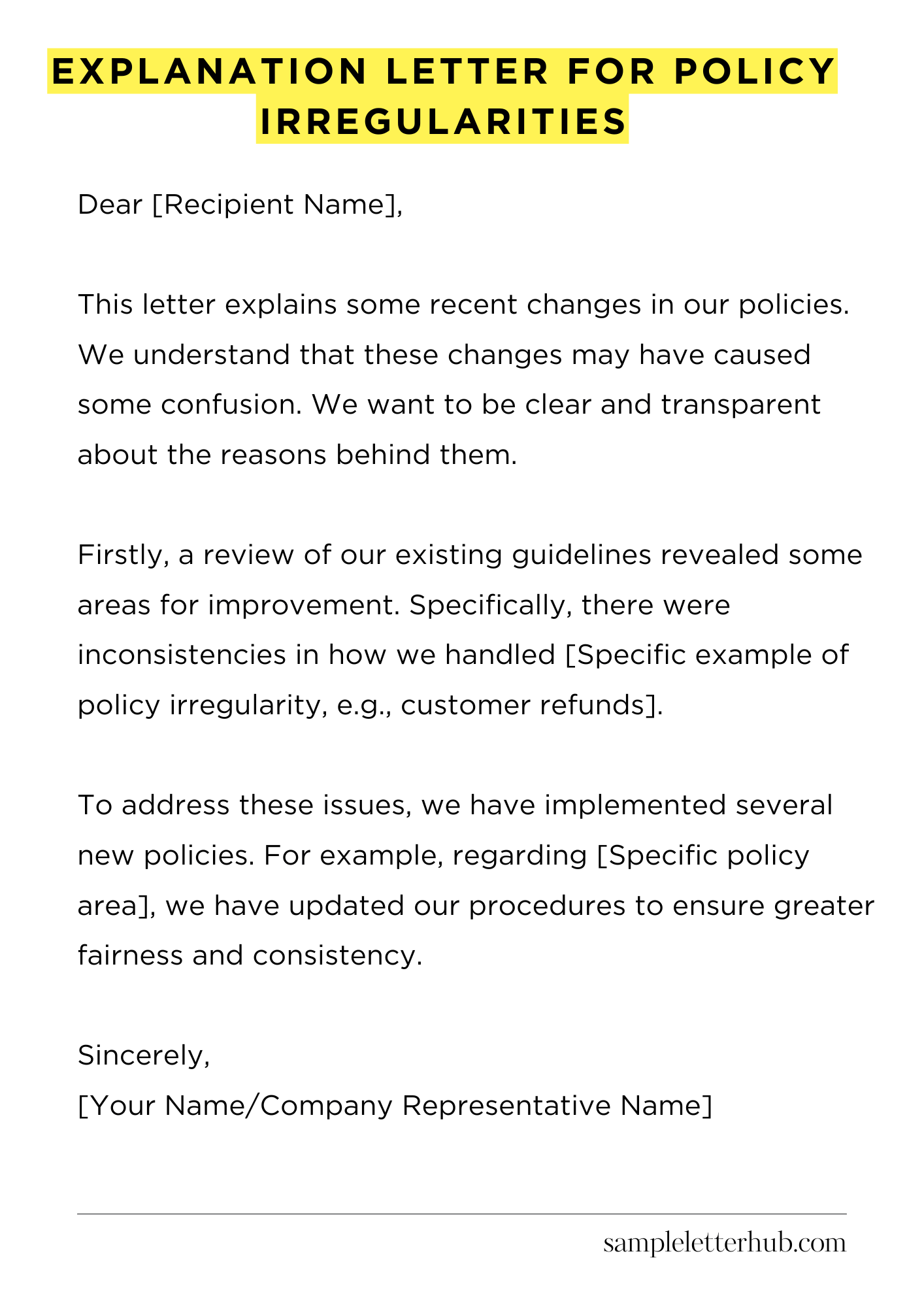
This letter explains some recent changes in our policies. We understand that these changes may have caused some confusion. We want to be clear and transparent about the reasons behind them.
Firstly, a review of our existing guidelines revealed some areas for improvement. Specifically, there were inconsistencies in how we handled [Specific example of policy irregularity, e.g., customer refunds]. This led to unfair outcomes for some of our customers. That’s something we take very seriously.
To address these issues, we have implemented several new policies. For example, regarding [Specific policy area], we have updated our procedures to ensure greater fairness and consistency. This means [Explain the change in simple terms]. The goal is to make sure everyone is treated equally and that we meet their needs more effectively.
Secondly, these revisions also reflect our commitment to staying compliant with evolving regulations. Laws and industry standards are constantly changing, and we need to adapt to keep up. This means sometimes our internal guidelines also need updates. These changes are in place to benefit both you and us.
We understand that change can be inconvenient. We want to assure you that we have done our best to make the transition as smooth as possible. We’re working hard to make our services even better.
Detailed information about the revised policies can be found on our website, [Website Address]. We encourage you to review them at your earliest convenience. If you have any questions, please do not hesitate to contact us.
We are confident that these changes will ultimately benefit everyone. Thank you for your understanding and cooperation. We truly appreciate your continued partnership.
Sincerely,
[Your Name/Company Representative Name]
How to Write Explanation Letter for Policy Irregularities
Navigating the choppy waters of policy violations can be daunting. But crafting a clear and persuasive explanation letter is a crucial skill. This guide will help you construct a communication that is both cogent and professional, allowing you to address and mitigate the situation effectively.
1. Pre-Letter Protocol: A Moment of Introspection
Before putting pen to paper (or fingers to keyboard), take a moment to reflect. Thoroughly review the specific policy that was allegedly transgressed. Scrutinize all documentation related to the infraction.
Gather all relevant information. Accurately assess your understanding of the situation. Objectivity is paramount; be honest with yourself about your role. This preliminary introspection forms the bedrock of a credible explanation.
2. The Salutation: A Formal Overture
The commencement of your letter sets the tone. Use a formal salutation. Employ the appropriate title (Mr., Ms., Dr., etc.) and the recipient’s full name. If you are unsure of the addressee’s specific title, err on the side of formality, especially when corresponding with legal or compliance personnel. For example: “Dear Mr. Abernathy,” is better than “Hi John!”
3. Statement of the Issue: Crystal Clarity
The opening paragraph should succinctly state the matter at hand. Clearly identify the specific policy violation under scrutiny. Avoid ambiguity or evasiveness.
State the date(s) on which the incident(s) occurred. A concise and factual account demonstrates that you are taking the matter seriously and providing full transparency. For instance: “This letter is written to address a potential violation of Company Policy 3.4, regarding the use of company resources, which allegedly occurred on October 26, 2024.”
4. Providing Your Explanation: A Narrative of Context
This is where you elucidate the circumstances surrounding the alleged violation. Offer a detailed, yet concise, explanation of what transpired. Be precise in your descriptions. Offer the pertinent details. Provide context without making excuses. Admit any responsibility, if applicable.
Acknowledging a misstep shows accountability. If there were extenuating circumstances, present them judiciously, emphasizing any mitigating factors. Support your assertions with verifiable facts. Avoid using emotional language or overly casual phrasing. Aim for a tone that is both sincere and professional.
5. Remedial Actions: Demonstrating Proactive Solutions
This section is vital, it conveys your commitment to rectification. Outline the steps you have taken or will take to prevent similar occurrences in the future.
This could include attending training, implementing new procedures, or modifying your behavior. Highlight any corrective actions undertaken and any changes you’ve made as a result of the situation. Emphasize your commitment to adhering to company policy moving forward. Show that you have proactively learned from the situation.
6. The Conclusion: A Professional Dismissal
Conclude your letter with a professional and respectful closing. Reiterate your commitment to the company’s policies. Express your appreciation for the opportunity to clarify the situation.
Offer yourself as a resource for any further inquiries. Use a formal closing, such as “Sincerely,” or “Respectfully,” followed by your full name and signature (if a physical letter).
7. Proofreading and Submittal: Final Inspection
Before submitting, proofread your letter meticulously. Check for grammatical errors, typos, and inconsistencies. Ensure that the language is clear, concise, and professional.
Have another person review the letter for objectivity and clarity. Make certain you have all required attachments or supporting documentation. Submit the letter according to the prescribed channels, whether it’s through email, physical mail, or a company portal. A well-crafted and error-free letter reflects your seriousness in addressing the policy violation.
FAQs about Explanation Letter for Policy Irregularities
What is an Explanation Letter for Policy Irregularities?
An Explanation Letter for Policy Irregularities is a formal document written to address instances where an individual or entity has deviated from established company policies, guidelines, or procedures. It serves to provide a detailed account of the circumstances surrounding the deviation, the reasons behind it, and any corrective actions taken or planned to prevent future occurrences.
This letter is typically requested by the relevant authorities or management within an organization to understand the nature of the irregularity and to determine appropriate actions, such as disciplinary measures, policy revisions, or process improvements.
What should be included in an Explanation Letter?
A comprehensive Explanation Letter should include a clear identification of the policy or procedure that was violated, a factual description of the event or incident, the reasons for the deviation (which could include unintentional errors, misunderstandings, extenuating circumstances, or systemic issues).
It should also outline steps to prevent future violations, such as training, process adjustments, or changes in behavior. The tone should be professional and contrite, focusing on providing context and demonstrating a commitment to compliance.
Who should write an Explanation Letter?
The Explanation Letter is generally written by the individual or individuals directly responsible for the policy irregularity. If the irregularity involves a group, the letter may be jointly authored, or separate letters from each involved party may be requested.
In some cases, a supervisor or manager may be involved in the preparation or review of the letter, particularly if the irregularity is complex or involves multiple departments. The author(s) should possess firsthand knowledge of the situation and be able to provide an accurate and detailed account.
What are the potential consequences of a poorly written Explanation Letter?
A poorly written Explanation Letter can have significant negative consequences. If the letter is vague, incomplete, or fails to address the core issues, it may raise doubts about the author’s credibility and willingness to take responsibility.
It can lead to further investigation, more severe disciplinary actions (such as warnings, suspension, or termination), damage to professional reputation, and erosion of trust within the organization. A poorly written letter can also hinder the organization’s ability to understand the root causes of the irregularity and implement effective solutions to prevent future occurrences.
How can I ensure my Explanation Letter is effective?
To ensure your Explanation Letter is effective, be factual, honest, and transparent. Clearly state the policy or procedure involved and describe the event or situation accurately.
Explain the reasons for the deviation objectively, without making excuses or shifting blame. Acknowledge your responsibility, if any, and describe the steps you have taken or will take to correct the issue and prevent future occurrences.
Proofread the letter carefully for clarity, grammar, and tone. If unsure, seek guidance from a supervisor, HR representative, or legal counsel. Finally, maintain a professional and respectful tone throughout the letter.
Related:
Resignation letter due to rude boss
Resignation letter moving to another state
Resignation letter due to illness of family member
Resignation letter due to study