

Facing a minor accident? Need to file an insurance claim? You’ll likely need an explanation letter for a minor accident claim. This letter clarifies what happened during the incident. It provides details and context for the insurance company. Its goal? To help them understand the accident and process your claim smoothly.
Writing this letter can feel tricky. Don’t worry, we got you. This article is your guide. We’ll give you templates, examples, and samples of an explanation letter for a minor accident claim. You can easily adapt these to your specific accident situation.
Consider these samples your cheat sheets. They’ll simplify writing your own explanation letter. They cover various scenarios and help you craft a clear, concise claim letter. Get ready to write with confidence. Your accident claim journey starts here.
[Your Name]
[Your Address]
[Your Phone Number]
[Your Email Address]
[Date]
[Insurance Company Name]
[Insurance Company Address]
Subject: Explanation for Minor Accident Claim – [Policy Number]
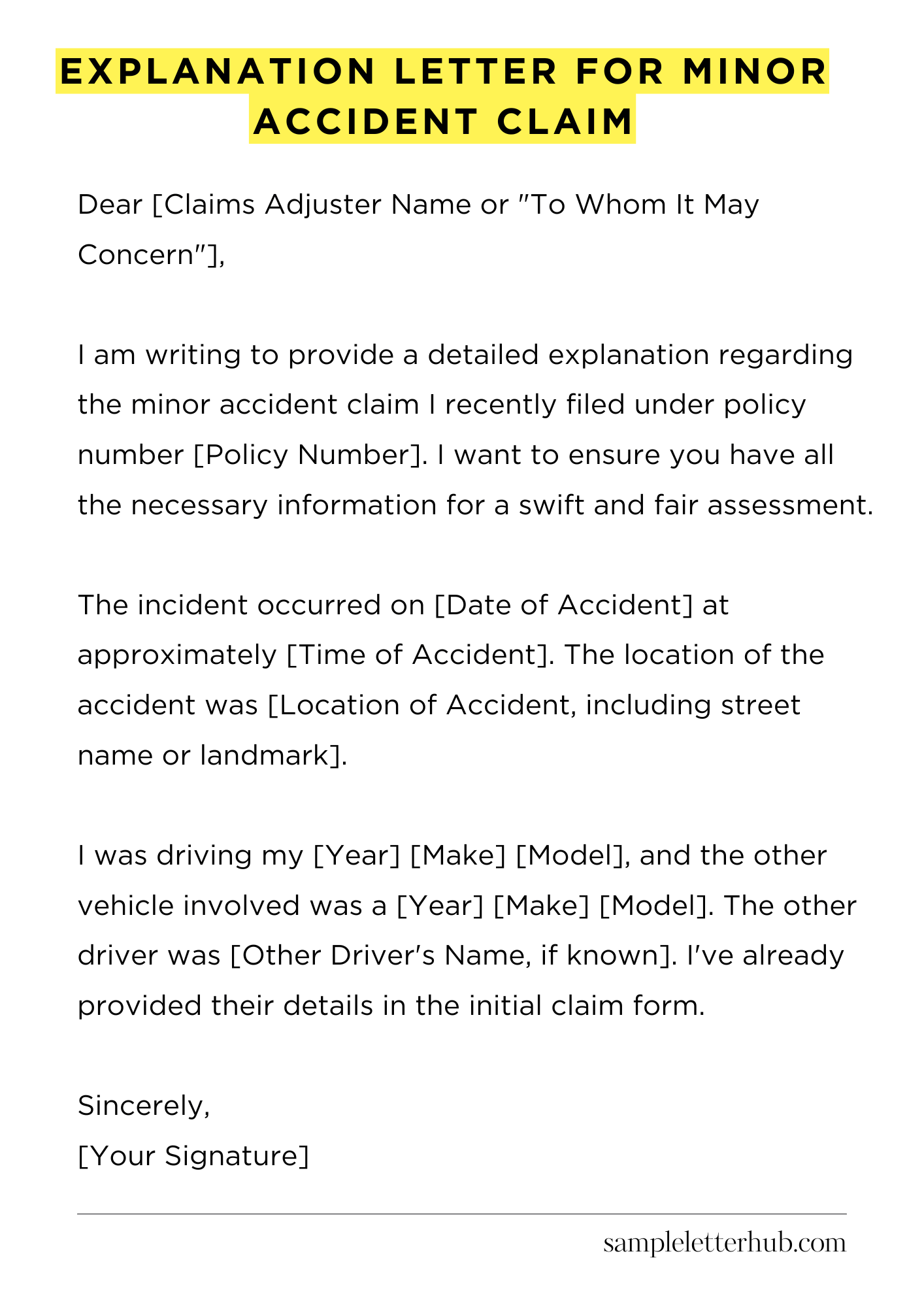
Dear [Claims Adjuster Name or “To Whom It May Concern”],
I am writing to provide a detailed explanation regarding the minor accident claim I recently filed under policy number [Policy Number]. I want to ensure you have all the necessary information for a swift and fair assessment.
The incident occurred on [Date of Accident] at approximately [Time of Accident]. The location of the accident was [Location of Accident, including street name or landmark]. The weather conditions at the time were [Weather Conditions, e.g., clear, rainy, etc.].
I was driving my [Year] [Make] [Model], and the other vehicle involved was a [Year] [Make] [Model]. The other driver was [Other Driver’s Name, if known]. I’ve already provided their details in the initial claim form.
The accident itself was quite minor. It involved a [Brief Description of Accident, e.g., rear-end bump at low speed]. There was a very small amount of damage to both vehicles.
The cause of the accident, as I understand it, was [Explanation of the Cause, e.g., the other driver stopped suddenly, my attention was momentarily diverted, etc.]. I do apologize for my involvement in this. I’ve taken steps to be extra careful now.
Photographs of the damage to both vehicles have already been submitted with the claim. You can also review those.
I am fully cooperating with the investigation and have provided all requested documentation. I have the utmost confidence in your team’s ability to thoroughly assess the situation. I want to assist in any way that I can.
I kindly request that you review this explanation alongside the initial claim form and supporting documentation. I hope this clarifies the situation.
Thank you for your time and consideration.
Sincerely,
[Your Signature]
How to Write an Explanation Letter for a Minor Accident Claim
A fender bender. A slight bump. A minor mishap on the road. These events, while inconvenient, often necessitate the submission of an explanation letter to your insurance provider. It’s a crucial document that can significantly influence the outcome of your claim. Getting it right is paramount. Let’s delve into how to craft a compelling and cogent explanation letter.
1. Commence with Congruence: Your Salutation and Identification
Begin your letter professionally. A formal salutation is expected. Address the recipient appropriately, such as “To Whom It May Concern” or, if you know the claims adjuster’s name, “Dear Mr./Ms. [Last Name]”.
Subsequently, provide your full legal name, address, policy number, and the date of the accident. This preempts any confusion and ensures that your missive is properly routed.
2. The Genesis of the Incident: Articulating the Facts
Herein lies the crux of your letter: the accident narrative. Be meticulous. Detail the circumstances leading up to the incident. Specify the location, time, and weather conditions.
Then, delineate the precise sequence of events. State which vehicles were involved, their respective positions, and the direction they were traveling. Avoid using ambiguous terms or speculative assertions. Present the facts with unflinching clarity. Remember, brevity is a virtue; however, comprehensiveness is even more so.
3. Deciphering Damage and Damages
Accurately describe the damage sustained by each vehicle, including your own. Be objective. Note any physical impairments to your vehicle, such as dents, scratches, or shattered components.
Also, detail any personal injuries, however slight, that you, or any other occupants of the vehicle, experienced. Mention whether emergency services were present, and if police were notified, indicate the responding agency and the case number they assigned. Documentation from a repair shop is helpful here.
4. Assigning Responsibility: Adjudicating the Accountability
Address the issue of liability directly. Offer your perspective on how the accident transpired and who you believe was at fault. Support your claims with concrete evidence and observations.
If the other party admitted fault, mention it. If there were witnesses, provide their names and contact information. Your aim is to provide sufficient information to the claims adjuster to assist in their investigative processes.
5. Supporting Documentation: Augmenting Your Assertion
Integrate any supporting documentation. Enclose copies of the police report, photographs of the accident scene and the damage to the vehicles, and witness statements.
This supplemental material fortifies your explanation and provides tangible proof to support your account. These extra materials should corroborate your explanations.
6. The Concluding Cadence: Proper Closure
Conclude your letter with a polite, yet assertive, closing statement. Summarize the key points of your explanation and reiterating your desire for a prompt and equitable resolution of your claim.
Express your willingness to provide additional information if needed. End with a professional closing, such as “Sincerely” or “Respectfully,” followed by your full name and signature.
7. Polishing the Prosaic: Review and Refinement
Before submitting your letter, proofread it diligently. Scrutinize your writing for any grammatical errors, spelling mistakes, or factual inaccuracies. Ensure that your explanation is clear, concise, and logical.
A well-written letter exudes professionalism and bolsters the credibility of your claim. A final review is an essential step to ensure your message is communicated precisely.
FAQs about Explanation Letter for Minor Accident Claim
What is an explanation letter for a minor accident claim, and why is it needed?
An explanation letter for a minor accident claim is a written document submitted to an insurance company or relevant authority to provide details about a small-scale traffic incident. It serves as a formal record of the event, offering clarity and context regarding the circumstances.
It’s needed to support the claim, assisting the insurer in understanding the situation, determining liability, and processing the claim accurately. It helps insurers assess the claim and arrive at a fair settlement.
What information should be included in an explanation letter for a minor accident claim?
A comprehensive explanation letter should include the date, time, and location of the accident; a clear description of the events leading up to the incident; details of the vehicles involved, including make, model, and license plate numbers; a description of any damage sustained.
How should I format and write an explanation letter for an accident claim?
The letter should be written in a clear, concise, and objective tone. Begin with a formal salutation and state the purpose of the letter. Structure the content logically, covering the essential details mentioned above.
Use precise language and avoid emotional expressions or admissions of fault. End with a closing statement, and include your signature. Proofread carefully before submitting. Include pictures of the damage if applicable. Consider using a template as a guide.
Who should I send the explanation letter to, and when should I submit it?
The explanation letter should be sent to your insurance company or the insurance company of the other party involved, depending on the circumstances and the claim process.
It’s important to submit the letter as soon as possible after the accident. Check your insurance policy’s specific guidelines regarding deadlines. Prompt submission ensures that the claim is processed efficiently, minimizing potential delays or complications.
What are the common mistakes to avoid when writing an explanation letter for a minor accident claim?
Avoid admitting fault, as this could impact your claim. Refrain from exaggerating the details or providing inaccurate information. Do not omit crucial information or leave blanks.
Ensure the letter is legible and free of grammatical errors. Do not make assumptions or speculate on the cause of the accident without factual evidence. Keep the tone factual and unbiased throughout the letter.
Related:
Resignation letter due to rude boss
Resignation letter moving to another state
Resignation letter due to illness of family member
Resignation letter due to study