

Dealing with frequent insurance claims? You might need to write an explanation letter for frequent insurance claims. Insurance companies often request these letters. The purpose is simple: to help them understand why you have made multiple claims. It’s about clarity and transparency regarding your insurance claims.
Feeling overwhelmed by the thought of writing this letter? Don’t worry, we got you! This article is your guide to crafting effective explanation letters. We’ll provide you with various letter samples, templates, and examples. Using our guide, you can create a clear and concise letter.
We aim to simplify the process. These samples of letters are designed to assist you. Adapt these explanation letters to your specific situation. Writing your own letter for insurance claims just got easier.
[Your Name/Insurance Company Letterhead]
[Your Address]
[Your Phone Number]
[Your Email Address]
[Date]
[Insured’s Name]
[Insured’s Address]
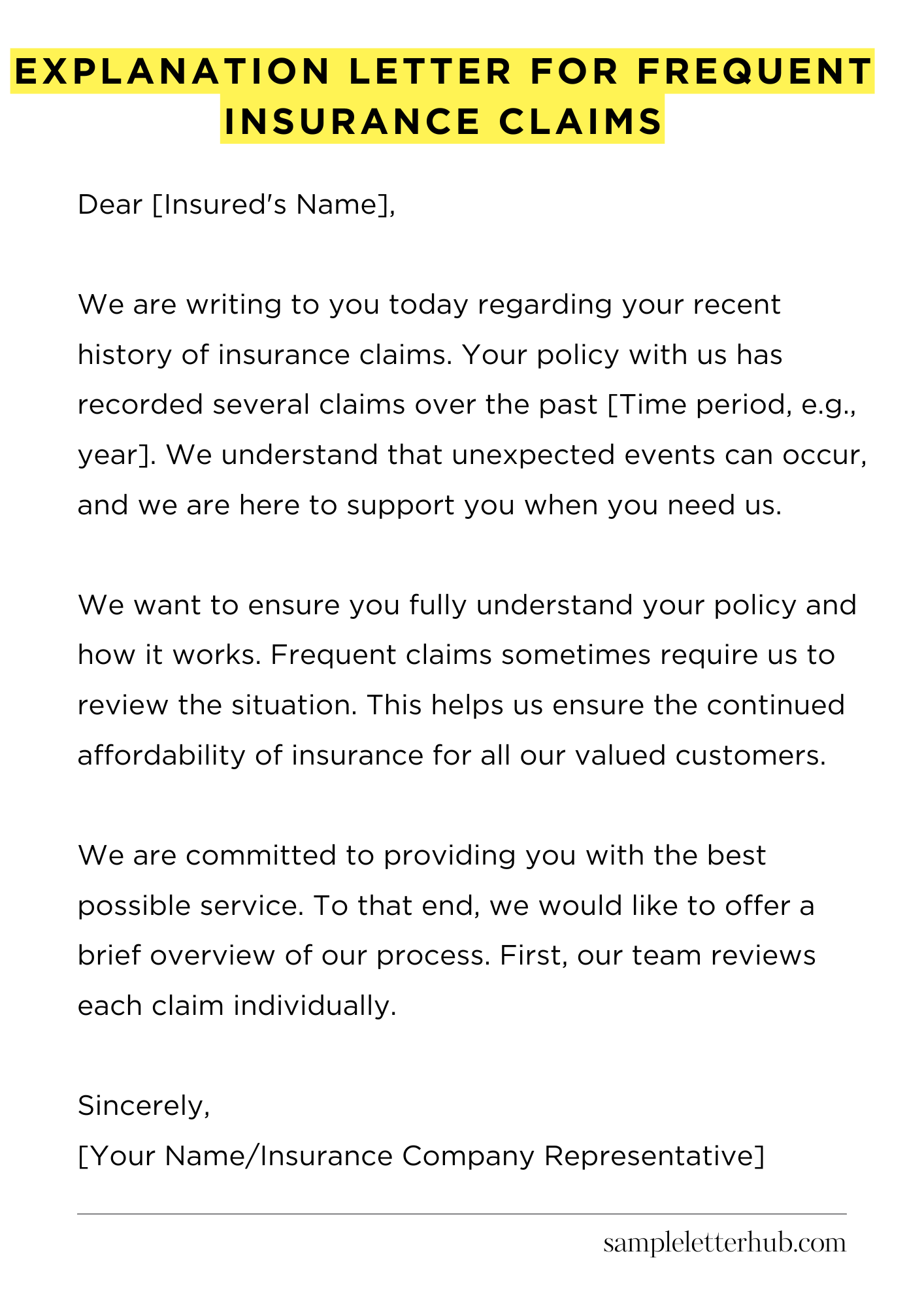
Dear [Insured’s Name],
We are writing to you today regarding your recent history of insurance claims. Your policy with us has recorded several claims over the past [Time period, e.g., year]. We understand that unexpected events can occur, and we are here to support you when you need us.
We want to ensure you fully understand your policy and how it works. Frequent claims sometimes require us to review the situation. This helps us ensure the continued affordability of insurance for all our valued customers. We appreciate your loyalty to our company.
We are committed to providing you with the best possible service. To that end, we would like to offer a brief overview of our process. First, our team reviews each claim individually.
We carefully examine the details provided. We look at the nature of the damage or loss reported. Then, we determine if the claim falls within the terms of your policy.
Secondly, we may need to request additional information from you. This is a standard procedure. Such information can include repair estimates, photographs, or police reports, depending on the nature of the claim.
Providing this promptly assists us in completing the review efficiently. The faster we receive the information, the faster we can process your claim.
Finally, we communicate our decision to you in writing. You will receive a formal notification regarding the status of your claim. It will include all the details of the decision. You have the right to appeal our decision if you disagree with it.
If you have any questions about this process, please do not hesitate to contact us. We are available to help you understand your policy or clarify anything. We can provide further clarification on claim procedures.
We value your business and are here to help you.
Sincerely,
[Your Name/Insurance Company Representative]
How to Write Explanation Letter for Frequent Insurance Claims
Navigating the terrain of insurance claims can be tricky. When dealing with frequent claims, it becomes even more imperative to craft a cogent and persuasive explanation letter.
This is your chance to elucidate the rationale behind your claim history, effectively mitigating potential scrutiny. Here’s a comprehensive guide to help you compose a compelling letter.
1. Understand the Premise: Why an Explanation is Essential
Insurance companies meticulously analyze claims. A history of frequent claims often triggers a review. An explanation letter acts as your advocate, providing context that might otherwise be overlooked. A well-crafted letter can make all the difference.
2. Pre-Letter Amelioration: Gather Your Arsenal of Information
Before you begin penning your letter, collect all the necessary documentation. This includes policy details, claim records, bills, and any supporting evidence. Thorough preparation bolsters your argument, providing concrete substance to your claims. Organize your data meticulously.
3. Crafting the Salutation: Addressing the Recipient Correctly
Always commence with a professional salutation. Use the insurance company’s official name, the relevant department or agent’s name (if known). Use a formal and respectful tone. This sets the right tone from the outset.
4. The Expository Section: Laying Out Your Case Methodically
In the body of your letter, clearly state the purpose of your communication. Start with a succinct and unambiguous introduction. Then, methodically explain each claim. Detail the circumstances surrounding each incident, including dates, locations, and involved parties. Be absolutely truthful. Provide all relevant facts.
5. Substantiating Your Case: Providing Concrete Support
This is where your gathered documentation comes into play. Refer to specific policy clauses and incorporate evidence to substantiate your claims. Attach copies of supporting documents, ensuring they are legible. Proper referencing and attaching supporting evidence will fortify your letter.
6. Addressing the elephant in the room: Acknowledging Claim Frequency
Directly address the frequency of your claims. Explain any contributing factors that may have led to the situation. Perhaps you had a series of unfortunate events, or maybe the circumstances of your policy were specific.
If applicable, outline the steps you’ve taken to prevent future incidents. Proactive measures can demonstrate responsible behavior.
7. The Conclusion and Postscript: Reiteration and Assurance
In your concluding paragraph, reiterate your understanding of the situation and express your commitment to complying with policy terms. Thank the recipient for their time and consideration.
End with a professional closing, such as “Sincerely” or “Respectfully”. Include your full name, address, and contact information. A postscript (P.S.) can be used to emphasize a key point or offer further clarification.
FAQs about Explanation Letter for Frequent Insurance Claims
What is an Explanation Letter for Frequent Insurance Claims?
An Explanation Letter for Frequent Insurance Claims is a document requested by an insurance provider when a policyholder submits a higher-than-average number of claims.
This letter allows the policyholder to provide context and reasons for the frequent claims, helping the insurance company understand the circumstances and assess potential risks.
Why is an Explanation Letter needed?
Insurance companies use Explanation Letters to manage risk and understand the reasons behind frequent claims. They might request it to verify the legitimacy of claims, assess if the policyholder is engaging in high-risk behaviors or to determine if adjustments to the policy are necessary, such as an increase in premiums or changes to coverage.
What should be included in an Explanation Letter?
An effective Explanation Letter should clearly and concisely explain the reasons for each claim. Include the dates of incidents, a description of the incidents, and any supporting documentation, like medical reports or police reports. It should also address any preventative measures taken to avoid future incidents and a commitment to complying with policy terms.
What happens if I don’t provide an Explanation Letter?
Failure to provide an Explanation Letter when requested can have several consequences. Your claims may be delayed, denied, or your insurance coverage may be reviewed. The insurance company might increase your premiums, limit your coverage, or even cancel your policy. Providing a timely and thorough response is crucial to maintaining your coverage.
How can I prepare for writing an Explanation Letter?
Gather all relevant documents related to the claims, such as receipts, medical records, and police reports. Outline the reasons for each claim, ensuring they are factually accurate and clearly explained. Review your insurance policy to understand the terms and conditions.
If necessary, consider seeking advice from a legal or insurance professional to ensure your letter effectively addresses the insurance company’s concerns.
Related:
Resignation letter due to rude boss
Resignation letter moving to another state
Resignation letter due to illness of family member
Resignation letter due to study