

Dealing with a denied medical claim is frustrating. An explanation letter for a denied medical claim re-review is your tool. It’s how you formally challenge the denial. This letter asks the insurance company to take a second look. The goal? To get your claim approved and your medical bills covered.
Writing this letter can feel daunting. We get it. We are here to help you. We have crafted helpful templates. You’ll find examples and samples of these letters. They cover various scenarios of medical claim denials. Use these to build your own persuasive letter.
Need a letter for denied claims? Consider this your writing cheat sheet. We’ve simplified the process. Our easy-to-use samples will guide you. Writing a winning re-review letter has never been easier. We will show you how to write a good one.
[Your Name/Address]
[Your Phone Number]
[Your Email Address]
[Date]
[Insurance Company Name/Address]
Subject: Request for Re-Review of Denied Medical Claim – [Claim Number]
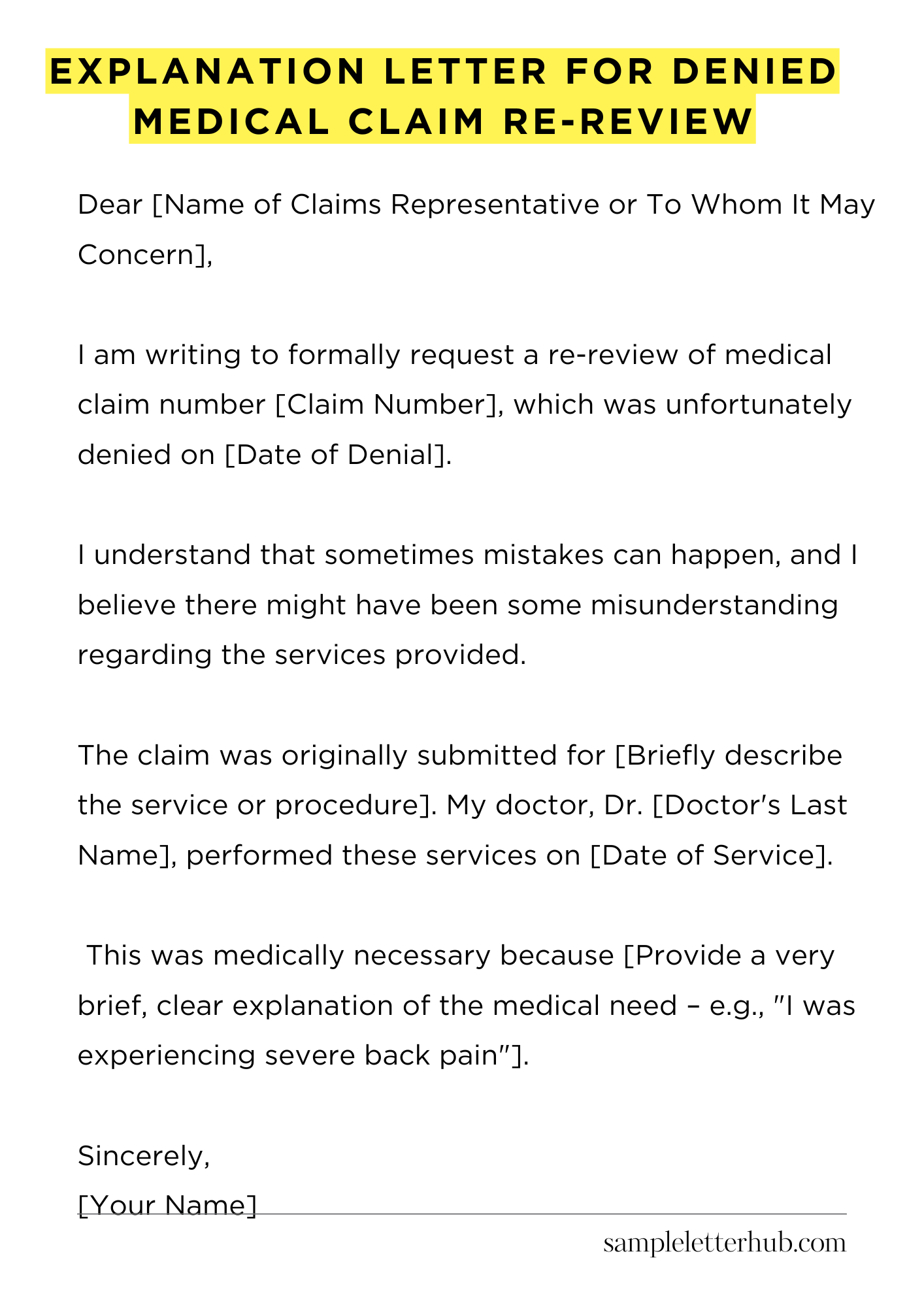
Dear [Name of Claims Representative or To Whom It May Concern],
I am writing to formally request a re-review of medical claim number [Claim Number], which was unfortunately denied on [Date of Denial]. I understand that sometimes mistakes can happen, and I believe there might have been some misunderstanding regarding the services provided.
The claim was originally submitted for [Briefly describe the service or procedure]. My doctor, Dr. [Doctor’s Last Name], performed these services on [Date of Service]. This was medically necessary because [Provide a very brief, clear explanation of the medical need – e.g., “I was experiencing severe back pain”].
The denial notice stated that [State the reason for denial as given in the denial letter]. I respectfully disagree with this decision. I have attached the following documents to support my claim: [List the documents you are attaching – e.g., “A copy of the original claim form.”
The letter from my doctor explicitly details the medical necessity for the procedures and confirms that these were standard and appropriate treatments for my condition. The attached test results further support this.
I am confident that upon re-evaluation, the claim will be approved. I kindly request that you review the attached materials carefully. Please let me know if you require any additional information from me or my healthcare provider.
Thank you very much for your time and consideration in this matter. I appreciate your prompt attention to this request.
Sincerely,
[Your Name]
How to Write Explanation Letter for Denied Medical Claim Re-Review
A denied medical claim can feel like a labyrinthine nightmare, a frustrating maze of paperwork and jargon. Don’t despair. You can dispute the denial.
This guide, a practical primer on navigating this complex process, equips you with the tools to write a compelling explanation letter that advocates for your right to receive the medical benefits you deserve.
1. Scrutinize the Denial Notice
The initial step is to thoroughly examine the denial notice. Scour it for clues. Identify the precise reasons the insurance company cited for denying your claim. This is paramount.
Look for the specific codes, such as CPT or ICD-10 codes, used by the provider and insurance company. They are crucial for framing your rebuttal. Decipher the insurance company’s explanations.
Perhaps they claim the procedure was not medically necessary, or that pre-authorization was lacking. Note any supporting documentation the insurer recommends providing.
2. Gather Pertinent Documentation
Amass all the documentation that can bolster your case. This is where your meticulousness truly shines. These vital documents act as the bedrock of your claim. This may include detailed medical records.
These should encompass physician notes, diagnostic test results, and any operative reports. Any evidence showcasing the medical necessity of the treatment you received should be compiled.
Obtain letters of medical necessity from your doctor. Compile any supporting evidence for your claim, such as copies of prior correspondence, invoices, and the original claim form.
3. Craft a Clear and Concise Opening
Commence your letter with a clear and concise introduction. This is your chance to make a strong first impression. State the purpose of your letter upfront, explicitly identifying the denied claim and providing its reference number.
Include your full name, your insurance policy number, and the date. You must make it easily understandable for the recipient. Be polite, but assertive. State your case without superfluous verbiage. It should be a crisp and professional opening.
4. Address the Specific Reasons for Denial
Here is where you directly counter the insurance company’s arguments. Methodically address each reason for denial, one by one. Refer to the specific denial codes to show you know what the issue is.
Provide clear and irrefutable evidence. If the denial cites a lack of medical necessity, meticulously explain why the treatment was, in fact, necessary. Quote directly from your physician’s notes. Provide relevant medical literature or guidelines. Show, don’t just tell. For each point of contention, offer a persuasive rebuttal based on factual evidence.
5. Present Supporting Evidence Strategically
Cleverly integrate your supporting documentation into your arguments. Don’t simply dump a pile of papers on them; instead, use the documentation to reinforce your points.
When citing medical records, include page numbers and specific quotes to guide the reader. If you are citing medical literature, be sure to include the source (e.g., journal name, date).
Organize your documentation in a logical and easy-to-follow sequence, cross-referencing it to the points you make in your letter. Make sure your references are impeccable, and make it easy for the reviewer to locate the evidence.
6. Maintain a Professional and Persuasive Tone
Throughout the letter, maintain a professional and persuasive tone. Use clear and unambiguous language. Avoid emotive language that could undermine your credibility.
Stay focused on the facts and the medical evidence. Demonstrate your knowledge of the situation by using relevant medical terminology. This showcases your understanding and adds weight to your arguments. Be persistent, yet cordial.
7. Conclude and Request a Re-evaluation
Close your letter with a clear and definitive request for a re-evaluation of your claim. Restate the claim number and clearly reiterate your desired outcome, such as the approval of the claim.
Reiterate your supporting documentation. Include your contact information. Express gratitude for their time and consideration. You must make it easy for them to contact you, as well. Sign and date your letter. By following these steps, you’ll increase your chances of a successful re-review.
FAQs about Explanation Letter for Denied Medical Claim Re-Review
What is an Explanation Letter for a Denied Medical Claim Re-Review?
An Explanation Letter for a Denied Medical Claim Re-Review is a formal written document that you, or your healthcare provider, submit to your insurance company.
This letter explains why you believe a previously denied medical claim should be reconsidered. It provides supporting documentation and arguments to overturn the initial denial, advocating for the claim’s approval and subsequent payment.
What information should be included in the Explanation Letter?
The Explanation Letter should include essential details such as the patient’s name, policy number, claim number, and the date of service. It must clearly state the reason for the re-review, directly addressing the insurance company’s denial reason.
Provide detailed medical information, relevant medical records (e.g., test results, doctor’s notes, etc.), and any other supporting evidence. You might also need to refer to your insurance policy benefits or specific medical guidelines to help bolster your case.
Who typically writes the Explanation Letter?
The letter can be written by either the patient, the patient’s physician, or a healthcare provider involved in the treatment. It’s often most effective for the treating physician to draft the letter, as they have direct knowledge of the medical necessity and can use their professional medical expertise to support the claim.
However, the patient can write the letter themselves, especially if the denial relates to non-medical issues such as a coding or billing error.
What are the common reasons for medical claim denials that warrant a re-review?
Claim denials often occur for several reasons, including a lack of medical necessity, pre-existing condition exclusions, coding errors, incorrect billing information, lack of prior authorization, and exceeding plan benefits.
Other reasons might include insufficient documentation, experimental or investigational treatments, and services considered not medically appropriate by the insurer. Addressing the specific reason provided in the denial notice is crucial when composing your re-review letter.
How do I submit the Explanation Letter and associated documentation for a re-review?
The submission method varies by insurance provider. Check the denial notice for instructions, which may include mailing addresses, email addresses, or online portals.
Ensure you submit the letter and all supporting documentation within the appeal timeframe specified in the denial letter, typically 60-180 days. Keep a copy of the letter and all supporting documents for your records, along with proof of submission (e.g., certified mail receipt or electronic confirmation).
Related:
Resignation letter due to rude boss
Resignation letter moving to another state
Resignation letter due to illness of family member
Resignation letter due to study