

An explanation letter for a single-vehicle accident is a written document. It explains the circumstances of a car accident. This letter is often needed for insurance claims. The purpose is to provide clarity. It can also help with legal processes.
Dealing with an accident is stressful. Writing this kind of letter can be tough. Don’t worry, we’re here to help you. We will share explanation letter templates. You’ll find examples and samples too.
These explanation letter samples are easy to follow. They help you write your own explanation letter for a single-vehicle accident. Use them to draft the perfect letter. We’ll make it simple for you.
[Your Name/Company Name (If Applicable)]
[Your Address]
[Your Phone Number]
[Your Email Address]
[Date]
[Recipient’s Name/Insurance Company]
[Recipient’s Address]
Dear [Recipient’s Name/Insurance Company],
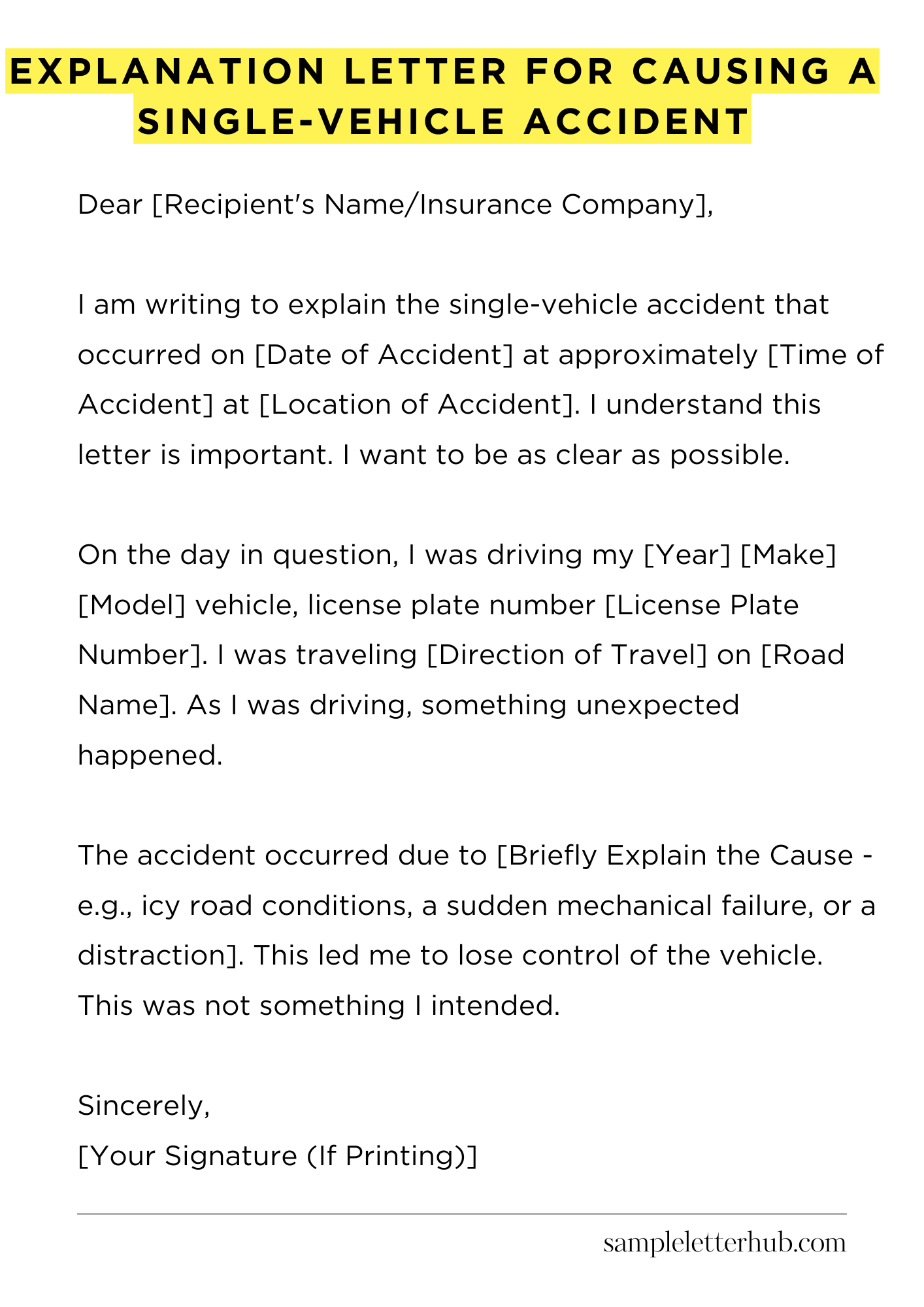
I am writing to explain the single-vehicle accident that occurred on [Date of Accident] at approximately [Time of Accident] at [Location of Accident]. I understand this letter is important. I want to be as clear as possible.
On the day in question, I was driving my [Year] [Make] [Model] vehicle, license plate number [License Plate Number]. I was traveling [Direction of Travel] on [Road Name]. As I was driving, something unexpected happened.
The accident occurred due to [Briefly Explain the Cause – e.g., icy road conditions, a sudden mechanical failure, or a distraction]. This led me to lose control of the vehicle. This was not something I intended.
The vehicle then [Describe the sequence of events – e.g., veered off the road, collided with a fixed object, etc.]. Thankfully, no other vehicles or individuals were involved in the accident, and I am grateful for that. I am also thankful that my injuries were minor.
After the accident, I immediately [Actions taken after the accident – e.g., contacted the authorities, exchanged information, etc.]. I cooperated fully with the police and provided them with all necessary information. I tried to follow all the correct protocols.
I understand the importance of this matter and am taking full responsibility for the incident. I have already [Actions taken since the accident – e.g., contacted my insurance company, had my vehicle assessed for damages, etc.]. I have also considered the potential impacts.
I am committed to ensuring that such an event does not happen again. I understand that accidents happen. I appreciate your understanding in this matter.
Sincerely,
[Your Signature (If Printing)]
How to Write an Explanation Letter for Causing a Single-Vehicle Accident
A single-vehicle accident, a perplexing event that invariably demands a well-crafted explanation letter. This missive serves as your formal narrative, outlining the circumstances that precipitated the unfortunate incident.
Crafting a cogent and persuasive account is paramount; it can influence insurance claims, legal proceedings, and, most importantly, your peace of mind. Here’s how to navigate this crucial process.
1. Commence with a Formal Salutation and Identification
Begin your letter with a formal salutation; use “To Whom It May Concern” or, if applicable, the specific recipient’s title and name. Directly after the salutation, immediately identify yourself.
Explicitly state your full name, address, and any pertinent identifiers like your driver’s license number or the policy number associated with your vehicle insurance. This introductory section establishes the crucial framework.
2. The Chronological Recount: Detailing the Accident’s Genesis
This is where you weave the tapestry of events. Start at the beginning, preceding the moment of impact. Detail your activities immediately before the accident. Be meticulously precise about the time, location, and prevailing weather conditions.
Explain the conditions of the roads you were traveling on at that moment. Provide a chronological narrative, detailing each action. This is crucial for painting a clear picture.
3. Pinpointing the Precipitating Factor: Unveiling the Catalyst
Here, you identify the primary reason for the accident. Objectively address what triggered the incident. Did you swerve to avoid an animal? Was visibility significantly impaired by inclement weather?
Did you succumb to a lapse in concentration? Honesty is crucial here. Do not obfuscate; a transparent account, even of your own culpability, garners more credibility than a half-truth.
4. Describing the Physics of the Mishap: Articulating the Impact
Provide a clear account of the accident’s physical dynamics. Detail what happened when your vehicle collided with an object, a road, or the land surrounding it. Include what your car hit.
Mention the position of the car. Elaborate on the movements and trajectory of your vehicle from the moment of impact until it came to rest. A concise understanding of the accident’s physical reality helps bolster the validity of your explanation.
5. Post-Accident Actions and Observations: Documenting the Aftermath
Detail your immediate actions post-accident. Did you alert authorities? Did you exchange information with other parties? Describe any injuries sustained or observed.
Document any immediate observations you made at the scene, such as damage to your vehicle, signs of environmental hazards. This phase is about the immediate aftermath and ensures that you have all the facts in order.
6. The Concluding Affirmation and Expression of Regret
Conclude your letter with a sincere expression of regret for the accident. Acknowledge any damage or inconvenience caused. Reiterate your cooperation with any investigation or process.
Ensure that your account is honest and free of any contradictions. This closure reinforces your sincerity and willingness to accept responsibility.
7. Finalization: Review, Sign, and Secure
Before submitting, thoroughly review your entire explanation letter. Ensure all information is accurate, factually sound, and easy to understand. Proofread it meticulously for any grammatical errors or typos.
Sign the document. Make a copy for your records, keeping a duplicate for your files. This meticulous approach guarantees a well-prepared and defensible explanation.
FAQs about Explanation Letter for Causing a Single-Vehicle Accident
What is the purpose of an explanation letter for a single-vehicle accident?
The primary purpose of an explanation letter is to provide a detailed account of the events leading up to a single-vehicle accident. This letter aims to clarify the circumstances surrounding the incident, offering context for why the accident occurred.
It is often submitted to insurance companies, law enforcement, or other relevant parties to explain your actions and the factors that contributed to the accident.
What information should be included in an explanation letter?
A comprehensive explanation letter should include the date and time of the accident, the exact location, and a clear and concise description of the events leading up to the crash. This should include the road conditions, weather conditions, your speed, any distractions, and your driving behavior before the accident.
Importantly, the letter should state the cause of the accident according to your understanding. You should also include any witness information and whether there were any injuries or damage to the vehicle. Be sure to provide the make and model of the vehicle and your insurance information.
How can I write a clear and effective explanation letter?
To write an effective letter, be factual, and objective, and avoid speculation. Start with a brief summary of the accident, then provide a chronological account of the events. Be as detailed as possible without being overly verbose.
Use clear and simple language, and proofread carefully for grammar and spelling errors. Remain calm and factual. If you’re unsure how to phrase something, consider consulting with a legal professional or insurance representative.
What are the potential consequences of not writing or providing an inadequate explanation letter?
Failure to provide an explanation letter, or providing an inadequate one, can have several negative consequences. Your insurance claim may be denied, as they may lack sufficient information to understand the circumstances.
It could lead to increased insurance premiums in the future, if they deem you at fault. In more serious cases, especially if there were injuries or significant property damage, it could lead to legal action.
When should I seek legal advice regarding an explanation letter?
It’s advisable to seek legal advice if you believe there’s a chance you may be held liable for the accident. This is particularly important if there were any injuries, significant property damage, or if you are unsure of the legal implications of your statements.
A lawyer can advise you on how to best protect your interests and ensure that your explanation letter accurately reflects the events while considering the legal implications.
Related:
Resignation letter due to rude boss
Resignation letter moving to another state
Resignation letter due to illness of family member
Resignation letter due to study