

An Executive Sales resignation letter is a formal document. It announces your departure from a high-level sales role. The letter’s purpose is to officially inform your employer. It also communicates your last day of employment. It needs to be professional and respectful.
This situation calls for a carefully written letter. We will make it easier for you. We are providing several templates. These templates offer different approaches. You can customize them for your specific situation.
Think of it as your writing toolkit. Use these samples as starting points. Adapt them to fit your needs. Writing this letter doesn’t have to be hard. We’ve got you covered.
Executive Sales Resignation Letter
Below is a sample of a Executive Sales Resignation Letter:
[Your Name]
[Your Address]
[Your Phone Number]
[Your Email Address]
[Date]
[Recipient Name]
[Recipient Title]
[Company Name]
[Company Address]
Dear [Mr./Ms./Mx. Last Name],
Please accept this letter as formal notification that I am resigning from my position as Executive Sales at [Company Name]. My last day of employment will be [Your Last Day of Employment].
I would like to thank you for the opportunity to work at [Company Name] over the past [Number] years/months. I have learned a great deal and appreciate the experiences I’ve gained.
I am committed to ensuring a smooth transition during my departure. I am happy to assist in training my replacement and completing any outstanding tasks to the best of my ability.
I wish you and the company all the best in the future.
Sincerely,
[Your Signature]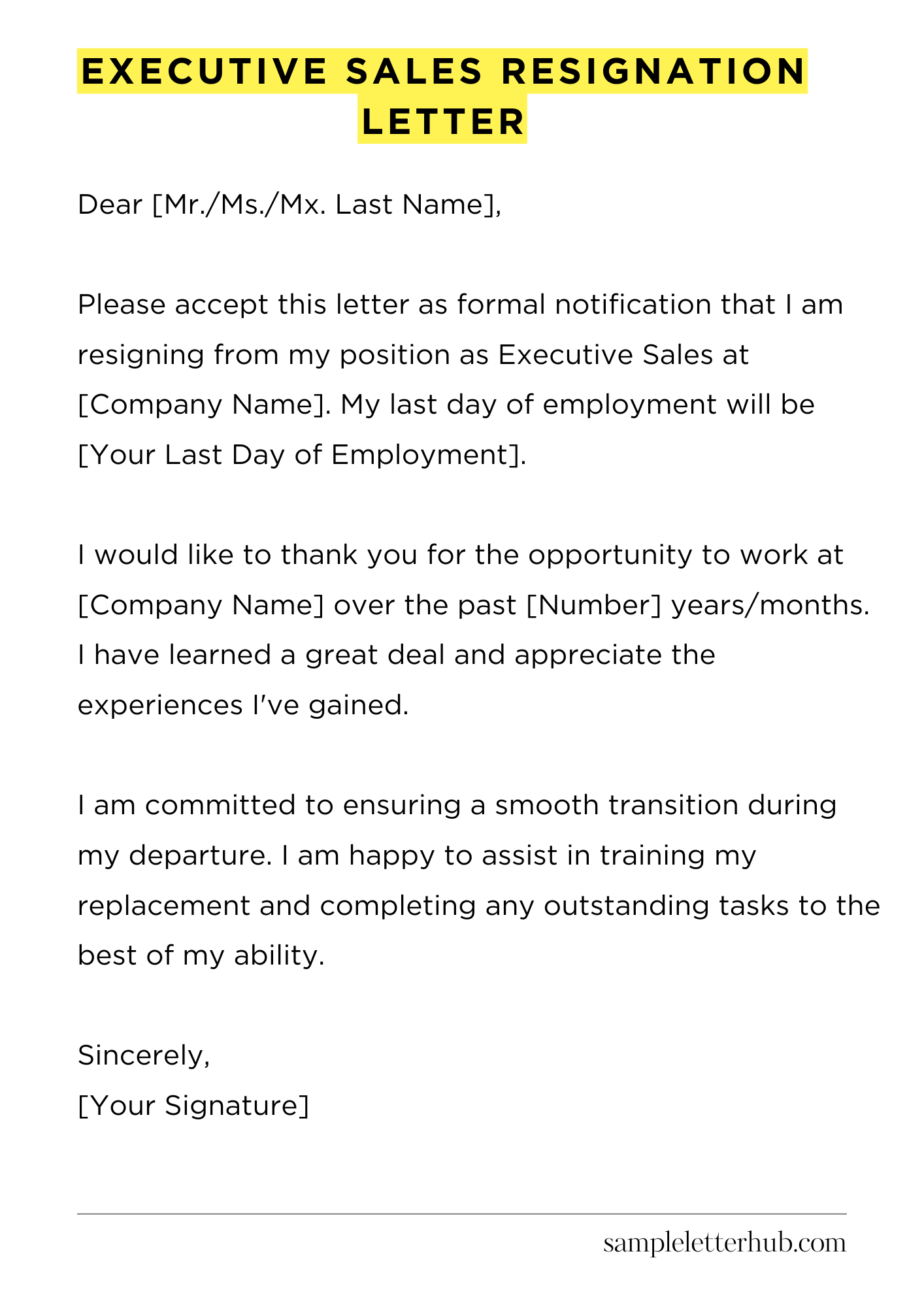
How to Write an Executive Sales Resignation Letter
Resigning from an executive sales position is a big move. It’s a critical moment, and you need to handle it with grace and professionalism. Your resignation letter is a crucial part of that process. It’s your last official communication. You want to ensure it reflects well on you. Here’s a breakdown of how to craft an impactful letter that serves its purpose.
1. Keep It Concise and Clear
Don’t beat around the bush. State your intention to resign clearly and directly. The purpose of this letter is straightforward: to inform your employer of your departure. Get right to the point. A concise letter is more effective. Be brief, but ensure you include essential details.
Begin by stating your formal resignation. Mention the date of your last day of employment. This is crucial for the company to process your departure correctly. Avoid overly verbose language. Remember, brevity and clarity are your allies here.
2. Express Gratitude and Professionalism
Even if you’re leaving due to negative experiences, it’s best to maintain a professional tone. Express your gratitude for the opportunity to work at the company. A simple “Thank you for the opportunity” can go a long way. Consider acknowledging any valuable experiences you gained. This demonstrates respect for the company and the people you’ve worked with.
Avoid any negativity or complaints about your job or colleagues. This is not the appropriate place for venting. Instead, focus on the positive aspects of your time there, even if you’re eager to move on.
3. Provide Necessary Information and Offer Assistance
Include details about your last day of employment. Ensure this aligns with your employment agreement or any company policy. This helps ensure a smooth transition. Consider offering assistance during the handover process. This is a classy move that leaves a lasting positive impression. Offer your help to train your replacement or to complete any urgent tasks.
Outline any necessary handover plans. This shows your commitment to a smooth transition. Providing contact information for future communication can also be helpful. It’s professional. This shows you are dedicated to ensuring a seamless exit.
4. Format and Tone: The Key to a Good Impression
Format your letter professionally. Use a standard business letter format. Include your contact information, the date, and the recipient’s information. Choose a professional font like Times New Roman or Arial. Keep the tone formal and respectful.
Proofread the letter carefully for any spelling or grammatical errors. Before you send it, carefully check it over. The tone should remain positive, even if you are leaving on less-than-ideal terms. Your goal is to maintain a professional reputation. This will serve you well in the future.
5. Review and Revise Before Submission
Before you send your resignation letter, take a moment to review it carefully. Read it aloud. Does it convey the message you intend? Does it sound professional and respectful? Does it say what you want it to say? Make any necessary revisions to ensure it reflects your best self.
Consider asking a trusted colleague or friend to review the letter. A fresh pair of eyes can often catch errors or suggest improvements. This final step can help you ensure the letter is polished and professional before you send it. This can make all the difference in the world.
FAQs about Executive Sales Resignation Letter
What is the primary purpose of an executive sales resignation letter?
The primary purpose of an executive sales resignation letter is to formally notify an employer of an executive sales professional’s intent to leave their position. It serves as a legal record of the resignation, and it provides an opportunity to express gratitude, highlight accomplishments, and outline the departure process.
What key elements should be included in an executive sales resignation letter?
Key elements include a clear statement of resignation, the effective date of departure, a brief expression of gratitude for the opportunity, and optional acknowledgment of specific achievements or positive experiences. Additionally, it should detail any outstanding responsibilities and offer assistance with the transition process.
How much notice should an executive sales professional give when resigning?
The standard is generally two to four weeks. However, the required notice period can vary depending on the employment contract, company policy, and the seniority of the role. For executive-level positions, a longer notice period, such as a month or more, is often expected to allow for a smoother handover.
Should an executive sales resignation letter mention the reasons for leaving?
While not mandatory, it’s advisable to keep the reasons concise, professional, and positive. You can briefly mention a career change, better opportunity, or personal reasons, avoiding any negative comments about the company or colleagues. This ensures a more amicable departure and preserves a good professional reputation.
How should an executive sales resignation letter be delivered and to whom?
The resignation letter should be delivered formally, typically to the immediate supervisor, the head of sales, or Human Resources, depending on company protocol. It should be delivered in writing, either as a printed document or an email, and a copy should be kept for personal records. It is often beneficial to follow up the written letter with a face-to-face conversation.
Related:
Resignation letter due to rude boss
Resignation letter moving to another state
Resignation letter due to illness of family member
Resignation letter due to study