

An Executive Coordinator resignation letter is a formal document. It informs the employer of your intent to leave. Its purpose is to officially announce your departure. It also details the last day of your employment.
Writing a resignation letter can be tricky. You want to be professional and clear. We’re here to help! We’ll provide different templates. You can use them as a starting point.
These samples make the process simpler. Choose the one that suits your needs. You can easily adapt them. Craft your own polished resignation letter quickly.
Executive Coordinator Resignation Letter
Below is a sample of a Executive Coordinator Resignation Letter:
[Your Name]
[Your Address]
[Your Phone Number]
[Your Email Address]
[Date]
[Recipient Name]
[Recipient Title]
[Company Name]
[Company Address]
Dear [Recipient Name],
Please accept this letter as formal notification that I am resigning from my position as Executive Coordinator at [Company Name]. My last day of employment will be [Your Last Day of Employment].
I would like to express my gratitude for the opportunities I have been given during my time here. I have learned a great deal and appreciate the experiences I have gained.
I am committed to ensuring a smooth transition during my departure. I am happy to assist in training my replacement and completing any outstanding tasks.
I wish the company continued success in the future.
Sincerely,
[Your Name]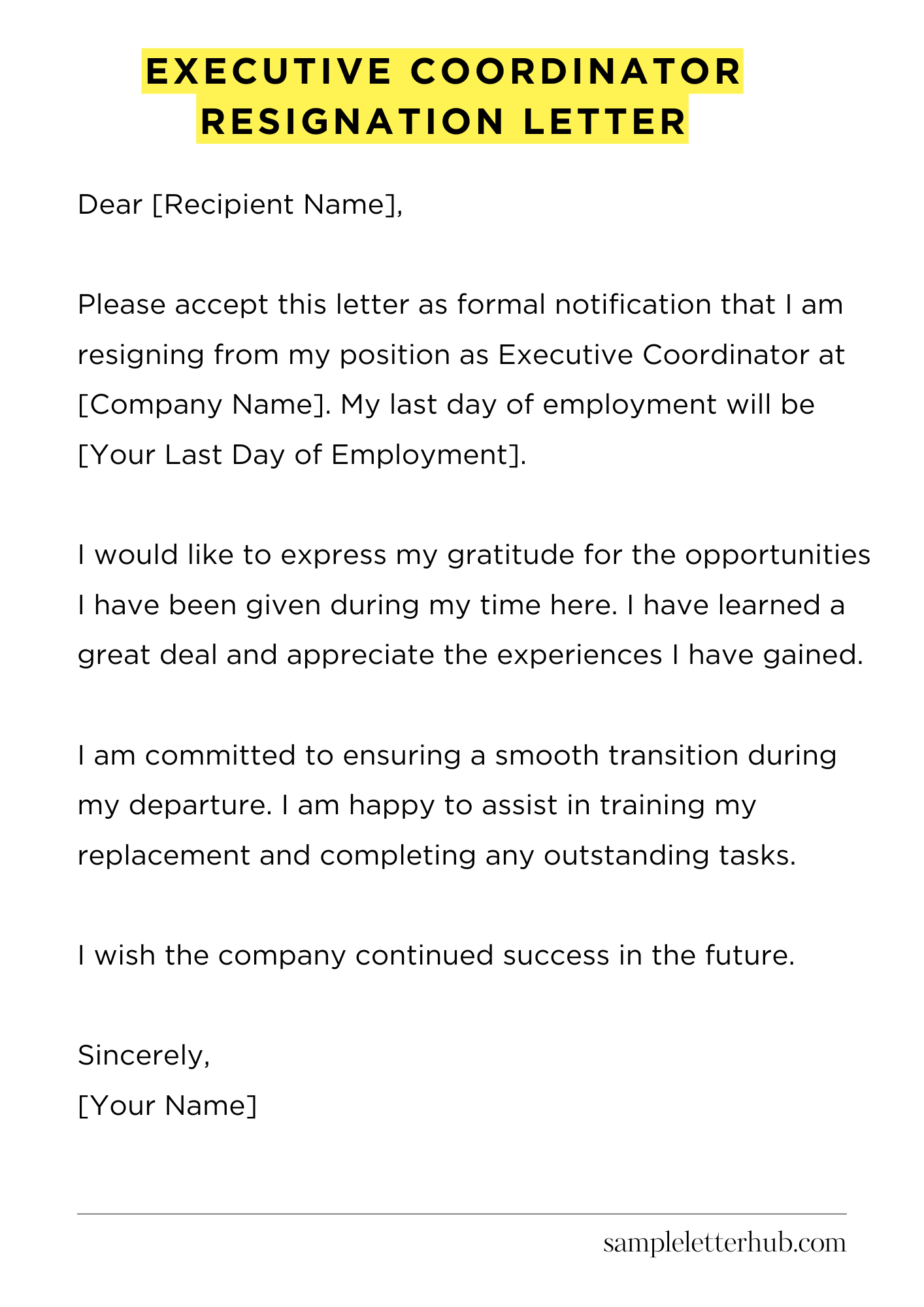
How to Write Executive Coordinator Resignation Letter
Know the Basics Before You Start
Resigning from a job, any job, requires a certain level of professionalism. An Executive Coordinator position is no exception. Before you even think about putting pen to paper (or fingers to keyboard), take a deep breath. Reflect on your experiences. You will need to address your supervisor directly. It’s often best to keep things concise and positive.
Your resignation letter is a formal document, a record of your departure. Keep it clear, polite and factual. No need to bring in unnecessary drama!
Crafting the Core of Your Letter
Let’s get down to the practicalities. Your letter needs a few key elements. First, state your intention to resign. This should be clear and unequivocal. The date of your resignation is crucial. Specify the last day you will be working. Next, express your gratitude for the opportunity. Mentioning specific experiences you enjoyed can be helpful.
A brief acknowledgment of your reason for leaving can be included. However, avoid going into excessive detail. Offer assistance with the transition. Finally, end with a polite closing, expressing your best wishes. Don’t forget to add your name! A typed letter is the norm.
Formatting and Tone: Professionalism is Key
Presentation matters. Begin with your contact information and the date. Address the letter to your supervisor or the appropriate person in the company. Use a formal tone throughout the letter.
Avoid slang and casual language. Keep paragraphs short and easy to read. Proofread meticulously! Typos and grammatical errors undermine your professionalism. Aim for a tone that is respectful, positive, and forward-looking. Remember, you want to leave a good impression.
What to Include (and What to Avoid)
Essential components include your formal resignation statement, the effective date, and a thank you to the company. Be specific. Mention any projects you contributed to. If possible, offer to help train your replacement. Do not include negativity. Avoid venting about your grievances, even if you have them.
Resist the urge to criticize your employer or colleagues. Your letter should focus on the future. Maintain a positive attitude. Personal attacks have no place in a professional resignation letter.
Example Resignation Letter Structure
Here’s a basic framework you can adapt:
[Your Name]
[Your Address]
[Your Phone Number]
[Your Email]
[Date]
[Recipient’s Name]
[Recipient’s Title]
[Company Name]
[Company Address]
Dear [Recipient’s Name],
Please accept this letter as formal notification that I am resigning from my position as Executive Coordinator at [Company Name]. My last day of employment will be [Your Last Day].
I would like to express my gratitude for the opportunities I have been given during my time here. I have greatly valued my experience and the skills I have developed.
I am happy to assist with the transition process in any way I can, including training my replacement.
I wish you and [Company Name] all the best in the future.
Sincerely,
[Your Signature]
[Your Typed Name]
FAQs about Executive Coordinator resignation letter
How do I start my Executive Coordinator resignation letter?
Start your resignation letter with a clear and concise statement of your intent to resign from your position as Executive Coordinator. Include the date of your resignation. Address the letter to your immediate supervisor or the appropriate person in your organization (e.g., HR representative).
What key information should be included in an Executive Coordinator resignation letter?
Your letter should include your formal resignation, the effective date of your departure, a brief expression of gratitude for the opportunity to work at the company, and any relevant details regarding the handover of your responsibilities. It’s also polite to offer assistance in the transition period.
Should I provide a reason for resigning in my Executive Coordinator resignation letter?
While you are not obligated to provide a specific reason for your resignation, it’s often courteous to offer a general explanation. You can keep it brief and professional, focusing on the direction of your career or personal circumstances. Avoid negative comments about the company or your colleagues.
How long should my Executive Coordinator resignation letter be?
Keep your resignation letter concise and professional. Aim for a length of one page. Focus on the necessary information: your intent to resign, your last day of employment, a brief expression of gratitude, and an offer to assist with the transition.
What is the proper format for an Executive Coordinator resignation letter?
Use a formal business letter format. Include your contact information (name, address, phone number, email) at the top, followed by the date, the recipient’s name and title, and the company’s address. Use a professional font such as Times New Roman or Arial, and maintain a clear, easy-to-read layout.
Related:
Resignation letter due to rude boss
Resignation letter moving to another state
Resignation letter due to illness of family member
Resignation letter due to study