

An Executive Administrative Assistant resignation letter is a formal document. It informs your employer of your intention to leave your job. It serves as an official record of your departure.
Writing such a letter can feel daunting. We’re here to help ease the process. We’ve gathered different templates for you. They cover various scenarios and situations.
This article provides helpful examples. You’ll find samples ready to use. They will guide you in crafting your own perfect resignation letter.
Executive Administrative Assistant Resignation Letter
Below is a sample of a Executive Administrative Assistant Resignation Letter:
[Your Name]
[Your Address]
[Your Phone Number]
[Your Email Address]
[Date]
[Recipient Name] (If known, otherwise use title)
[Recipient Title]
[Company Name]
[Company Address]
Dear [Mr./Ms./Mx. Last Name],
Please accept this letter as formal notification that I am resigning from my position as Executive Administrative Assistant at [Company Name]. My last day of employment will be [Your Last Day of Employment].
I would like to express my sincere gratitude for the opportunity to work at [Company Name] for the past [Number] years/months. I have enjoyed my time here and have learned a great deal.
I am committed to ensuring a smooth transition during my departure. I am happy to assist in training my replacement and completing any outstanding tasks to the best of my ability before my last day.
I wish you and the company continued success in the future.
Sincerely,
[Your Signature]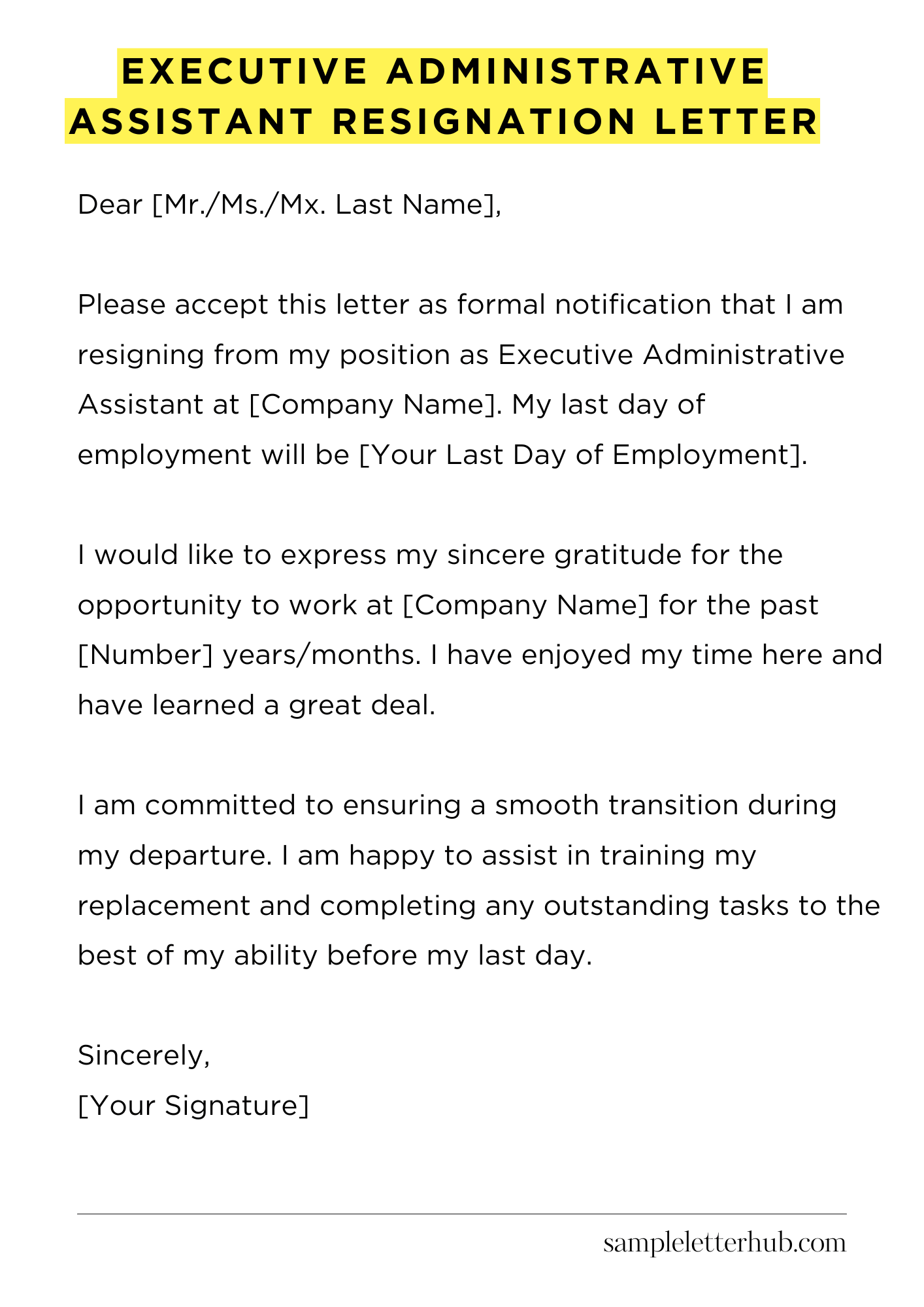
How to Write an Executive Administrative Assistant Resignation Letter
Start with a Professional Tone
Okay, let’s get down to business. You’ve made the decision, and now it’s time to resign from your position as an Executive Administrative Assistant. First things first: keep it professional, always. Your resignation letter is a formal document. Think of it as a bridge, a way to leave on good terms, hopefully.
Begin with a polite and direct statement of your intent to resign. State your name and your position clearly. This helps avoid any confusion about who exactly is stepping down. The tone should remain respectful, no matter your feelings. That is the best approach.
State Your Effective Date of Resignation
This is a crucial detail and needs to be crystal clear. Include the specific date your resignation takes effect. This allows your employer to start planning for your departure.
Be sure to adhere to your employment contract’s stipulations regarding notice periods. Generally, two weeks is considered standard, but your contract may require more. Be sure to adhere to company policies, too. This is not the time to “wing it.”
Express Gratitude and Briefly Explain (Optional)
Show some appreciation, it is just smart. Thank your employer for the opportunity to have worked there. Mention specific experiences or skills you gained. This reinforces that you valued your time in the role. You can also briefly explain the reason for your departure if you wish. This is optional. Keep it brief.
For instance, you could simply state you are pursuing another opportunity. No need to go into too much detail. Make sure to stay positive, always.
Offer Assistance with the Transition
Help make the transition smoother. Offer your assistance in training your replacement. This shows you are willing to cooperate. This demonstrates your professionalism and commitment, even on the way out. You can also offer to help with any pending tasks or projects to ensure a clean handover. This can leave a very positive lasting impression, and could make the difference.
Formal Closing and Contact Information
End the letter with a formal closing. Use phrases like “Sincerely,” “Respectfully,” or “Best regards.” Then, sign your name above the typed version. Include your contact information (phone number and email address), and make sure it is current. This is so your employer can easily reach you with any questions during your transition.
Don’t forget to proofread the letter carefully before submitting. Ensuring your letter is error-free enhances the impression you make.
FAQs about Executive Administrative Assistant resignation letter
Here are some of the most common questions regarding resignation letters for Executive Administrative Assistants, along with informative answers to assist you:
What essential information should I include in my Executive Administrative Assistant resignation letter?
Your resignation letter should contain: a clear statement of your intent to resign, the effective date of your resignation, a concise expression of gratitude for the opportunity, and any necessary information regarding the handover of responsibilities. It’s also advisable to include your contact information for future correspondence.
Avoid overly emotional language, focusing instead on professionalism and clarity.
How much notice should I give in my resignation letter?
The standard is typically two weeks’ notice, but this can vary based on your employment agreement, company policy, or the seniority of your role. Review your contract and company handbook to understand the required notice period. Giving more notice is generally considered professional and can leave a positive impression, even if it’s not contractually required.
Should I provide a reason for my resignation in the letter?
While not mandatory, you can briefly state your reason for leaving, if you choose. Keep it concise and professional, such as “to pursue other opportunities” or “for personal reasons”. Avoid detailed complaints or negative feedback. The focus of the letter should be on your departure, not on dissatisfaction with your previous employment.
How should I handle the handover of my duties in my resignation letter?
In your letter, you can express your willingness to assist with the transition. Mention your availability to train your replacement, document procedures, or provide any necessary support during your remaining time. This demonstrates a commitment to ensuring a smooth handover and maintaining a positive relationship with your employer.
What is the proper tone to use in my Executive Administrative Assistant resignation letter?
Maintain a professional and respectful tone throughout the letter. Express gratitude for the opportunity to work at the company and acknowledge any positive aspects of your experience.
Be courteous, even if you are leaving due to negative circumstances. A professional tone is crucial in maintaining a positive reputation and leaving a lasting impression on your employer.
Related:
Resignation letter due to rude boss
Resignation letter moving to another state
Resignation letter due to illness of family member
Resignation letter due to study