

An Estimator resignation letter is a formal document. It informs your employer of your intent to leave your job. The letter officially states your last day of employment. It’s a crucial step in ending your employment professionally.
Crafting the perfect resignation letter can be tricky. It needs to be clear and concise. We understand this. That’s why we’re here to help.
We’ve compiled various templates. You’ll find examples and samples. Use them to create your own resignation letter. Make the process simple and stress-free.
Estimator Resignation Letter
Below is a sample of a Estimator Resignation Letter:
[Your Name]
[Your Address]
[Your Phone Number]
[Your Email Address]
[Date]
[Recipient Name]
[Recipient Title]
[Company Name]
[Company Address]
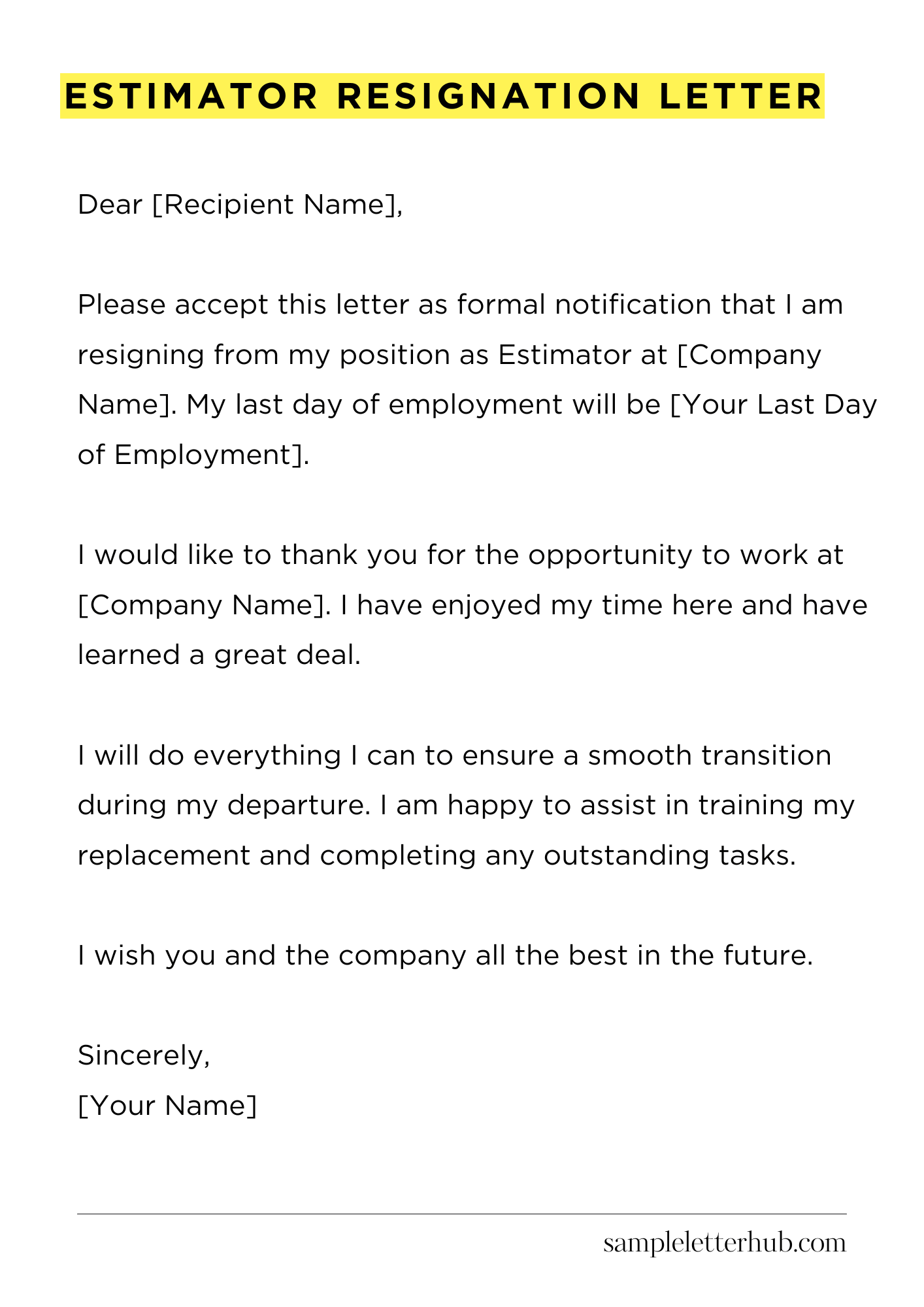
Dear [Recipient Name],
Please accept this letter as formal notification that I am resigning from my position as Estimator at [Company Name]. My last day of employment will be [Your Last Day of Employment].
I would like to thank you for the opportunity to work at [Company Name]. I have enjoyed my time here and have learned a great deal.
I will do everything I can to ensure a smooth transition during my departure. I am happy to assist in training my replacement and completing any outstanding tasks.
I wish you and the company all the best in the future.
Sincerely,
[Your Name]
How to Write an Estimator Resignation Letter
So, you’re moving on! Congratulations on taking the next step in your career. Deciding to resign from your position as an estimator is a big decision. Before you bid farewell, you’ll need to formally announce your departure. This is where your resignation letter comes in. A well-written resignation letter is crucial.
It’s not just a formality; it reflects your professionalism. It will also help you leave a positive lasting impression. Follow these simple steps for a clear and effective letter.
1. Start with the Basics: The Formalities
First things first. You need to get the basics right. Your resignation letter needs to be formal. Start by including the date. Then, address the letter to your direct supervisor or the appropriate person in the company (like HR).
You must include the date of your last day of employment. This is vitally important. Be sure to use a professional and respectful tone throughout the letter.
Here’s a quick example.
[Your Name]
[Your Address]
[Your Phone Number]
[Your Email Address]

[Date]

[Recipient's Name]
[Recipient's Title]
[Company Name]
[Company Address]

Dear [Mr./Ms./Mx. Recipient's Last Name],

Please accept this letter as formal notification that I am resigning from my position as Estimator at [Company Name]. My last day of employment will be [Your Last Day of Employment].
2. State Your Intention Clearly and Concisely
Get straight to the point. The first paragraph should state your intention to resign. Avoid any beating around the bush. You can, for instance, mention the position you are leaving. Make it clear and simple. Remember, brevity is a virtue here. The letter is about your departure. Don’t include unnecessary details that might cause confusion. Be direct.
3. Express Gratitude (Optional, but Recommended)
This is where you show some appreciation. It’s always a good idea to express gratitude. Consider this a great opportunity. Thank your employer for the opportunity. You can mention specific experiences or skills you gained.
This will leave a positive impression. You don’t need to write an essay. A sentence or two about your time at the company does the job. It’s a nice touch that reflects well on you. This small gesture can go a long way in maintaining a positive relationship.
4. Offer Assistance with the Transition
This is where you show commitment. Offer to help with the transition. Be willing to assist in training your replacement. Or, you can document ongoing projects. Your willingness to help will show your professionalism. It can also help smooth the handover process. This is not always necessary.
This kind gesture helps build a positive relationship with your employer. Provide any necessary assistance. Make sure you are making the departure as smooth as possible.
5. Close with a Professional Closing
Wrap it up professionally. You need to use a standard, professional closing. This could be “Sincerely,” or “Respectfully,” followed by your full name. Also, make sure you sign the letter. You can optionally include your typed name below your signature. After this, you are good to go!
Proofread your letter carefully before submitting it. Ensure everything is accurate and clear. Remember, this letter is a reflection of you and your professionalism.
FAQs about Estimator Resignation Letter
What is the primary purpose of an Estimator resignation letter?
The primary purpose of an Estimator resignation letter is to formally notify the employer of the employee’s intent to leave their position. It serves as an official record of the resignation, the last day of employment, and can include other pertinent details.
What key information should be included in an Estimator resignation letter?
An effective Estimator resignation letter should include: the employee’s name and job title, the formal statement of resignation, the effective date of resignation (last day of employment), a brief expression of gratitude (optional), and the employee’s signature.
Is it necessary to provide a reason for resignation in the letter?
While not mandatory, providing a reason for resignation is optional. However, if the employee feels it is appropriate or necessary, they may briefly state the reason. Common reasons include accepting a new job, pursuing further education, or personal circumstances. Keeping it concise and professional is key.
How should an Estimator address any ongoing projects or handover responsibilities in the letter?
The letter should briefly address the handover of responsibilities. Estimators may offer assistance in training a replacement, completing outstanding tasks, or providing any necessary documentation to ensure a smooth transition. Specificity here depends on company policy and the employee’s discretion.
What is the appropriate tone and format for an Estimator resignation letter?
The tone should be professional and courteous. The format should be clear and concise. The letter should be typed, well-formatted, and free of grammatical errors. It’s best to maintain a positive and professional relationship, leaving the company on good terms, if possible.
Related:
Resignation letter due to rude boss
Resignation letter moving to another state
Resignation letter due to illness of family member
Resignation letter due to study