

So, you’re an estate agent, and it’s time to move on? You’ll need an “Estate Agent Resignation Letter.” This document formally tells your employer that you’re leaving. It officially ends your employment. It’s a crucial step.
Crafting the perfect letter can feel daunting. We can help ease the process. We provide various templates. These templates offer different styles. Consider them your starting points.
This guide will offer several examples. Choose the one that suits your needs. Adapt it to your situation. Make your exit smooth and professional. Let’s get you started.
Estate Agent Resignation Letter
Below is a sample of a Estate Agent Resignation Letter:
[Your Name]
[Your Address]
[Your Phone Number]
[Your Email Address]
[Date]
[Estate Agent Company Name]
[Estate Agent Company Address]
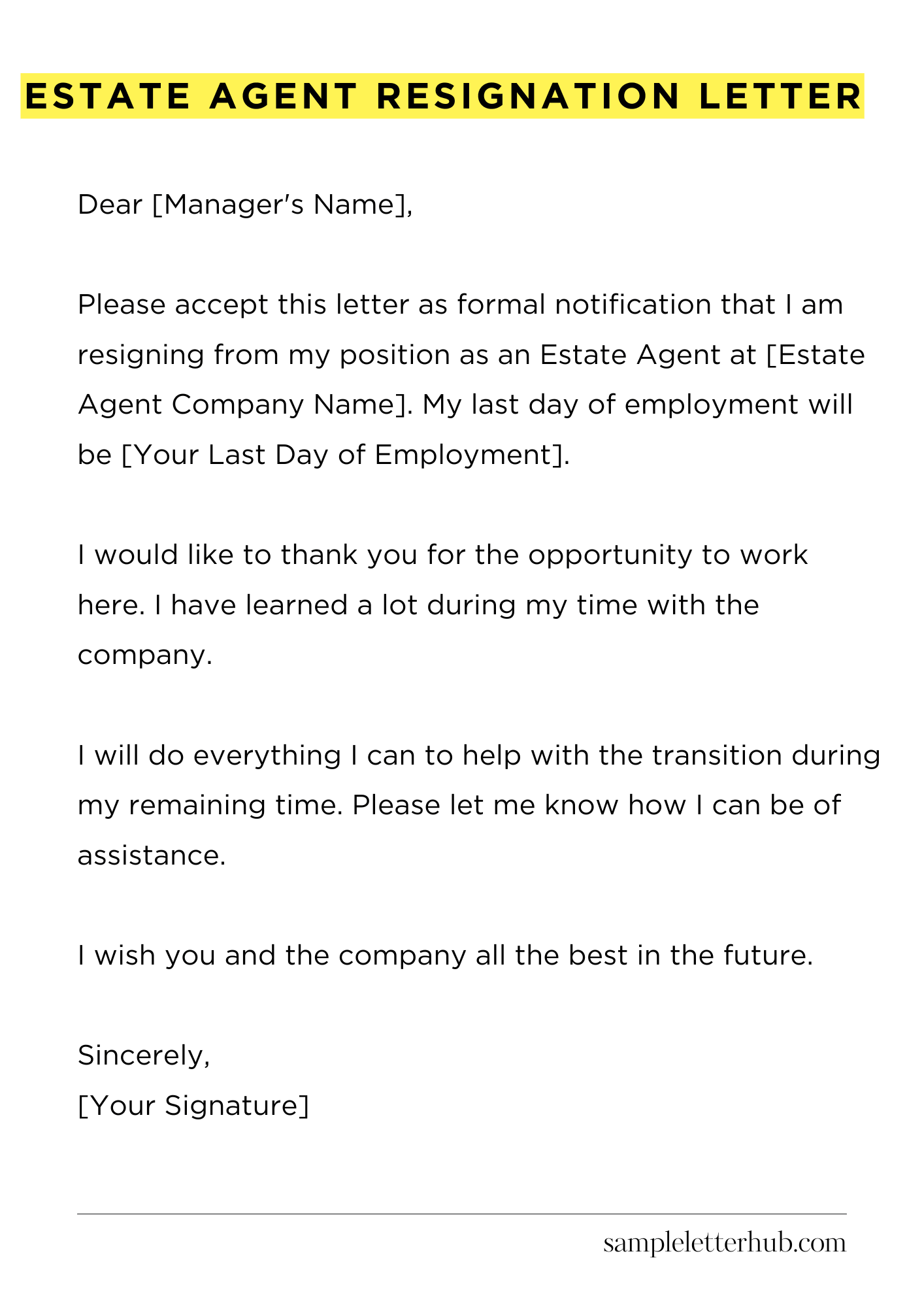
Dear [Manager’s Name],
Please accept this letter as formal notification that I am resigning from my position as an Estate Agent at [Estate Agent Company Name]. My last day of employment will be [Your Last Day of Employment].
I would like to thank you for the opportunity to work here. I have learned a lot during my time with the company.
I will do everything I can to help with the transition during my remaining time. Please let me know how I can be of assistance.
I wish you and the company all the best in the future.
Sincerely,
[Your Signature]
How to Write Estate Agent Resignation Letter
Know Your Basics First
Resigning from any job can be daunting. It’s especially true when you’ve invested time and effort in a role. However, life changes, and sometimes a new opportunity presents itself. Writing an estate agent resignation letter is the first formal step. First things first: be professional, clear, and concise.
Keep it brief, usually a single page will do. Avoid any emotional language or unnecessary complaints. This letter is your official notice; it’s not a place to air grievances.
Crafting the Core of Your Letter
The main body of your letter is where you do the work. Start with a clear and direct statement of your resignation. State your name, your position, and the effective date of your departure. Next, express your gratitude. Acknowledge the opportunities and experiences the role has offered. Now, you must make a proper statement for your resignation.
Here’s a basic structure: Begin with your address, followed by the date, then the recipient’s information. Next, use a professional salutation.
This should be followed by a clear statement of your resignation, including the date of your last day of employment. Offer to help with the transition. It can be useful to offer assistance in training your replacement. Then, express your gratitude for the opportunity. End with a polite closing and your signature.
What to Include (and What to Leave Out)
Always include the essential information: your name, the date, your position, and the last day of employment. Offer a helping hand, such as training your replacement. Avoid negativity. Do not mention negative experiences. Unless absolutely necessary, keep the specific reason for leaving private. Remember, this is about formality. Avoid personal opinions or rumors.
Focus on the positives, if possible. Keep things polite and professional. You do not need a long reason. One or two short sentences can cover that. Always thank your employer for the experience.
The Importance of a Professional Tone
Your resignation letter is a reflection of your professionalism. Keep it formal and polite, even if you are not happy. Using respectful language, shows your ability to handle difficult situations. Be brief and to the point. Proofread carefully before sending it. Errors can undermine your credibility.
Maintain a positive attitude. Even if you are leaving on bad terms, keep things polite and concise. You may need a reference in the future. Remember that leaving a positive impression is always beneficial. A good reference can be crucial.
Finalizing and Delivering Your Letter
Before you send it, review your letter. Ensure it is free of errors. Check the formatting. Make sure all the details are accurate. Once you are satisfied, print the letter and sign it. Always keep a copy for your records.
Hand the letter to your manager in person if possible. If not, send it via email. Follow company protocol. Follow instructions given to you by the company.
FAQs about Estate Agent Resignation Letter
What is the primary purpose of an Estate Agent resignation letter?
The primary purpose of an Estate Agent resignation letter is to formally notify your employer of your intention to leave your position. It serves as an official record of your departure and helps to initiate the handover process, ensuring a smooth transition for both you and the company.
What key elements should be included in an Estate Agent resignation letter?
Essential components include a clear statement of your resignation, the effective date of your departure, a concise expression of gratitude for the opportunity, and any necessary information regarding outstanding tasks or handover plans. It is also advisable to include your contact details for any follow-up.
How much notice should an Estate Agent provide in their resignation letter?
The required notice period depends on your employment contract and local labor laws. Typically, it ranges from two weeks to one month. Always refer to your contract to determine the specific notice period outlined by your employer.
Should an Estate Agent provide a reason for resigning in their letter?
While not mandatory, providing a brief, professional reason for your resignation can be helpful. This could be to pursue another opportunity, for personal reasons, or simply to move on. Keep it concise and avoid negativity. If you have specific concerns, they are generally best addressed separately with HR or your manager.
What is the best way to deliver an Estate Agent resignation letter?
It’s best to deliver your resignation letter in writing, either physically or electronically, depending on your company’s policy. It’s also often beneficial to inform your manager verbally before providing the written letter to foster open communication. Always retain a copy for your records.
Related:
Resignation letter due to rude boss
Resignation letter moving to another state
Resignation letter due to illness of family member
Resignation letter due to study