

An Environmental Specialist resignation letter is a formal document. It informs an employer of your intention to leave your job. The letter officially states your last day of employment. It also helps to maintain a professional relationship.
Planning your exit can be tricky. This article provides helpful examples. We’ll share various templates. They cover different scenarios. These will simplify your writing process.
Need to draft a letter quickly? We’ve got you covered. From polite and brief to more detailed options, find inspiration here. Crafting the perfect resignation just got easier!
Environmental Specialist Resignation Letter
Below is a sample of a Environmental Specialist Resignation Letter:
[Your Name]
[Your Address]
[Your Phone Number]
[Your Email Address]
[Date]
[Employer’s Name]
[Employer’s Title]
[Company Name]
[Company Address]
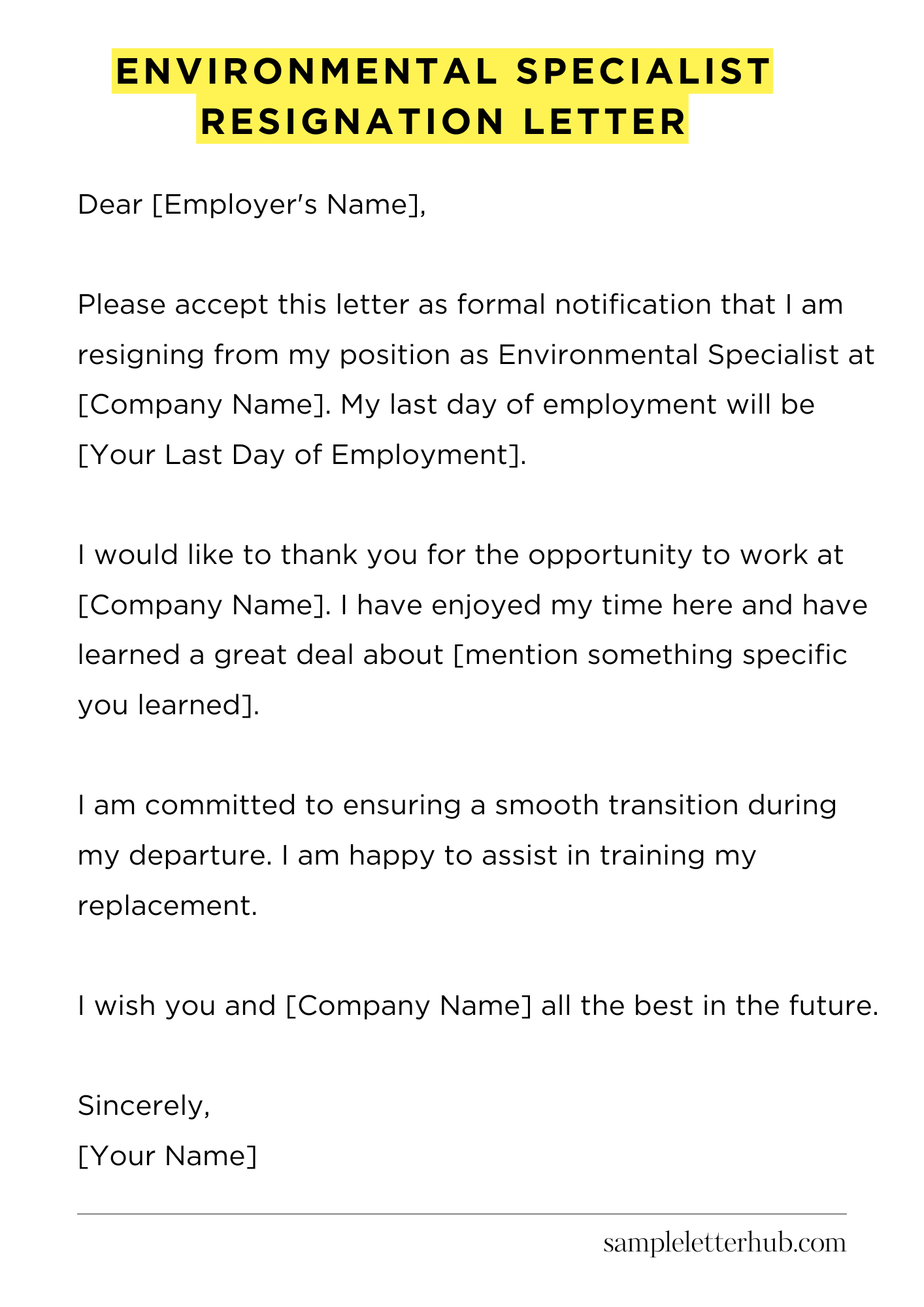
Dear [Employer’s Name],
Please accept this letter as formal notification that I am resigning from my position as Environmental Specialist at [Company Name]. My last day of employment will be [Your Last Day of Employment].
I would like to thank you for the opportunity to work at [Company Name]. I have enjoyed my time here and have learned a great deal about [mention something specific you learned].
I am committed to ensuring a smooth transition during my departure. I am happy to assist in training my replacement and completing any outstanding tasks to the best of my ability before my final day.
I wish you and [Company Name] all the best in the future.
Sincerely,
[Your Name]
How to Write an Environmental Specialist Resignation Letter
1. Grasping the Basics: Your Foundation
Resigning from any job can feel daunting. But it doesn’t have to be a stressful ordeal. The key lies in approaching it professionally and with clear communication. An environmental specialist position, with its inherent responsibilities, demands a particularly careful approach. You’re leaving a role that likely involves sensitive projects and compliance requirements.
This means your resignation letter needs to be well-structured, polite, and above all, professional. Understand that this document is a formal record, a crucial part of your employment history, and a reflection of your character.
Think of it this way: your resignation letter is a bridge. It allows you to move on smoothly, without burning bridges behind you. Let’s make sure that bridge is solid.
2. Structure: Building Your Letter
The structure of your resignation letter is critical. It ensures that your message is clear and easy to understand. Start with your contact information. This includes your name, address, phone number, and email.
Then, add the date, followed by your supervisor’s name and title, and the company’s address. Use a formal salutation, like “Dear [Supervisor’s Name],” which shows respect and professionalism.
The core of your letter should comprise several key elements. Begin by stating your intent to resign, and make it concise and direct. Specify your last day of employment. This is crucial for HR and your supervisor to plan accordingly.
Express gratitude for the opportunities you’ve been given. Briefly mention any key achievements during your tenure, if you feel it’s appropriate. Finally, offer assistance during the transition phase. This shows your commitment to a smooth handover.
Consider this example: “I am writing to inform you of my resignation from the position of Environmental Specialist at [Company Name]. My last day of employment will be [Date]. I am grateful for the opportunities I’ve had here and for the experience I’ve gained. I am available to assist with the transition of my responsibilities.”
3. Content: What to Say, What to Avoid
The content of your letter is just as important as its structure. Be professional in your tone. Keep it positive. Avoid negativity or complaints about your job. Stick to the facts.
Provide a valid reason, if you wish to, but it’s not always necessary. Common reasons include “to pursue other opportunities,” “for personal reasons,” or simply “to focus on new challenges.” These are perfectly acceptable.
Focus on your strengths and contributions. Briefly mention your positive experiences. However, avoid going into unnecessary detail. Do not discuss any sensitive company information. Never reveal confidential information. Proofread your letter carefully for any grammatical errors or typos. This small step can make a big difference.
4. Tailoring Your Letter: Environmental Specialist Specifics
As an environmental specialist, your resignation letter needs to reflect your specialized role. You’ve likely been involved in projects with specific regulations and compliance requirements.
Acknowledge this in your letter if appropriate. Indicate your willingness to assist with the handover of any ongoing projects or critical documentation. Offering to help with transferring data or training a replacement, shows professionalism and consideration for the company’s obligations. This gesture can strengthen your positive departure.
For example, you could add: “I am happy to assist in the handover of my current projects, ensuring a smooth transition for my successor.” Or, “I am available to train my replacement, and provide necessary information on existing environmental compliance programs.”
5. Final Steps: Polishing and Delivery
Before submitting your letter, always review it carefully. Read it aloud to catch any errors or awkward phrasing. Have someone else read it over for a fresh perspective. Then, sign and date the physical copy of the letter. This is a common practice.
How you deliver your resignation is essential. Hand it in person to your supervisor, if possible. This demonstrates respect. Follow up with an email to confirm your resignation and keep a copy for your records.
Remember, the goal is to leave on a positive note, maintaining a good relationship with your former employer. The relationships you build today can benefit you in the future.
Good luck!
FAQs about Environmental Specialist resignation letter
How do I start my Environmental Specialist resignation letter?
Begin with a formal salutation (e.g., “Dear [Manager’s Name]”) and a clear, concise statement of your intent to resign from your position as Environmental Specialist. Include the date of your resignation and the last day of your employment.
What should I include in the body of my Environmental Specialist resignation letter?
The body of your letter should briefly state the reason for your resignation (if you choose to include it – this is optional), express gratitude for the opportunity to work at the company, and, if appropriate, mention any positive experiences or skills gained. Maintain a professional and respectful tone throughout.
Is it necessary to provide a reason for my resignation in the letter?
Providing a reason is optional. You can choose to state your reason (e.g., “to pursue another opportunity” or “for personal reasons”) or simply state your resignation. If you choose to provide a reason, keep it brief and professional. Avoid negativity.
What details about my final tasks and transition should I include?
You can offer to assist with the transition of your responsibilities, especially if you have ongoing projects. Include a sentence indicating your willingness to help ensure a smooth handover and, if possible, specify any tasks you will complete before your departure. Provide your contact information, if you’re open to it.
How do I end my Environmental Specialist resignation letter?
Conclude your letter with a professional closing, such as “Sincerely” or “Best regards,” followed by your full name. It’s often advisable to include your contact information for future communication. Consider providing a hard copy of the letter and emailing an electronic copy to the appropriate parties.
Related:
Resignation letter due to rude boss
Resignation letter moving to another state
Resignation letter due to illness of family member
Resignation letter due to study