

An Enterprise Account Executive resignation letter is a formal document. It is written when an Account Executive decides to leave their job. The letter officially informs the employer of the employee’s departure. It also states the last day of employment.
This can be a tricky task. We have you covered. We’re sharing templates and examples. These are Enterprise Account Executive resignation letters. You can use them as a starting point. Make your resignation process easier.
Writing a resignation letter doesn’t have to be hard. We offer different samples. Find one that fits your needs. Tailor it to your situation. Make the process smoother.
Enterprise Account Executive Resignation Letter
Below is a sample of a Enterprise Account Executive Resignation Letter:
[Your Name]
[Your Address]
[Your Phone Number]
[Your Email Address]
[Date]
[Hiring Manager Name] (If known, otherwise use title)
[Hiring Manager Title]
[Company Name]
[Company Address]
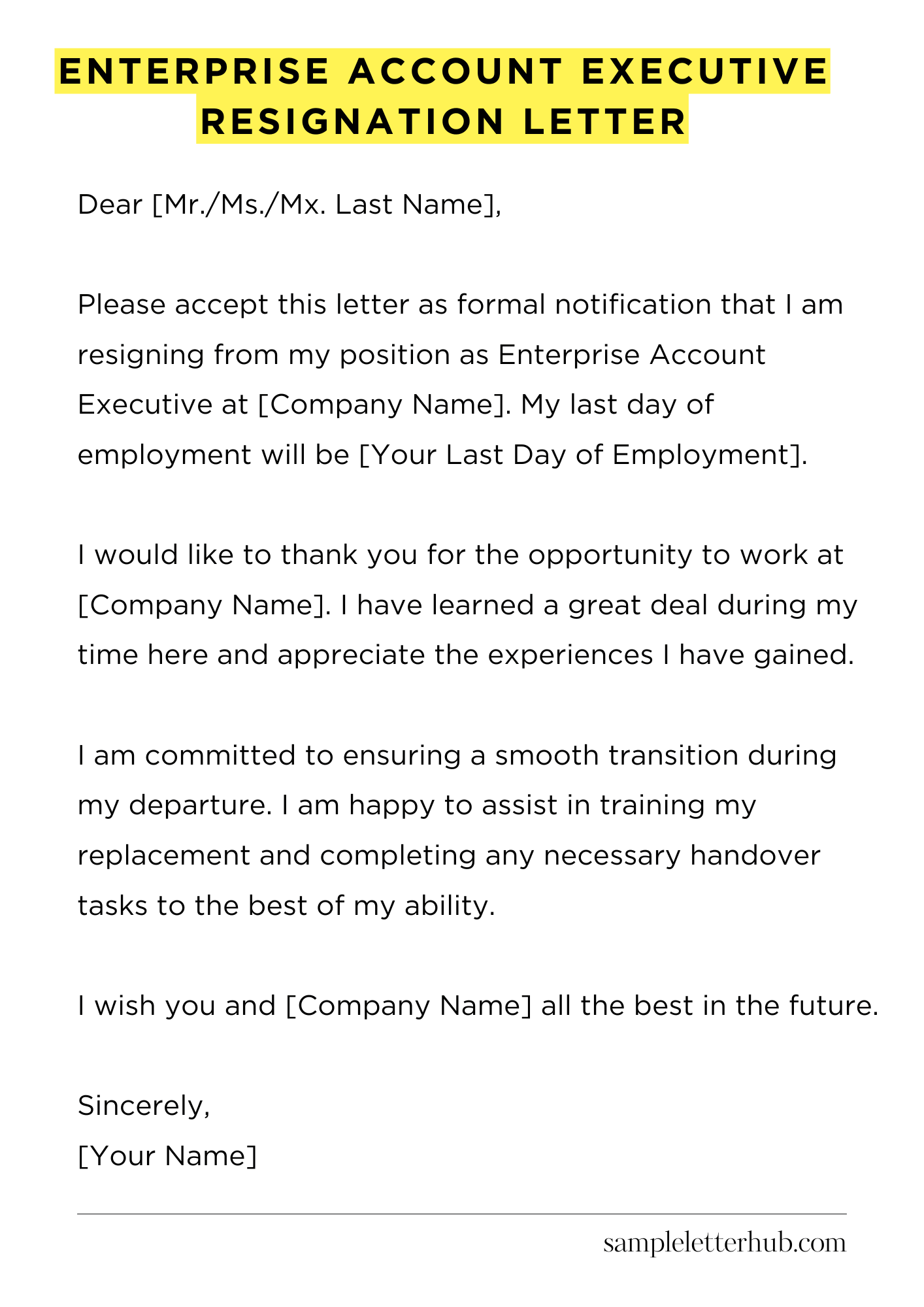
Dear [Mr./Ms./Mx. Last Name],
Please accept this letter as formal notification that I am resigning from my position as Enterprise Account Executive at [Company Name]. My last day of employment will be [Your Last Day of Employment].
I would like to thank you for the opportunity to work at [Company Name]. I have learned a great deal during my time here and appreciate the experiences I have gained.
I am committed to ensuring a smooth transition during my departure. I am happy to assist in training my replacement and completing any necessary handover tasks to the best of my ability.
I wish you and [Company Name] all the best in the future.
Sincerely,
[Your Name]
How to Write Enterprise Account Executive Resignation Letter
1. Getting Started: The Basics You Can’t Miss
Resigning from any job can be tricky, but it’s especially important to handle it professionally when you’re leaving a role as crucial as an Enterprise Account Executive. This letter is your formal notice.
Think of it as a handshake, a polite departure that leaves the door open for future opportunities. Before you start, gather your essential information. Know your company’s policy on resignation – this dictates how much notice you need to give.
Typically, two weeks is the standard, but it could be longer depending on your contract. Also, you need the right person to address your letter to – usually your direct manager, or a HR representative.
Now, let’s get into the details.
2. Crafting the Core: What to Actually Say
The core of your letter should be straightforward and to the point. Start with a clear and concise statement of your intention. Something like, “Please accept this letter as formal notification that I am resigning from my position as Enterprise Account Executive at [Company Name], effective [Your Last Day of Employment].”
This immediately establishes your purpose. Next, express your gratitude. Acknowledge the opportunities and experiences you’ve gained during your time at the company. Be genuine – even if things weren’t perfect, find something positive to mention. This maintains a respectful tone.
Be brief, be polite, and be professional.
3. Adding the Polish: Key Elements for Success
Beyond the core, there are elements that add professionalism. Consider including a brief mention of any ongoing projects or responsibilities you’re currently managing.
Offer your assistance in the transition process. This shows you are committed to a smooth handover. You could write, “I am committed to ensuring a seamless transition and am happy to assist in training my replacement.”
Offer to help, but don’t commit yourself to more than you can realistically manage within your remaining time. Proofread carefully before sending it. Typos and grammatical errors are easily avoided, and can damage your credibility.
Details matter.
4. Keeping it Classy: Tone and Style Guidelines
The tone of your resignation letter is critical. Maintain a positive and professional tone throughout. Avoid negativity, complaints, or criticism of the company or its employees. Even if you’re leaving due to dissatisfaction, it’s best to keep your letter neutral. Use formal language. Avoid slang or overly casual expressions.
Choose a business-appropriate font, like Times New Roman or Arial, and use a standard font size, like 12 points. Keep your letter concise, ideally one page. Your resignation letter is not the place for lengthy explanations or personal opinions.
Focus on your professionalism.
5. The Final Touches: What to Do After You Send It
After you’ve sent your letter, prepare for the next steps. Be prepared for a meeting with your manager or HR. They might want to discuss your reasons for leaving or the transition process. You’ll likely be asked to participate in an exit interview. This is your chance to provide feedback, but keep it constructive and professional.
During your remaining time, focus on finishing your tasks, documenting your work, and helping with the handover. Always maintain a positive attitude until your last day. This will leave a good impression.
End on a high note.
FAQs about Enterprise Account Executive resignation letter
Understanding the nuances of crafting a resignation letter as an Enterprise Account Executive is crucial for maintaining professionalism and ensuring a smooth transition. Here are some frequently asked questions and their answers:
What are the essential elements to include in an Enterprise Account Executive resignation letter?
An effective resignation letter should include: a clear statement of resignation (e.g., “I am writing to formally resign from my position as Enterprise Account Executive”), the effective date of your resignation, a concise expression of gratitude to the company (mentioning specific individuals or teams if desired).
How much notice should an Enterprise Account Executive give when resigning?
The standard notice period is typically two to four weeks, but this can vary depending on your employment contract, company policy, and the seniority of your role. Review your employment agreement and company handbook to determine the required notice period. Giving more notice than required is often viewed positively.
Should I explain my reasons for leaving in the resignation letter?
While not mandatory, it’s generally a good practice to briefly explain your reason for leaving, especially if it’s for a new opportunity. Keep it professional and positive. Avoid negative comments about the company or colleagues. If you prefer, you can state that you’re pursuing other opportunities or simply express your desire to move on.
How should I handle outstanding client relationships in my resignation letter?
Acknowledge your commitment to a smooth handover of your client accounts. Offer to assist in the transition process and provide any necessary information or documentation to facilitate the transfer of responsibilities. Express your willingness to collaborate with your successor to ensure a seamless experience for your clients.
What is the proper format and tone for an Enterprise Account Executive resignation letter?
The tone should be professional, respectful, and courteous. The format should be a formal business letter, including your contact information, the date, the recipient’s information, and a clear subject line (e.g., “Resignation – [Your Name]”). Keep the letter concise and focused on the key information. Proofread carefully for any errors in grammar or spelling.
Related:
Resignation letter due to rude boss
Resignation letter moving to another state
Resignation letter due to illness of family member
Resignation letter due to study