

So, you’re an English Language Instructor ready to move on. A resignation letter is your official way to announce your departure. It informs your employer of your decision. It also outlines your last day of employment. This letter is a professional courtesy.
Writing the perfect resignation letter can feel tricky. Don’t worry, we’ve got you covered. We’ll provide you with various letter samples. These examples will serve as your guide. Tailor them to fit your specific needs and situation.
From basic templates to more detailed formats, we offer a range. You can easily adapt these samples. Craft a clear, concise, and professional resignation letter. Saying goodbye has never been easier!
English Language Instructor Resignation Letter
Below is a sample of a English Language Instructor Resignation Letter:
[Your Name]
[Your Address]
[Your Phone Number]
[Your Email Address]
[Date]
[Recipient’s Name]
[Recipient’s Title]
[School/Organization Name]
[School/Organization Address]
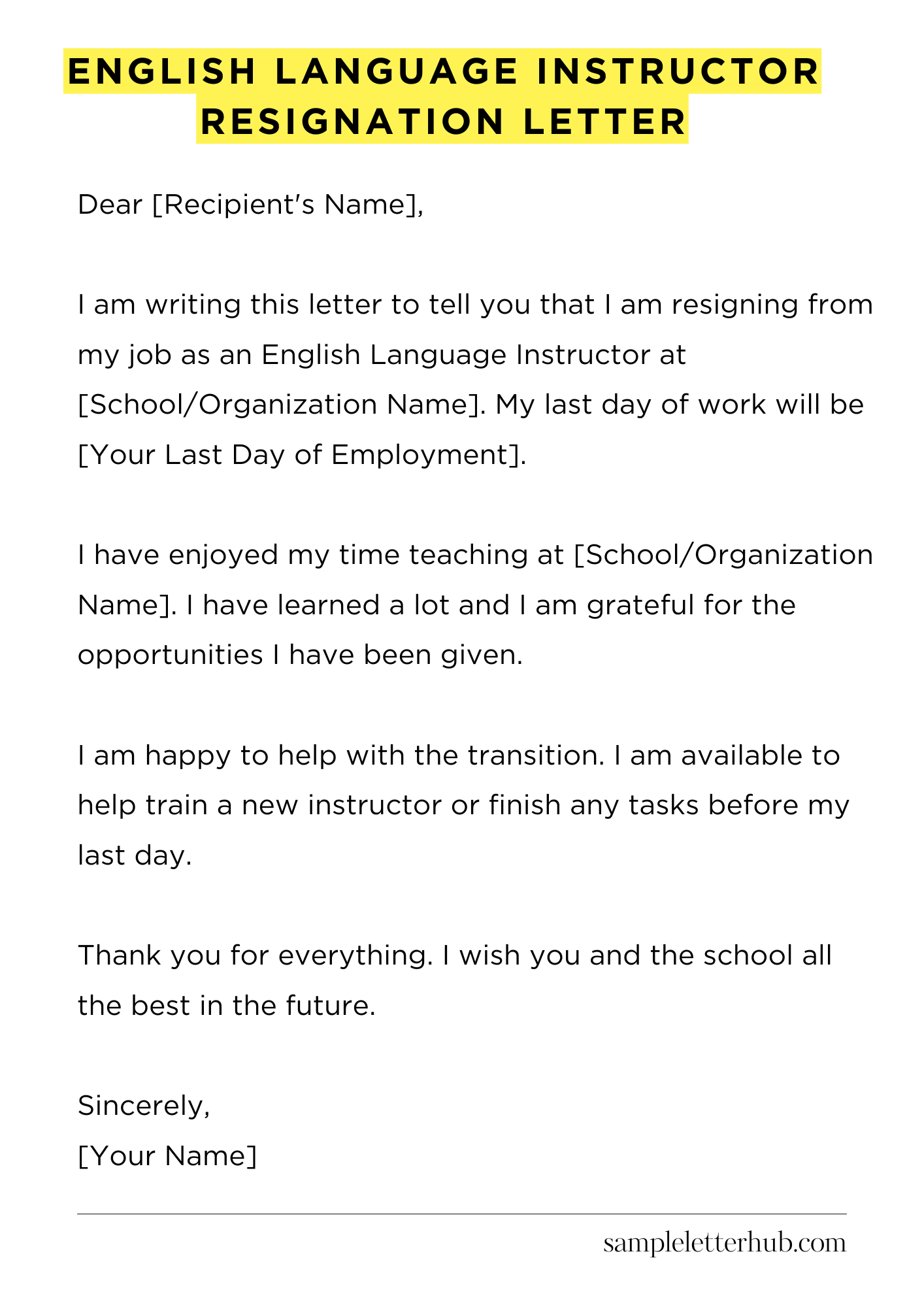
Dear [Recipient’s Name],
I am writing this letter to tell you that I am resigning from my job as an English Language Instructor at [School/Organization Name]. My last day of work will be [Your Last Day of Employment].
I have enjoyed my time teaching at [School/Organization Name]. I have learned a lot and I am grateful for the opportunities I have been given.
I am happy to help with the transition. I am available to help train a new instructor or finish any tasks before my last day.
Thank you for everything. I wish you and the school all the best in the future.
Sincerely,
[Your Name]
How to Write an English Language Instructor Resignation Letter
So, you’ve decided to move on from your role as an English Language Instructor. That’s fine. It’s important to craft a professional resignation letter. Resigning is a significant step in your career. You want to leave a positive impression. Here’s a guide to help you do it right.
1. Formatting and Basics
First things first. You need to get the formatting right. Your letter should be business-like and easy to read. Use a standard font like Times New Roman or Arial. Keep the font size at 12 points.
Address the letter to your direct supervisor or the appropriate person in the human resources department. It should include your name, address, phone number, and email address, along with the date. Next, you need to add the recipient’s information below that: their name, title, and the organization’s address.
It sounds simple, but this is an essential part. A well-formatted letter is a sign of respect and professionalism. A clear structure makes for easy reading. Think of it as the foundation of your letter.
2. The Core: Stating Your Resignation
This is the most crucial part. You need to clearly state your intention to resign. Be direct and concise. Avoid beating around the bush. Start with a clear sentence expressing your resignation. You could say something like, “Please accept this letter as formal notification that I am resigning from my position as English Language Instructor…”
Following this, specify your last day of employment. This is important for HR to process everything. Ensure the date aligns with your employment contract or any required notice period. Be precise and avoid any ambiguity. It’s also wise to check your contract for any specifics.
3. Expressing Gratitude and Appreciation
Now, let’s inject a little positivity. It’s important to show gratitude. Even if you’re leaving, acknowledging your time at the organization is key.
Thank the employer for the opportunity to work there. Mention specific experiences, skills gained, or people you worked with. This also helps maintain a good relationship for the future.
This section is all about showing appreciation. You want to leave on a positive note. Remember, the world is small. So being nice can go a long way.
4. Offering Assistance with Transition
This step shows professionalism and consideration. Offer to assist with the transition process. This might involve training a replacement, completing outstanding tasks, or providing any relevant documentation. This can make the process go smoothly for everyone involved.
Show them you’re willing to help. This gesture can leave a positive lasting impression. Remember, you want to make it easy for your employer.
5. Closing and Sign-off
Finish your letter professionally. Reiterate your last day of employment. Offer your contact information if needed for questions. Use a formal closing, such as “Sincerely” or “Respectfully.” Then, leave space for your signature above your printed name. This final touch completes the professional look.
Always proofread your letter before you send it! Typos and grammatical errors can diminish your professionalism. Finally, keep a copy of your letter for your records. This is just good practice.
FAQs about English Language Instructor resignation letter
How much notice should an English Language Instructor give when resigning?
The standard notice period for an English Language Instructor typically aligns with the employment contract. Common practice is to provide two to four weeks’ notice.
However, it’s essential to consult the employment agreement or company policy to determine the exact notice period required by the employer. In cases of exceptional circumstances, such as a serious breach of contract by the employer, shorter notice might be considered, although this could lead to legal repercussions.
What key elements should be included in an English Language Instructor’s resignation letter?
A well-structured resignation letter for an English Language Instructor should include: a clear statement of resignation (e.g., “I am writing to formally resign from my position as English Language Instructor”); the instructor’s name and the date; the effective date of resignation; a brief statement of gratitude for the opportunity; and, if desired, a concise reason for leaving.
Optional additions could include offers to assist with the transition and contact information for future correspondence. Accuracy in dates and clarity are paramount.
Can an English Language Instructor provide a reason for resignation in the letter, and is it recommended?
While not mandatory, an English Language Instructor can choose to include a reason for resignation in the letter. Whether to include a reason depends on personal preference and the circumstances.
A brief and professional reason, such as pursuing a new career opportunity or personal reasons, is often acceptable. Avoid negative comments about the employer or colleagues. If the reason is a sensitive one, a conversation with the supervisor might be more appropriate than detailing it in the letter itself.
Should an English Language Instructor offer to help with the transition after resigning?
Offering to assist with the transition is a generally recommended practice for English Language Instructors. It demonstrates professionalism and a commitment to ensuring a smooth handover.
This can include offering to train a replacement, providing documentation or resources, or answering questions. The specific level of assistance offered may vary depending on the instructor’s workload and the employer’s needs. Such an offer could increase your professional reputation.
How should an English Language Instructor address the resignation letter?
The resignation letter should be addressed to the appropriate person, usually the direct supervisor, the head of the language department, or the human resources department.
The correct title of the recipient should be included. If unsure, checking with a colleague or reviewing the company’s internal communication protocols is advisable. The letter should be delivered in a professional manner, either in person or through a secure electronic platform, as per company policy.
Related:
Resignation letter due to rude boss
Resignation letter moving to another state
Resignation letter due to illness of family member
Resignation letter due to study