

An English Instructor resignation letter is a formal document. It is written by an English teacher. The purpose is to officially inform the school of their departure. It marks the end of their employment.
Leaving a job can be tricky. Writing the letter is essential. This article simplifies the process. We have compiled various templates. Examples and samples are readily available.
Need help crafting your own letter? Look no further. We offer a selection of letter formats. Choose the one that suits your needs. Make your resignation clear and concise.
English Instructor Resignation Letter
Below is a sample of a English Instructor Resignation Letter:
[Your Name]
[Your Address]
[Your Phone Number]
[Your Email Address]
[Date]
[Recipient’s Name]
[Recipient’s Title]
[School/Organization Name]
[School/Organization Address]
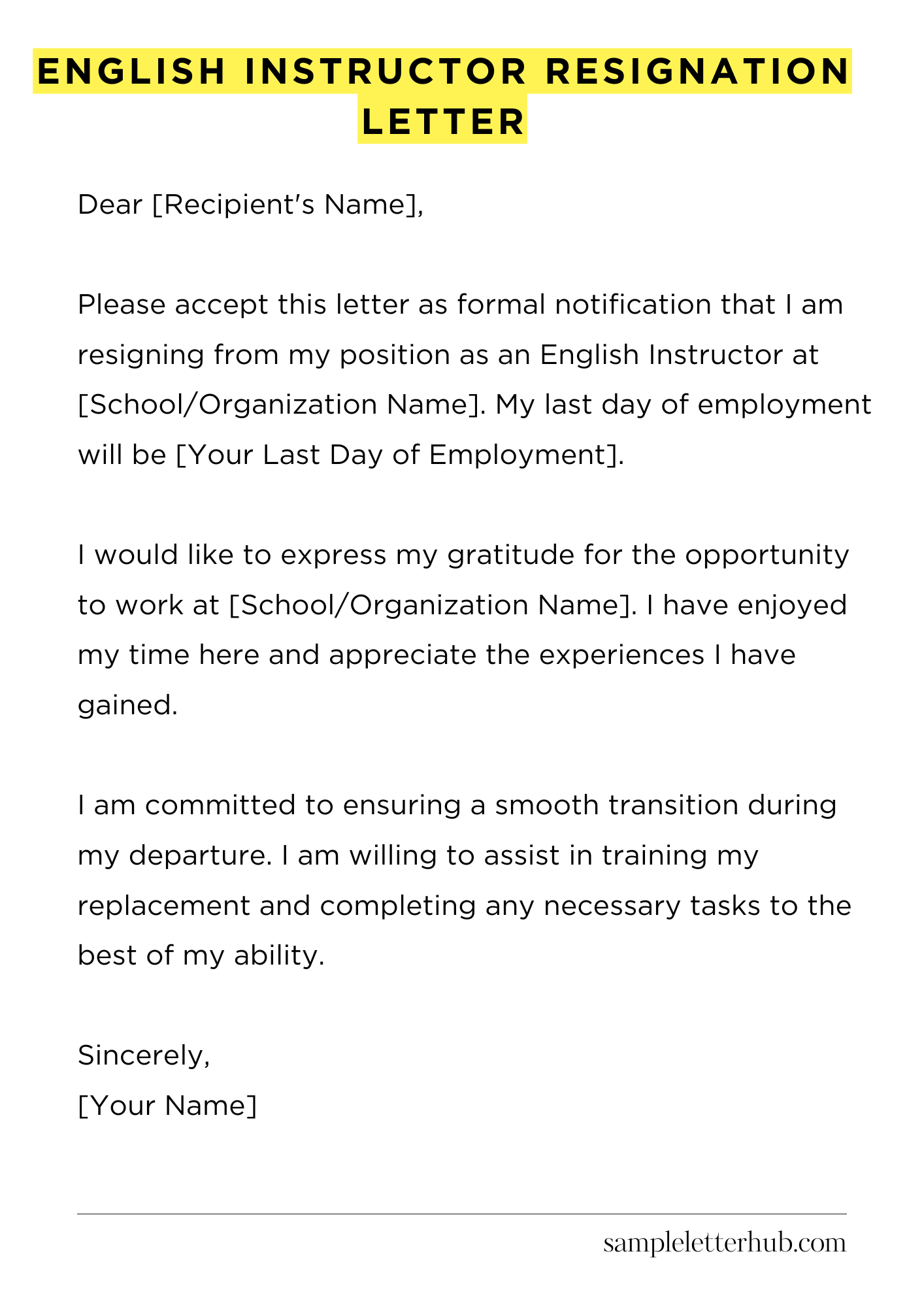
Dear [Recipient’s Name],
Please accept this letter as formal notification that I am resigning from my position as an English Instructor at [School/Organization Name]. My last day of employment will be [Your Last Day of Employment].
I would like to express my gratitude for the opportunity to work at [School/Organization Name]. I have enjoyed my time here and appreciate the experiences I have gained.
I am committed to ensuring a smooth transition during my departure. I am willing to assist in training my replacement and completing any necessary tasks to the best of my ability.
I wish the school and all my colleagues the very best in the future.
Sincerely,
[Your Name]
How to Write an English Instructor Resignation Letter
So, you’re moving on? Congratulations! Resigning from a teaching position, even one you may have loved, is a big step. It’s also important to do it right. This guide will walk you through how to craft a professional English instructor resignation letter. Getting it right ensures a smooth transition and leaves a positive lasting impression.
1. Format and Fundamentals
First things first: Your letter needs a professional format. Think of it as a formal essay, except shorter. Begin with your contact information (name, address, phone number, and email address) at the top, typically left-aligned. Underneath, include the date.
Then, address the letter to the appropriate person, usually the department chair or the head of the institution. Keep it formal and polite.
The letter itself should be concise. Stick to a one-page limit. Use a clear, easy-to-read font like Times New Roman or Arial, and use standard margins. Proofread it multiple times to catch any spelling or grammatical errors.
2. The Official Declaration
The first paragraph is crucial. It clearly states your intention: to resign from your position. Be direct and unambiguous. State your position (e.g., “English Instructor”) and the date your resignation will be effective.
For example, “Please accept this letter as formal notification that I am resigning from my position as English Instructor at [Institution Name], effective [Date].” This paragraph sets the tone and avoids any confusion.
Consider the effective date carefully. Follow your contract’s stipulations regarding the notice period, and adhere to it. Giving adequate notice is essential. This can leave a positive impression.
3. Expressing Gratitude and Appreciation
This is where you show some class. Next, include a paragraph expressing your gratitude for the opportunity to work at the institution. This shows respect for your employer.
Highlight any positive experiences you’ve had during your tenure, like professional growth or positive relationships. Avoid negativity, even if your experience hasn’t been perfect. Focus on what you learned and the positive aspects of your time there.
For example, you might say, “I am grateful for the opportunities I have been given during my time at [Institution Name]. I have valued my interactions with students and colleagues.” This demonstrates professionalism.
4. Briefly Explain (But Don’t Over-Explain)
You’re not obligated to provide a detailed explanation of why you’re leaving, but a brief, general reason can be helpful. Keep it concise and professional.
You might state that you are pursuing another opportunity, relocating, or simply seeking a change. Avoid oversharing personal details. It is perfectly acceptable to keep it short and sweet, such as, “I am pursuing other career opportunities that align with my professional goals.”
The goal is to provide enough information without getting into unnecessary details or potential conflicts. Keep things positive.
5. The Closing and Next Steps
Conclude your letter with a professional closing, such as “Sincerely” or “Respectfully,” followed by your typed name. Sign your name above your typed name. Also, indicate your willingness to assist with the transition. Offer to help train a replacement or complete any unfinished tasks.
This extra step will show how respectful you are. For instance, you could add: “I am happy to assist with the transition in any way I can, including helping to train my replacement.”
After you’ve written the letter, make a copy for your records. Then, deliver it to the appropriate person. It is recommended to hand-deliver the letter, but email or mail is also acceptable.
FAQs about English Instructor Resignation Letter
What is the primary purpose of an English Instructor resignation letter?
The primary purpose is to formally notify the employer of the intent to leave the position. It serves as a written record of the resignation, the effective date, and, often, a brief expression of gratitude or reason for leaving. It is a crucial step in the employment separation process.
What key elements should be included in an English Instructor resignation letter?
Essential elements include a clear statement of resignation, the effective date of the resignation, a professional closing, and your signature. It is also common to include a brief statement of gratitude for the opportunity or, optionally, a concise reason for leaving. Contact information is typically included as well.
How much notice should an English Instructor give when resigning?
The standard is typically two weeks’ notice, but this can vary depending on the employment contract, school policy, or local labor laws. It’s always best to review your employment agreement and, if necessary, inquire about the school’s specific requirements to ensure you provide adequate notice.
Should I provide a reason for resigning in my English Instructor resignation letter?
While not mandatory, it is often considered polite to provide a brief reason for leaving. This can be a general statement, such as “pursuing other opportunities,” or a more specific reason, such as “relocating.” Keep the reason concise and professional, focusing on the future rather than any past grievances.
Can an English Instructor resignation letter be used as a reference?
Yes, the resignation letter itself can potentially be used as a reference, especially for confirming employment dates and the professional nature of the departure.
However, it is not common practice to use a resignation letter as a primary source of reference. Providing details about work performance would not be in the letter, therefore, it is best to ask your employer for a reference letter.
Related:
Resignation letter due to rude boss
Resignation letter moving to another state
Resignation letter due to illness of family member
Resignation letter due to study