

Need to update your insurance account’s email? You’re in the right place. An email address update letter for insurance account is exactly what it sounds like. It’s a simple way to inform your insurance provider about a change. Its main purpose is to ensure you receive important insurance communications.
Crafting the perfect email address update letter can feel tricky. Don’t worry, we’ve got you covered. We will share several email address update letter for insurance account templates. These examples are designed to make it simple.
We provide samples you can easily adapt. Our goal is to make updating your insurance information quick. Writing these letters will be effortless. You can customize them for your insurance needs.
[Your Name/Insurance Company Letterhead]
[Your Address]
[Your City, Postal Code]
[Date]
[Recipient Name, if known, or “Insurance Account Holder”]
[Recipient Address]
[Recipient City, Postal Code]
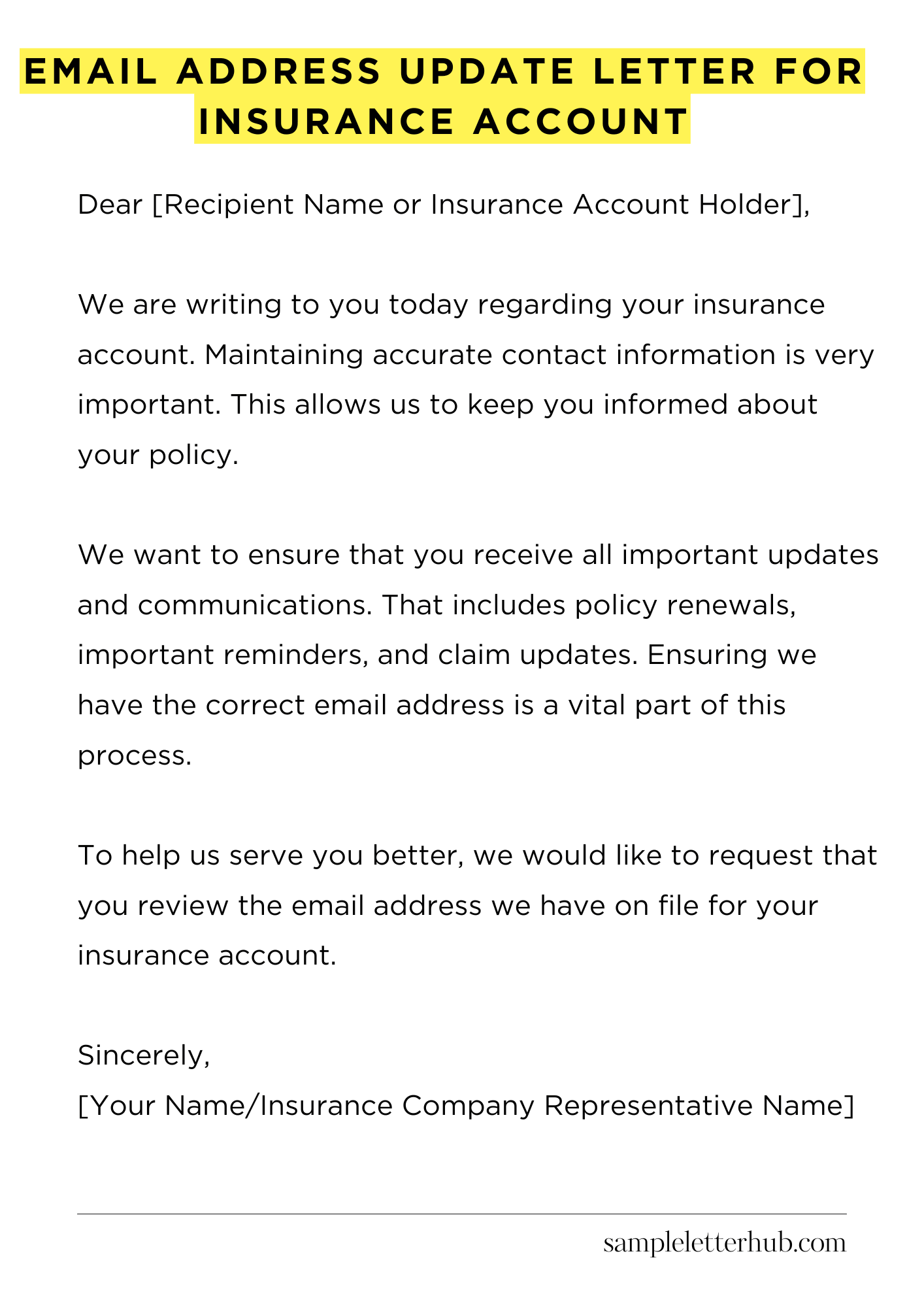
Dear [Recipient Name or Insurance Account Holder],
We are writing to you today regarding your insurance account. Maintaining accurate contact information is very important. This allows us to keep you informed about your policy.
We want to ensure that you receive all important updates and communications. That includes policy renewals, important reminders, and claim updates. Ensuring we have the correct email address is a vital part of this process.
To help us serve you better, we would like to request that you review the email address we have on file for your insurance account. If the email address we have is incorrect, or if you wish to change it, please let us know. You can do this quickly and easily.
You have a few options for updating your email address. You can reply directly to this email with your updated address. Alternatively, you can call us at [Phone Number] and speak with a customer service representative. Another option is to visit our website at [Website Address] and update your information through our secure online portal. This online portal provides the most modern update option.
Please provide us with your full name and policy number when you contact us. This is important for processing your update efficiently. It is important to remember that we take your privacy very seriously. Any information you provide will be kept secure and confidential.
We appreciate your cooperation in helping us keep your account information up to date. This simple step helps us ensure you continue to receive timely and important information about your insurance policy. Keeping your information current is something you can do.
Thank you for being a valued customer. We look forward to continuing to serve your insurance needs.
Sincerely,
[Your Name/Insurance Company Representative Name]
How to Write Email Address Update Letter for Insurance Account
Updating your email address with your insurance provider is a seemingly simple task, but it’s a crucial step to ensure the seamless receipt of vital communications. This letter acts as a formal instrument, a verifiable record of your correspondence. Crafting a cogent letter is paramount to preventing potential lapses in your coverage due to overlooked notifications.
1. Commence with the Header: Your Foundation
The genesis of your letter should begin with a precise and formal header. At the apex, to the left, include your full name, current mailing address, and the date. Below that, on the right, include the insurance company’s name and its mailing address.
This meticulous structuring ensures the letter’s proper delivery and recognition within the insurance company’s systems. A well-constructed header immediately confers credibility on your correspondence.
2. The Salutation: A Formal Overture
Address the recipient with courtesy. Initiate your letter with a formal salutation. Employ terms like “Dear Sir/Madam,” or if you have the name of a specific contact person, use “Dear [Mr./Ms./Mx. Last Name]”. This sets a professional tone, demonstrating respect for the recipient and the institution.
3. Clearly State Your Intent: The Core Message
The body of your letter is where you articulate your specific request. Start by explicitly stating the purpose of your letter: to update your email address. Clearly mention your policy number and any other identifying information, such as your date of birth, to facilitate prompt processing. Be direct and avoid ambiguity. This precision aids in expediting the update.
4. Provide the New Email Address: The Crucial Detail
This is where the rubber meets the road. Concisely provide your new, correct email address. Double-check your spelling and accuracy to prevent any future issues. This is the lynchpin of the entire process; any error here nullifies the letter’s objective. Consider including the address twice to preempt potential transcription errors on their end.
5. Include Supporting Information: Additional Clarification
While the core requirement is your email address, consider adding supporting details. This might include your phone number, or the date of the change. This additional information can sometimes expedite the process or provide an avenue for verification, if needed.
6. The Closing: Politeness and Professionalism
End your letter on a positive note. Use a formal closing such as “Sincerely,” or “Respectfully,” followed by your full name. Underneath your printed name, sign the letter manually. This underscores the formal nature of the correspondence. A polite, professional closing is the ultimate curtsy.
7. Proofread and Deliver: Final Act
Before dispatching your letter, meticulously proofread it for any grammatical errors or typos. A single mistake can undermine your credibility. After verifying, mail the letter via certified mail with a return receipt requested.
This provides you with documented proof of delivery and acknowledgement, creating an irrefutable paper trail. Consider retaining a copy for your records; it’s a wise precaution for future references.
FAQs about Email Address Update Letter for Insurance Account
Why is it important to update my email address with my insurance provider?
Keeping your email address current ensures you receive important communications from your insurance company. This includes policy updates, renewal notices, billing statements, claims confirmations, and potential security alerts. Accurate email contact allows for timely information delivery and prevents missed notifications, which could impact your coverage or lead to payment issues.
What information should I include in the email address update letter?
Your update letter should clearly identify your name, policy number, and old and new email addresses. Some providers may also require your date of birth, phone number, or address for verification purposes. It’s crucial to follow the specific instructions provided by your insurance company, which may include a specific form or contact method.
How can I submit my email address update letter to my insurance provider?
Insurance companies typically accept updates through various channels. Common methods include mailing a physical letter, submitting an update through an online portal (if available), emailing a scanned copy of the letter, or contacting customer service by phone. Check your policy documents or the insurance provider’s website for the preferred method.
How long does it take for the email address update to be processed?
The processing time can vary depending on the insurance company and the submission method used. Typically, you should expect the update to be processed within a few business days to a couple of weeks. It’s a good practice to follow up with your provider if you don’t receive confirmation within a reasonable timeframe. You may request confirmation of the update for your records.
What if I suspect fraudulent activity after updating my email address?
If you suspect unauthorized access or fraudulent activity after updating your email address, immediately contact your insurance provider and your financial institution.
Review your policy details and billing statements for any discrepancies. Consider changing your email password, enabling two-factor authentication, and reporting any suspicious communications to the appropriate authorities.
Related:
Resignation letter due to rude boss
Resignation letter moving to another state
Resignation letter due to illness of family member
Resignation letter due to study
Resignation letter due to long commute