

Planning to leave your job in education? You will need an education resignation letter. This is a formal document. It informs your employer of your departure. It officially ends your employment.
Writing this letter can feel tricky. Don’t worry, we’ve got you covered. We’ll provide you with various templates. You’ll find different examples. These samples are for different situations.
Use our guide to craft your perfect letter. It doesn’t have to be hard. We’ll make writing your resignation simple. Find the right format for your needs. Get ready to move on.
Education Resignation Letter
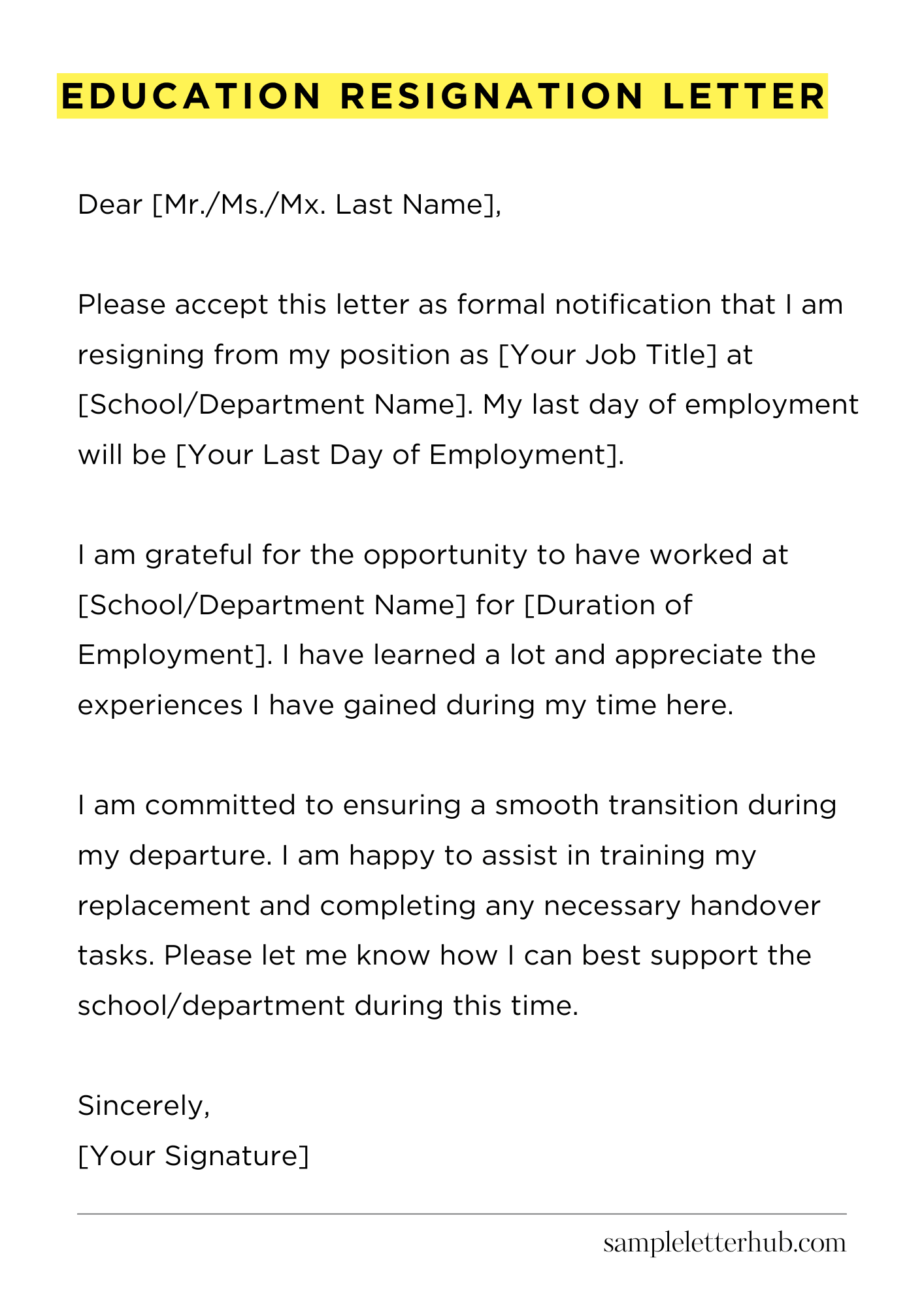
Below is a sample of a Education Resignation Letter:
[Your Name]
[Your Address]
[Your Phone Number]
[Your Email Address]
[Date]
[Principal’s/Head of Department’s Name]
[School/Department Name]
[School/Department Address]
Dear [Mr./Ms./Mx. Last Name],
Please accept this letter as formal notification that I am resigning from my position as [Your Job Title] at [School/Department Name]. My last day of employment will be [Your Last Day of Employment].
I am grateful for the opportunity to have worked at [School/Department Name] for [Duration of Employment]. I have learned a lot and appreciate the experiences I have gained during my time here.
I am committed to ensuring a smooth transition during my departure. I am happy to assist in training my replacement and completing any necessary handover tasks. Please let me know how I can best support the school/department during this time.
I wish you and [School/Department Name] continued success in the future.
Sincerely,
[Your Signature]
How to Write an Education Resignation Letter
Leaving a job, especially in education, is a significant decision. It’s also something that requires professionalism, even if you are leaving on less-than-ideal terms. Your resignation letter is a critical document.
This letter isn’t just about quitting; it’s a reflection of your character and a bridge to your future. It’s important to do it right. So, how do you compose a resignation letter that is clear, concise, and courteous?
1. Format and Fundamentals
First things first: format. Keep it clean and easy to read. Use a standard business letter format. This means your contact information (name, address, phone number, email) at the top, followed by the date, and then the recipient’s information (principal’s or superintendent’s name, title, school address).
Use a professional font like Times New Roman or Arial, and a standard font size (12 points). Keep it simple, right?
The core components of your letter are essential. You’ll need a clear statement of your resignation. State your intentions upfront and be direct. Include the date of your last day of employment. This is *crucial*. The letter should be brief and to the point.
2. The Body of Your Letter: Content Matters
Now, let’s look at the body of the letter. This is where you actually say something. Start with a polite opening. Express your gratitude for the opportunity to have worked at the school.
This shows respect, even if you weren’t thrilled with your time there. You can mention specific positive experiences or professional development opportunities you appreciated. Do not go overboard here.
Next, keep it simple. Avoid negativity or a lengthy explanation of your reasons for leaving. If you feel compelled to explain, keep it brief and general, focusing on personal or professional growth opportunities. Don’t burn bridges. You never know when you’ll cross paths again.
3. Key Elements: Specifics and Sensitivity
Specificity is key, particularly about your departure date. Double-check this against your contract and any school policies. Ensure the date aligns with the school’s needs and any required notice period. The date is a formal commitment. It’s important to provide enough notice, which can vary depending on your contract. Ignoring this could lead to complications.
Regarding sensitivity, it’s imperative. Remember, this letter is a public document. It’s likely to be reviewed by other staff, school board members, and possibly even the public. Avoid anything that could be interpreted as unprofessional or inflammatory. Maintain your composure; even if you’re leaving because of difficult circumstances, remain tactful.
4. Offering Assistance and Expressing Gratitude
Offering assistance with the transition can make a positive impression. This shows that you are committed to the students and the school, even as you leave. Offer to help with lesson plans, training a replacement, or whatever is feasible. This demonstrates your professionalism and commitment to the students’ well-being. This is an admirable step.
Closing on a positive note is essential. Reiterate your appreciation for the opportunity. Wish the school and its staff well. End with a professional closing, such as “Sincerely” or “Respectfully,” followed by your typed name. This is a finishing touch.
5. Review and Refine
Before sending your letter, review it carefully. Proofread it multiple times. Check for any grammatical errors, spelling mistakes, and formatting inconsistencies. It also needs to be perfect. Ensure the tone is professional, and the information is accurate. Ask someone you trust to proofread it as well.
A second pair of eyes can often catch mistakes you missed. Make sure you have the correct addressee and everything is spot-on. Finally, it’s time to send it. Good luck with your next endeavor!
FAQs about Education Resignation Letters
What information should I include in my education resignation letter?
Your education resignation letter should include your formal resignation, the date of your last day of employment, and a brief and professional expression of gratitude for the opportunity. You may optionally include a short reason for leaving, but this is not required. Be sure to address the letter to the appropriate person, usually your principal or superintendent.
When should I submit my education resignation letter?
It’s generally recommended to submit your education resignation letter at least two weeks before your intended last day of employment. Check your employment contract or school district policies for specific guidelines regarding the notice period, which might be longer.
How do I write a professional tone for my education resignation letter?
Maintain a professional and respectful tone throughout your letter. Avoid negative comments about the school, colleagues, or administration. Keep the language concise and formal. Expressing appreciation for the experience and opportunities provided is always a good idea. Proofread carefully for any grammar or spelling errors.
Should I provide a reason for resigning in my education resignation letter?
While it’s not mandatory, providing a reason is often courteous. You can keep it brief and general, such as “to pursue other opportunities” or “for personal reasons.” Avoid going into excessive detail or expressing dissatisfaction. If you prefer not to disclose your reasons, simply stating your resignation and last day is acceptable.
What if I want to leave my education job mid-year?
Leaving mid-year can be more complex due to contractual obligations and the impact on students. Carefully review your employment contract for stipulations regarding early resignation. Consider discussing your intentions with your principal or supervisor first to understand the potential implications.
Be prepared to explain your reasons and assist in the transition process as much as possible, potentially involving helping with handover notes and providing materials.
Related:
Resignation letter due to rude boss
Resignation letter moving to another state
Resignation letter due to illness of family member
Resignation letter due to study