

An Editorial Assistant resignation letter is a formal document. It informs your employer of your departure. The letter states your last day of employment. It’s a crucial step in ending your job professionally.
So, you’re moving on? Need to craft that resignation letter? We’ve got you covered. We’ve compiled various templates. Examples are available. They’ll help you express yourself clearly.
These sample letters offer different approaches. Choose one that suits your situation. Adapt them to fit your needs. Writing your resignation just got a whole lot easier!
Editorial Assistant Resignation Letter
Below is a sample of a Editorial Assistant Resignation Letter:
[Your Name]
[Your Address]
[Your Phone Number]
[Your Email Address]
[Date]
[Hiring Manager Name] (If known, otherwise use title)
[Hiring Manager Title]
[Company Name]
[Company Address]
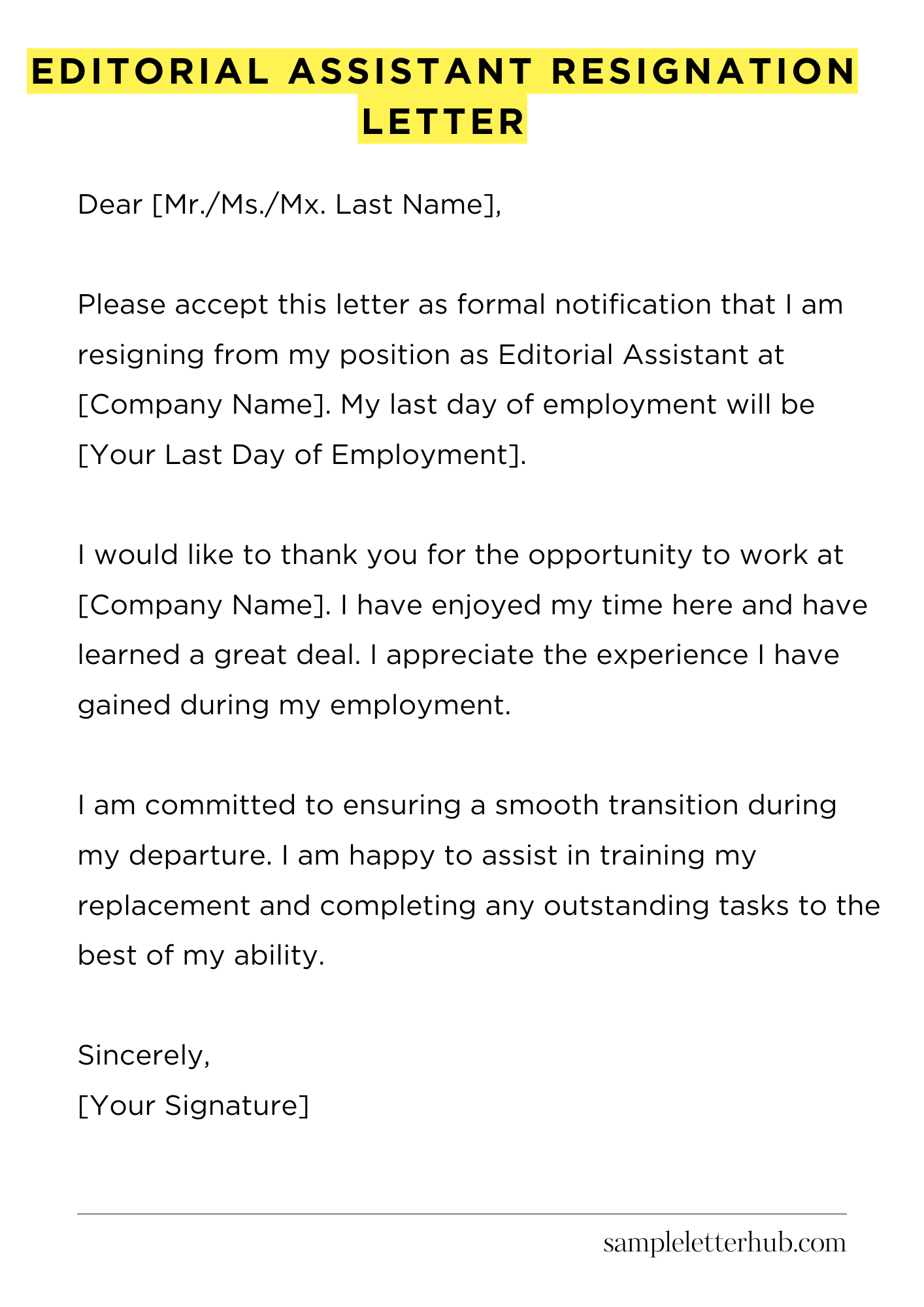
Dear [Mr./Ms./Mx. Last Name],
Please accept this letter as formal notification that I am resigning from my position as Editorial Assistant at [Company Name]. My last day of employment will be [Your Last Day of Employment].
I would like to thank you for the opportunity to work at [Company Name]. I have enjoyed my time here and have learned a great deal. I appreciate the experience I have gained during my employment.
I am committed to ensuring a smooth transition during my departure. I am happy to assist in training my replacement and completing any outstanding tasks to the best of my ability.
I wish you and [Company Name] all the best in the future.
Sincerely,
[Your Signature]
How to Write an Editorial Assistant Resignation Letter
So, you’ve made the decision to move on. Good for you! Resigning from your role as an Editorial Assistant means it’s time to craft a professional resignation letter. This isn’t just a formality; it’s a crucial step that can impact your future opportunities. Think of it as the final impression you leave on your employer. Let’s make it a good one, shall we?
1. Keep It Concise and Clear
Your resignation letter should be brief and to the point. No need for elaborate stories or lengthy explanations. State your intention to resign, the effective date of your departure, and that’s essentially it.
Avoid rambling or getting into the reasons behind your departure unless you’re comfortable doing so (and you really don’t have to be!). Your goal is to convey your message clearly and efficiently. Remember, clarity is key. Keep it simple.
2. Express Gratitude (Even if It’s Hard!)
Even if the job wasn’t a perfect fit or you’re leaving due to challenging circumstances, it’s always wise to express gratitude. This is just good practice, and it will serve you well in the long run.
A simple “Thank you for the opportunity” goes a long way. Acknowledge what you learned or the experiences you gained. It doesn’t require insincerity; it’s about acknowledging the time you spent with the company. This reinforces a positive tone and leaves a favorable impression on your former colleagues and management.
3. Provide the Necessary Information
Include the essential information without fail. This includes the date of the letter, your name, the name of the recipient (usually your supervisor or the HR department), your formal title, and the date of your last day of employment. Double-check all names, titles, and dates for accuracy.
This attention to detail shows professionalism and respect. Make sure the information is easy to find and easily readable.
4. Offer Assistance with the Transition
Consider offering your assistance during the transition period. This isn’t mandatory, but it’s a classy move that can bolster your reputation. You can offer to help with training your replacement, complete any ongoing projects, or provide documentation to ease the process.
This suggests you’re willing to help in any way you can. This also shows you are a team player. Even a simple phrase like, “I am happy to assist with the transition process,” can be incredibly impactful.
5. Maintain a Professional Tone
Above all, maintain a professional tone throughout the letter. Avoid any negative comments or complaints. Stick to a neutral and polite language. Even if your employment wasn’t the best experience, this is not the place to vent. Proofread your letter carefully for any spelling or grammatical errors before sending it.
A well-written, professional resignation letter reflects your character and leaves a lasting positive impression, regardless of your reasons for leaving. Your future self will thank you.
FAQs about Editorial Assistant Resignation Letter
What is the essential information to include in an Editorial Assistant resignation letter?
An effective Editorial Assistant resignation letter should include your formal resignation, the effective date of your departure, a concise statement of your reason for leaving (if desired), a note of appreciation for the opportunity, and any necessary information regarding the handover of your responsibilities.
You should also provide your contact information for future correspondence, if needed.
How should I structure my Editorial Assistant resignation letter?
The structure typically follows a formal business letter format. Start with your name and address, followed by the date, and the recipient’s name and address. The body should clearly state your intention to resign, the effective date, a brief explanation (optional), an expression of gratitude, and your contact information. Keep it concise, professional, and respectful.
Can I provide a reason for resigning in my Editorial Assistant resignation letter, and should I?
You have the option to provide a reason for your resignation. It is generally advisable to keep it brief and positive, focusing on personal or professional growth, or simply stating that you are pursuing other opportunities. Avoid negative comments about your employer or colleagues.
If you prefer, you can simply state that you are resigning for personal reasons, and that is completely acceptable.
What should I do about the handover of my responsibilities as an Editorial Assistant?
In your resignation letter, you can mention your willingness to assist with the handover process. Offer to train your replacement, complete any outstanding tasks, and provide any necessary documentation or information to ensure a smooth transition. Coordinate with your supervisor to determine the best approach for the handover process.
How should I conclude my Editorial Assistant resignation letter?
Conclude your letter by expressing your gratitude for the opportunity to work at the company and acknowledging any positive experiences. Offer to assist in the transition and reiterate your contact information, if necessary. Finally, sign the letter and type your name below the signature.
Related:
Resignation letter due to rude boss
Resignation letter moving to another state
Resignation letter due to illness of family member
Resignation letter due to study