

A Doctoral Candidate resignation letter is a formal document. It announces your decision to leave a doctoral program. The primary purpose is to officially inform your university. It also states the effective date of your departure.
This can be a tough process. It can be hard to know where to begin. We’ve got you covered. We’ll explore sample letters. They’ll cover different situations. We’ll offer templates.
Feel free to adapt them. Use these examples as a starting point. Make your resignation process easier. Craft a professional, clear, and effective letter.
Doctoral Candidate Resignation Letter
Below is a sample of a Doctoral Candidate Resignation Letter:
[Your Name]
[Your Address]
[Your Phone Number]
[Your Email Address]
[Date]
[Doctor’s Name] (or Dean/Department Head’s Name)
[Doctor’s Title]
[Department Name]
[University Name]
[University Address]
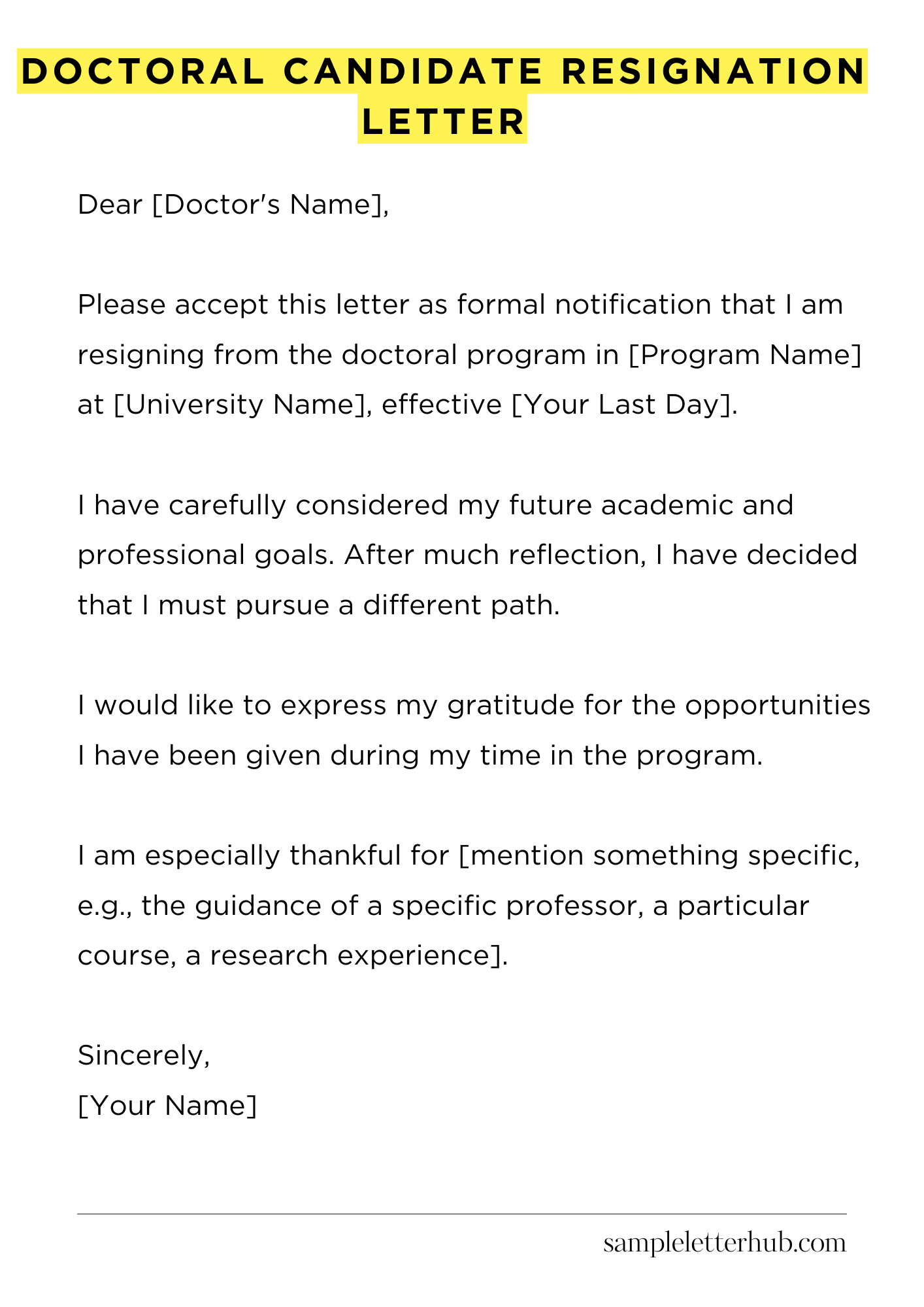
Dear [Doctor’s Name],
Please accept this letter as formal notification that I am resigning from the doctoral program in [Program Name] at [University Name], effective [Your Last Day].
I have carefully considered my future academic and professional goals. After much reflection, I have decided that I must pursue a different path.
I would like to express my gratitude for the opportunities I have been given during my time in the program. I am especially thankful for [mention something specific, e.g., the guidance of a specific professor, a particular course, a research experience].
I will ensure that all my outstanding obligations are completed before my departure. I will also make arrangements to return any university property that is in my possession.
I wish you and the department all the best in the future.
Sincerely,
[Your Name]
How to Write a Doctoral Candidate Resignation Letter
So, you’ve made a big decision. You’re ready to step away from your doctoral program. It’s a tough call, no doubt, and one that requires careful thought and planning.
The next step? Crafting your resignation letter. This isn’t just any email; it’s a formal document. It must be clear, professional, and respectful. Let’s break down how to write one that achieves these goals effectively.
1. Start with the Basics: The Essentials
Your letter needs a clear and concise beginning. Always start with your name, contact information, and the date. Next, identify the recipient.
This is typically your dissertation advisor, the program director, or the head of the department. Be sure to address the correct person; accuracy is key.
The opening paragraph should state your intention to resign from the program. Keep it direct and to the point. Example: “I am writing to formally resign from the Doctor of Philosophy program in [Your Department] at [Your University], effective [Your Last Day].” Make it short and sweet, yet fully explanatory.
2. Briefly Explain Your Reasons (But Keep it Brief)
Why are you leaving? You don’t need to write a novel. It’s best to be as brief as possible while maintaining transparency. A simple sentence or two is sufficient.
You might cite personal reasons, a career opportunity, or a change in your academic interests. If you’re leaving due to a conflict, keep the language neutral and avoid blame.
Focus on the core of your decision, not the specific details of the situation. Honesty, to a degree, is important, but oversharing is a misstep. Think about what is essential and go from there. This is your chance to show professionalism.
3. Express Gratitude and Professionalism
This is extremely important. Even if your experience wasn’t perfect, show gratitude for the opportunities you had. Acknowledge the support you received from your advisor, committee members, and the department.
Thank them for the time and resources they invested in you. Phrases like “I am grateful for the guidance I received from…” or “I appreciate the opportunities this program has provided me…” are excellent. Show respect for the effort that others have made. This leaves a positive lasting impression.
4. Offer Assistance with Transition and Logistics
Show you are responsible. If possible, offer assistance with the transition. This could involve returning any university property (e.g., keys, library books), completing any outstanding tasks, or assisting in the handover of your research. This demonstrates your commitment to a smooth departure.
Consider including a statement such as, “I am happy to assist with any transition tasks and ensure a smooth handover of my research materials.” It’s also wise to inquire about the procedures for withdrawing from the program, such as the return of fees or documentation. Providing for an orderly exit is respectful.
5. Closing and Formalities
Conclude your letter with a formal closing. Use phrases like “Sincerely,” “Respectfully,” or “Yours sincerely.” Your full name and contact information should follow this.
Proofread your letter carefully before sending it. Check for grammatical errors, spelling mistakes, and clarity of expression. Ensure your letter is well-formatted and easy to read.
After composing and reviewing the letter, send it via email and consider delivering a hard copy as well. This attention to detail speaks volumes about your professionalism. Good luck with your future endeavors!
FAQs about Doctoral Candidate resignation letter
Why is it necessary to submit a formal resignation letter as a doctoral candidate?
Submitting a formal resignation letter is crucial for several reasons. Primarily, it officially documents your withdrawal from the doctoral program.
This creates a clear record for both you and the university, confirming the end date of your enrollment and any associated responsibilities.
Furthermore, it ensures a proper process for the program to remove you from their records, which could impact future academic pursuits. Finally, a well-written letter can help maintain a positive relationship with your department and supervisors, which is vital for references and potential collaborations.
What essential information should be included in a doctoral candidate’s resignation letter?
Your resignation letter should contain several key components. Begin with a clear and concise statement of your intent to resign, including the effective date of your resignation. Provide your full name, student ID (if applicable), and the name of your doctoral program and university.
It’s often advisable, though not always mandatory, to briefly state the reason for your resignation (e.g., personal reasons, career opportunities). Express your gratitude to your supervisor and the department for their support.
Finally, include your contact information for future correspondence. Keep the letter professional, respectful, and focused on the facts.
How should a doctoral candidate address their resignation letter?
The appropriate recipient for your resignation letter varies. In most cases, it should be addressed to the head of your doctoral program or the department chair.
If you have a primary supervisor, it’s also customary to provide them with a copy. Ensure you research the specific protocols of your university to determine the correct channels for submission.
Proper addressing is an essential detail to ensure that your resignation is appropriately processed and that all relevant individuals are informed.
Can a doctoral candidate withdraw their resignation after submitting the letter?
Generally, once a resignation letter is submitted and processed, withdrawing it is difficult and depends on the university’s policies. Resignation is a formal declaration.
If you change your mind shortly after submitting, contact the appropriate parties immediately and try to negotiate a retraction. However, the decision to allow you to remain in the program rests with the university and the department.
Therefore, think thoroughly before submitting the letter and prepare yourself for the possible implications of your decision.
What are the potential consequences of resigning from a doctoral program?
Resigning from a doctoral program can have several potential consequences. Firstly, it means you will no longer be eligible to receive funding, such as stipends or tuition waivers, from the program.
Secondly, you may lose access to university resources, including libraries, labs, and support services. It could also impact your future academic endeavors, making it more challenging to apply for certain positions or programs.
However, these are not always the case, and you can mitigate the negative consequences by maintaining a professional relationship with the program and ensuring all obligations are properly handled.
Related:
Resignation letter due to rude boss
Resignation letter moving to another state
Resignation letter due to illness of family member
Resignation letter due to study