

You’ve received a lowball offer from your insurance company. Don’t worry, you have options. A dispute letter for low insurance settlement is your tool. Its purpose? To formally challenge the insurance company’s offer. You want to negotiate a fairer payout.
We understand navigating this can be tough. That’s why we’re here to help. This article provides dispute letter samples and templates. We have examples of dispute letters. Use these sample insurance dispute letters to write your own. Our goal is to make it easy for you.
We want to empower you. These claim dispute letter examples cover various scenarios. They’re easy to customize and adapt. Getting a fair insurance settlement is your right. These sample settlement dispute letters can help you get it.
[Your Name]
[Your Address]
[Your Phone Number]
[Your Email Address]
[Date]
[Insurance Company Name]
[Insurance Company Address]
Subject: Dispute of Low Insurance Settlement – [Your Claim Number]
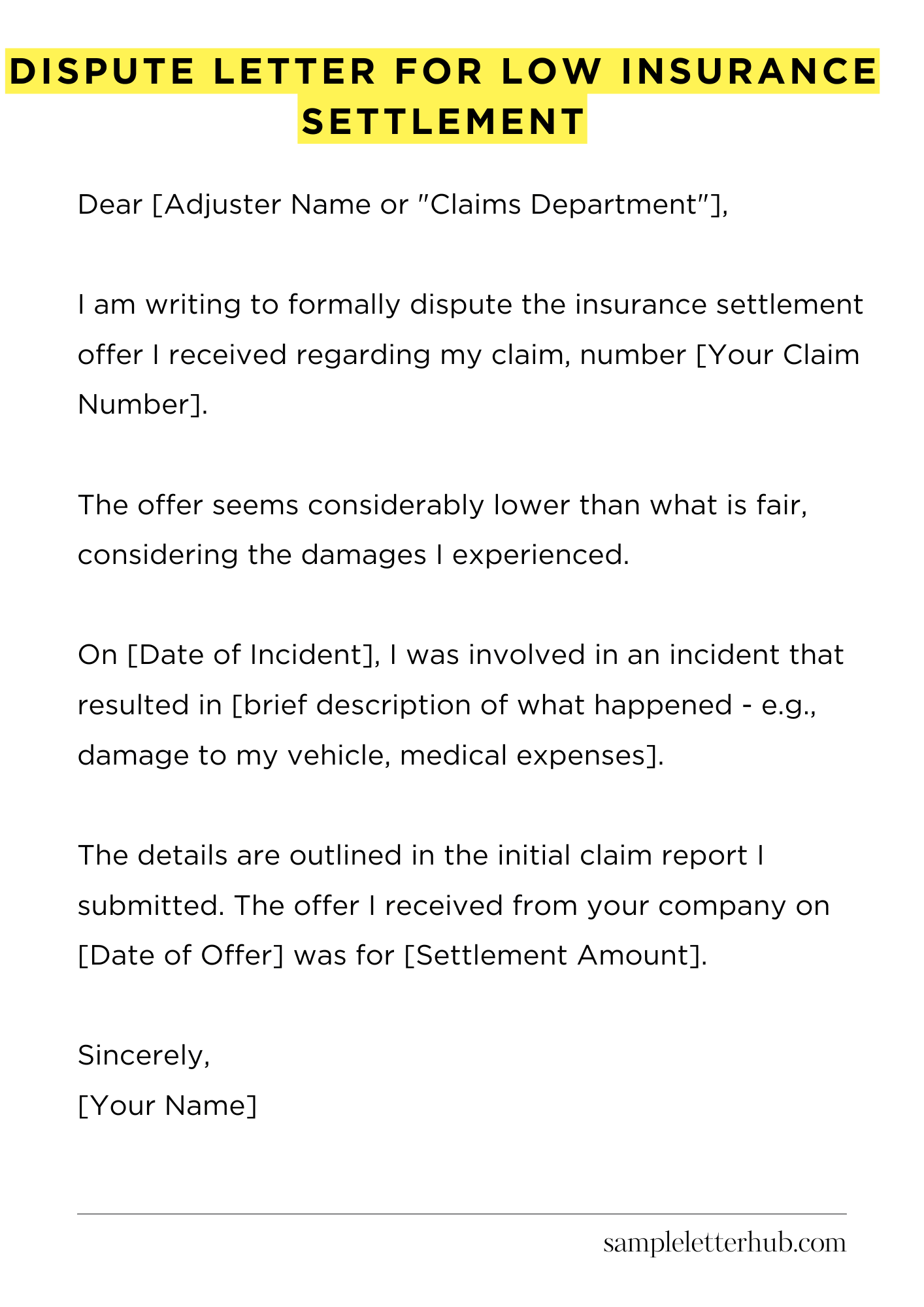
Dear [Adjuster Name or “Claims Department”],
I am writing to formally dispute the insurance settlement offer I received regarding my claim, number [Your Claim Number]. The offer seems considerably lower than what is fair, considering the damages I experienced. I believe the settlement does not accurately reflect the extent of the loss.
On [Date of Incident], I was involved in an incident that resulted in [brief description of what happened – e.g., damage to my vehicle, medical expenses]. The details are outlined in the initial claim report I submitted. The offer I received from your company on [Date of Offer] was for [Settlement Amount].
I have carefully reviewed the settlement offer. It appears that several crucial aspects were either overlooked or undervalued. For instance, the estimate for repairs on my vehicle significantly underestimates the actual cost.
I have attached supporting documentation like repair quotes from several reputable shops. This clearly shows that the offer is insufficient to cover the necessary repairs.
Furthermore, the settlement offer does not adequately address the expenses I incurred due to the incident. These include, medical bills and other related costs. I have attached copies of these bills for your review.
I would like you to reconsider the settlement amount based on the evidence I have provided. My expectation is a settlement that fairly covers all damages and expenses associated with this claim. I am confident that, upon reviewing this additional information, you will agree with me.
I look forward to your prompt response and a revised settlement offer. Please contact me within [Number] days to discuss this matter further. You can reach me by phone at [Your Phone Number] or by email at [Your Email Address].
Thank you for your time and attention to this important issue.
Sincerely,
[Your Name]
How to Write Dispute Letter for Low Insurance Settlement
Receiving an insurance settlement that feels inadequate can be incredibly frustrating. Don’t simply accept the initial offer. You have the right to challenge it. Crafting a compelling dispute letter is your crucial first step in seeking a fair recompense. This guide will take you through the essential elements of composing an effective response.
1. Initiate with Decorum: Formal Salutation and Identification
Begin your letter with a formal salutation. Address the adjuster or claims representative by name, if known. If you don’t know the name, address it as “Claims Department.”
Then, clearly state your purpose in the first paragraph. Provide unambiguous details like your policy number, claim number, and the date of the incident. This initial phase sets the tone for professionalism and ensures your correspondence is immediately directed to the correct recipient.
2. Concise Recapitulation of the Facts: The Antecedents
Summarize the facts of the accident or incident in a clear and chronological order. Keep it succinct; avoid extraneous details that might obfuscate the core issues.
Focus on the pertinent facts that support your claim. This is a critical opportunity to re-establish the narrative and remind the insurer of the specific details of the event. State clearly the loss you have incurred.
3. Articulate the Discrepancy: The Bone of Contention
Now, precisely explain why you believe the settlement offer is insufficient. Detail the specific areas where the insurer has undervalued your claim. This is where you meticulously outline the discrepancies. Perhaps they underestimated the extent of your property damage or ignored certain medical expenses.
Provide concrete reasons backed by evidence, such as repair estimates, medical bills, or property valuations. Omit any form of vagueness.
4. Supply Substantiating Evidence: The Corroborative Material
Bolster your arguments with supporting documentation. Include copies of all relevant evidence, such as photographs of the damage, medical reports, police reports, receipts for expenses, and any other evidence that supports your claim. Organize the attachments clearly and make sure to reference them in your letter.
A well-documented claim is far more likely to yield a favorable outcome. Avoid sending originals; keep copies for your records.
5. Demand Fair Compensation: The Stipulation
Clearly state the amount of compensation you are seeking. Be realistic and base your demand on the evidence you’ve presented. Avoid ambiguity. Be exact and assertive. Consider what you are owed and justify your demand. This leaves no room for misinterpretation. Clearly state your expectation for a fair resolution.
6. Impose a Deadline and Signal Imminence: The Ultimatum
Set a reasonable deadline for the insurer to respond to your letter. Provide a specific timeframe within which you expect to receive a response. Be firm and state the consequences of non-compliance, such as your intention to seek legal counsel or escalate the matter. A firm deadline adds a sense of urgency and motivates the insurer to take your claim seriously.
7. Formal Closing and Contact Information: The Peroration
Conclude your letter with a professional closing, such as “Sincerely” or “Respectfully.” Sign your name, and print your name clearly below your signature. Include your address, phone number, and email address for easy communication. Retain a copy of the letter and all supporting documentation for your records.
This ensures that you have a comprehensive record of your communication and the evidence you have provided. This final touch ensures clear communication lines.
FAQs about Dispute Letter for Low Insurance Settlement
What is a dispute letter, and why is it important in the context of a low insurance settlement?
A dispute letter, also known as a demand letter, is a formal written communication sent to an insurance company to challenge their initial settlement offer, typically when the offer is perceived as inadequate to cover the damages or losses incurred.
It’s crucial because it officially documents your disagreement and outlines the reasons why you believe a higher settlement is justified. It also initiates a formal process for negotiation and potentially litigation if necessary, protecting your rights to fair compensation.
What key information should be included in a dispute letter for a low insurance settlement?
A well-structured dispute letter should include the following: a clear and concise summary of the incident and the resulting damages, a detailed account of the damages, including medical bills, repair costs, lost wages, and pain and suffering, the specific reasons why the initial settlement is insufficient, referencing the relevant policy.
When is the best time to send a dispute letter?
It’s generally recommended to send the dispute letter as soon as possible after receiving the initial low settlement offer. Prompt action demonstrates your commitment to pursuing a fair resolution and can help preserve your legal options, especially considering statute of limitations deadlines.
Review the offer carefully, gather all necessary documentation, and consult with an attorney to ensure the letter is comprehensive and strategically sound before sending it.
What happens after I send a dispute letter?
After sending the dispute letter, the insurance company will typically review your claims and supporting documentation. They may respond by either increasing their settlement offer, denying your claim, or initiating further negotiations.
The outcome depends on the strength of your case, the insurance company’s assessment, and their willingness to negotiate. You may need to engage in further communication, provide additional information, or consider mediation or litigation if you cannot reach a satisfactory agreement through negotiation.
Should I consult with an attorney before writing and sending a dispute letter?
Consulting with an attorney is highly recommended, especially if the settlement involves significant damages or complexities. An attorney can help you assess the merits of your claim, guide you in drafting a strong and persuasive dispute letter, and advise you on your legal rights and options.
They can also represent you in negotiations with the insurance company and, if necessary, take legal action to protect your interests.
Related:
Resignation letter due to rude boss
Resignation letter moving to another state
Resignation letter due to illness of family member
Resignation letter due to study