

Dealing with a car accident settlement can be tricky. Sometimes, you might disagree with the insurance company’s offer. That’s where a dispute letter for car accident settlement comes in. It’s a formal way to express your dissatisfaction. The purpose is to negotiate a fair settlement.
Ready to take action? This article is your guide to crafting the perfect dispute letter. We understand the process can be overwhelming. Don’t worry, we’ve got you covered.
Inside, you’ll find dispute letter for car accident settlement templates. We’ll also share various samples and examples. Use these to make writing your car accident settlement dispute letter simple. Get ready to advocate for yourself!
[Your Name]
[Your Address]
[Your Phone Number]
[Your Email Address]
[Date]
[Insurance Company Name]
[Insurance Company Address]
Subject: Dispute Regarding Car Accident Settlement – Policy Number [Your Policy Number] – Claim Number [Your Claim Number]
Dear [Claims Adjuster Name or “Claims Department”],
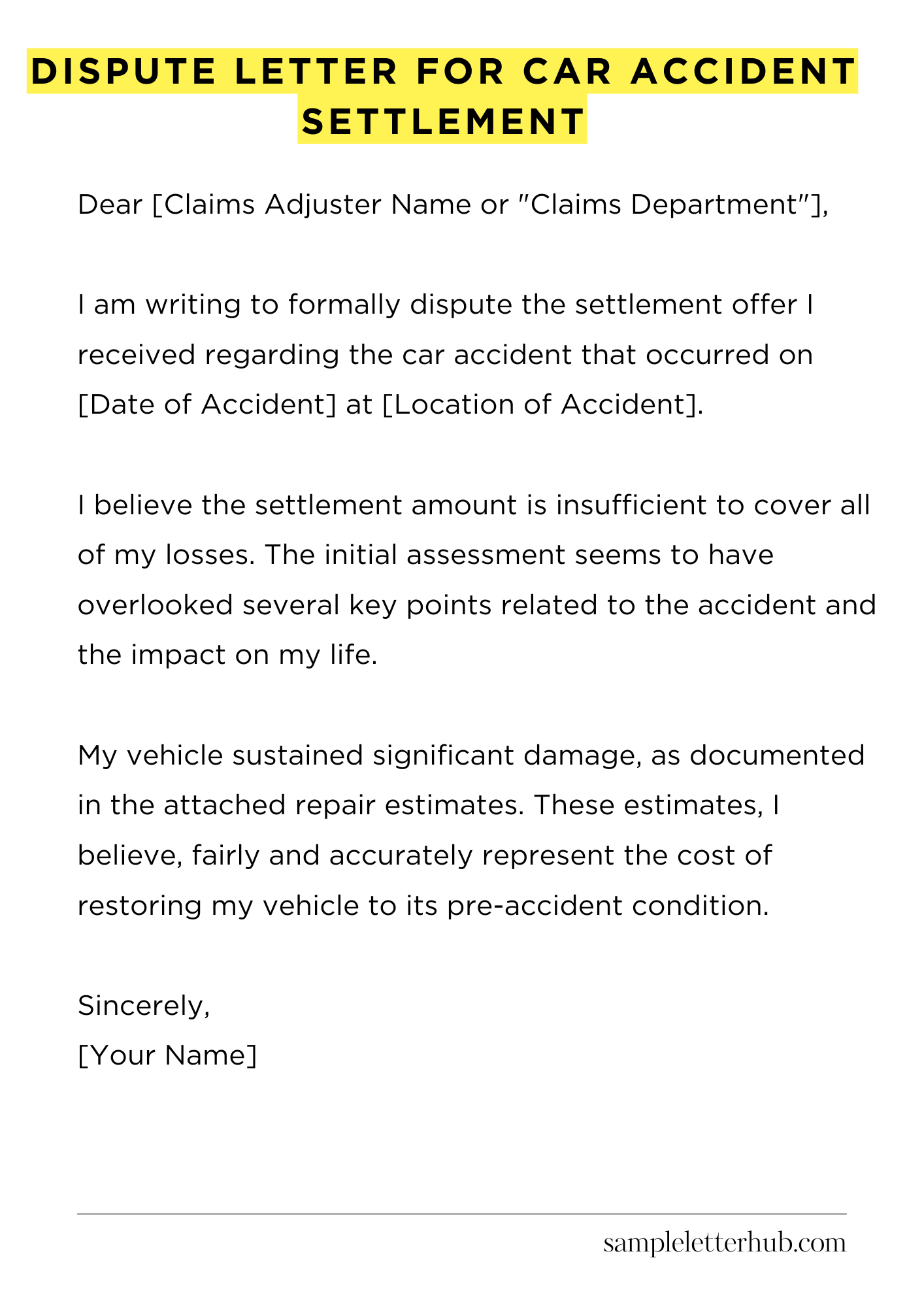
I am writing to formally dispute the settlement offer I received regarding the car accident that occurred on [Date of Accident] at [Location of Accident]. The offer, in my estimation, does not accurately reflect the extent of the damages I incurred. It’s really important to me that this is resolved properly.
I believe the settlement amount is insufficient to cover all of my losses. The initial assessment seems to have overlooked several key points related to the accident and the impact on my life.
My vehicle sustained significant damage, as documented in the attached repair estimates. These estimates, I believe, fairly and accurately represent the cost of restoring my vehicle to its pre-accident condition.
Furthermore, I have incurred medical expenses related to the injuries I sustained in the accident. I’ve included copies of relevant medical bills for your review; the costs are considerably higher than anticipated. These costs include doctor’s visits, physical therapy sessions, and medication.
I also believe the settlement does not adequately address the loss of use of my vehicle. This has caused me considerable inconvenience and significant expenses. The inability to use my car has created a lot of difficulties, honestly.
I would appreciate it if you would reconsider the settlement offer based on the information I have provided. I’m requesting that you increase the settlement amount to reflect the true costs of the damages, medical expenses, and loss of use. I believe that a fair and just settlement is necessary to bring this matter to a close.
I look forward to hearing from you within [Number] days to discuss this further. I am confident that we can reach a resolution that is fair to both parties. Please contact me at your earliest convenience to arrange a time to speak.
Sincerely,
[Your Name]
How to Write Dispute Letter for Car Accident Settlement
Navigating the aftermath of a car accident is often a convoluted process, especially when it involves insurance settlements. Disagreements can arise, and a well-crafted dispute letter is your most potent weapon.
This section provides a comprehensive guide to composing a persuasive letter to challenge an unsatisfactory settlement offer. You need to be methodical and articulate to get your claim over the line. Let’s delve into the intricacies.
1. Commence with a Concisely Crafted Salutation and Identification
Begin your missive with a formal salutation, addressed to the appropriate claims adjuster or manager. For instance, “Dear Mr./Ms. [Adjuster’s Last Name]”. Immediately follow with a clear identification of your case.
Include your full name, claim number, date of the accident, and policy number. This information allows for expeditious processing and ensures your letter reaches the right recipient. Make it easy for them to get to your case.
2. State the Unvarnished Facts of the Incident
Provide a concise and objective account of the accident. Avoid subjective opinions and emotional outbursts. Stick to the barebones facts: where the accident occurred, the prevailing traffic conditions, and the sequence of events.
Detail the pertinent factors of the collision, ensuring clarity and conciseness. Your goal here is to establish a credible foundation. The insurance adjuster needs to see what actually occurred. The more detail you add without hyperbole, the better you appear.
3. Explicitly Detail Your Damages and Losses
This is where you meticulously outline all the damages and losses you incurred as a direct consequence of the accident. This encompasses medical expenses, repair costs for your vehicle, lost wages, and any other relevant damages.
Provide documentation to substantiate each claim. Include itemized bills, receipts, doctor’s reports, and pay stubs. These items are the bedrock of your argument. Without it, you are just talking. Make certain you don’t miss anything. Be thorough.
4. Articulate the Reasons for Disputing the Settlement Offer
Clearly and unequivocally state why you believe the initial settlement offer is inadequate. This is your chance to explicitly highlight the areas where the insurance company has undervalued your claim.
Maybe they underestimated medical bills, missed out of pocket costs, or misrepresented the severity of your injuries. Refer to the specific parts of the offer you find to be objectionable. Make precise arguments. You will need to address all of their points specifically. Leave nothing to assumptions.
5. Present Supportive Evidence and Documentation
Back up your claims with irrefutable evidence. This can include: the police report (if applicable), photographs of the accident scene and vehicle damage, witness statements, and expert opinions.
The more evidence you offer, the stronger your argument. If you have been seeing a doctor, make sure they have a detailed report to substantiate the nature of your injury. All your evidence should support your claim’s veracity. The stronger the evidence, the more compelling the argument.
6. Propose a Reasonable Settlement Amount
Based on your damages and supporting documentation, state the settlement amount you deem fair and reasonable. This number should reflect the true extent of your losses.
It is okay to be very specific here, especially if you have an idea of what similar claims have been settled for. Don’t be greedy, but don’t sell yourself short. Present a well-calculated, justifiable figure. Be prepared to justify every part of that amount.
7. Conclude with a Call to Action and Professionalism
End your letter with a clear call to action, such as requesting a revised settlement offer or initiating negotiations. State the timeframe within which you expect a response.
Maintain a professional and respectful tone throughout the letter. Include your contact information for easy communication. Your demeanor here is just as important as the body of your letter.
It leaves the adjuster with a good feeling. Don’t come off as angry. It hurts you more than it helps. A polite and direct closing is very important. Then, proofread your letter meticulously before sending it.
FAQs about Dispute Letter for Car Accident Settlement
What is a dispute letter, and why is it necessary for a car accident settlement?
A dispute letter, also known as a demand letter or a letter of disagreement, is a formal written communication sent to the insurance company after a car accident. It outlines your disagreement with their initial settlement offer.
It’s necessary because it provides an opportunity to explain why you believe the offer is insufficient. It allows you to present additional evidence, detail the extent of your losses (medical bills, lost wages, property damage, pain and suffering), and negotiate for a fair compensation that accurately reflects the damages you incurred due to the accident.
What information should be included in a dispute letter for a car accident settlement?
A comprehensive dispute letter should include: your identifying information (name, address, policy number), a clear statement of disagreement with the insurance company’s offer, a concise summary of the accident details (date, location, how it happened), a list of all your damages and losses with supporting documentation.
When is the right time to send a dispute letter?
The best time to send a dispute letter is after you’ve received the insurance company’s initial settlement offer and thoroughly reviewed it. Ensure you have gathered all necessary documentation (medical records, repair estimates, police report, etc.) to support your claims.
Do not delay too long, as there are usually statutes of limitations that apply to claims, which vary depending on the jurisdiction. Review the offer carefully, consult with an attorney (if possible), and send the letter promptly after you’ve decided the offer is inadequate.
What happens after I send a dispute letter?
After you send the dispute letter, the insurance company will review your new information and supporting documentation. They may then respond with a counter-offer, ask for clarification or further documentation, or, in some cases, maintain their original position.
Negotiations may continue, potentially resulting in a settlement agreement. If an agreement cannot be reached, you may consider filing a lawsuit. It’s essential to keep records of all communications and deadlines.
Should I consult with an attorney before writing a dispute letter?
While you can write a dispute letter yourself, consulting with an attorney is highly recommended. An attorney experienced in car accident claims can evaluate your case, advise you on your rights and potential compensation, review your dispute letter to ensure it effectively addresses your damages, and represent you in negotiations with the insurance company.
They can also provide expert advice on the legal process, and represent you in court if a settlement is not reached.
Related:
Resignation letter due to rude boss
Resignation letter moving to another state
Resignation letter due to illness of family member
Resignation letter due to study