

Navigating the world of disability insurance can be tough. Sometimes, unexpected financial strains arise. This is where a Disability Insurance Hardship Letter comes in handy. Its main purpose? To explain your difficult financial situation to your insurance provider. It requests assistance with your disability claim because of pressing needs.
Dealing with paperwork can be overwhelming. Don’t worry, we’re here to help. This article provides hardship letter samples and letter templates. You can easily adapt these disability insurance hardship letter examples to fit your specific situation. Writing a letter for your disability insurance has never been easier.
We understand the stress of writing such a letter. Our goal is to simplify the process. We have curated a collection of hardship letter templates. This should make it easy to write your hardship letter for disability claim. We hope you find them helpful.
[Your Name]
[Your Address]
[Your Phone Number]
[Your Email Address]
[Date]
[Insurance Company Name]
[Insurance Company Address]
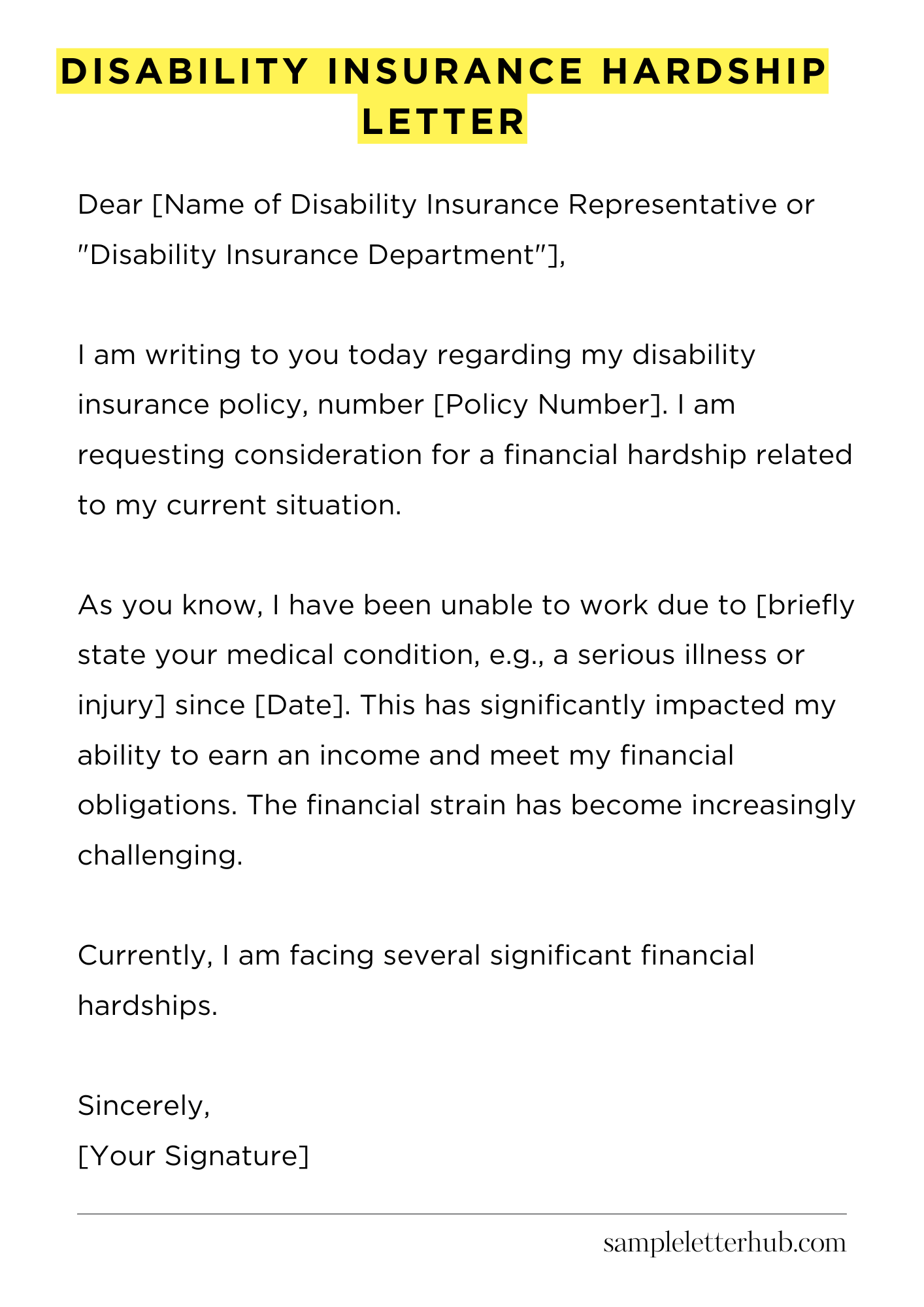
Dear [Name of Disability Insurance Representative or “Disability Insurance Department”],
I am writing to you today regarding my disability insurance policy, number [Policy Number]. I am requesting consideration for a financial hardship related to my current situation.
As you know, I have been unable to work due to [briefly state your medical condition, e.g., a serious illness or injury] since [Date]. This has significantly impacted my ability to earn an income and meet my financial obligations. The financial strain has become increasingly challenging.
Currently, I am facing several significant financial hardships. These include [list a few specific examples, e.g., difficulty paying rent/mortgage, medical bills, essential living expenses]. The costs are overwhelming.
I have attached supporting documentation, such as [list the attached documents, e.g., copies of medical bills, bank statements, and any other relevant financial documentation] to illustrate my situation. These documents clearly detail the challenges I am experiencing.
I understand that disability insurance policies often have specific provisions to address financial hardship, and I am hopeful that my situation qualifies for some form of assistance. I am seeking your assistance in understanding all available options. I would be grateful if you could provide information on any programs or benefits that might offer some relief.
I am committed to complying with all the terms of my policy and am available to provide any further information you may require. Please contact me at your earliest convenience to discuss my case. I can be reached by phone at [Your Phone Number] or by email at [Your Email Address]. Thank you for your time and your consideration of my request. Your assistance will make a real difference.
Sincerely,
[Your Signature]
How to Write Disability Insurance Hardship Letter
Navigating the terrain of disability insurance claims can be a complex endeavor. A hardship letter, a critical component of this process, serves as a poignant testament to your current predicament.
It presents an opportunity to illuminate the exigencies you are facing, effectively influencing the insurer’s perspective. Here’s a structured approach to composing a compelling disability insurance hardship letter:
1. Initiate with a Resolute Salutation
Commence your letter with a formal salutation. Address it to the specific claims adjuster or the relevant department head. Research and find out their official designation.
Use “Dear Mr./Ms. [Last Name]” to foster a sense of professionalism. This initial act underscores your seriousness and respect for the process.
2. Explicate Your Plight – The Core of the Matter
This section is the crux of your narrative. Clearly and concisely elucidate the hardships you are currently experiencing. Substantiate your claims with concrete examples. Detail how your disability has fundamentally altered your financial, emotional, and social well-being. Quantify the impact wherever feasible.
For instance, cite specific medical expenses, loss of income, or the inability to meet essential obligations. Avoid hyperbole, and maintain a tone of unwavering sincerity.
3. Furnish Unquestionable Evidence
Your assertions must be corroborated by irrefutable documentation. Gather all relevant evidence. This might encompass medical records, bank statements, utility bills, mortgage statements, and any other material that validates your claims of financial distress.
Categorize and concisely reference each piece of supporting evidence within your letter, for ease of review. Consider providing copies and always retain the originals.
4. Articulate Your Precise Needs – The Request
Be explicit about the specific assistance you are requesting. Are you seeking an expedited claims decision? A temporary advance on benefits? A modification of your payment schedule? State your needs unequivocally.
Frame your request within the context of your overall hardships, demonstrating how the requested support will provide tangible relief. Specify the duration and quantum of assistance needed, when possible.
5. Deliberate on the Impact of Denial – The Consequences
Without resorting to threats, subtly highlight the potential ramifications of a denial or delay of your claim. This is a delicate balance. Clearly articulate how a negative decision will exacerbate your hardships.
Emphasize the potential inability to meet basic necessities, maintain housing, or access necessary medical care. This section underscores the urgency of your situation, making your case more compelling.
6. Showcase Your Compliance – A Testament to Good Faith
If you’ve consistently adhered to the insurance policy’s requirements, now is the time to state so. Mention how you’ve promptly submitted all required documentation, attended medical appointments, and cooperated with the insurance company’s requests. This demonstrates your good faith and commitment to fulfilling your obligations under the policy. This can strengthen your claim.
7. Conclude with a Call to Action and Cordial Closure
Reiterate your request, emphasizing your urgent need for assistance. Express your gratitude for the adjuster’s time and consideration. Provide your contact information, including your phone number and email address, for seamless communication.
Sign the letter with your full legal name, and if possible, handwrite your signature above your typed name. This personal touch can subtly enhance the letter’s impact.
FAQs about Disability Insurance Hardship Letter
What is a disability insurance hardship letter?
A disability insurance hardship letter is a formal written request submitted to a disability insurance provider, typically by a policyholder who is experiencing significant financial difficulties due to a covered disability.
The letter outlines the specific hardships being faced and requests special consideration from the insurance company, which might include expedited claim processing, temporary benefit advances, or alternative payment arrangements.
What should be included in a disability insurance hardship letter?
A comprehensive hardship letter should include: the policyholder’s identifying information (name, policy number, contact details); a clear and concise explanation of the disability and its impact; detailed information about the financial hardships being experienced, such as overdue bills, loss of income, or increased medical expenses; supporting documentation.
Why would someone need to write a disability insurance hardship letter?
Policyholders might need to write a hardship letter for several reasons, including: to demonstrate the urgency of their financial situation due to their disability, to potentially expedite the processing of a disability claim, to request temporary financial assistance while a claim is being processed or if benefits are delayed, or to negotiate a payment plan.
How can I increase the effectiveness of my disability insurance hardship letter?
To increase the effectiveness of the letter, it’s crucial to be clear, honest, and specific. Include all relevant details about your situation and the impact of the disability. Provide copies of supporting documentation to validate your claims. Maintain a professional and respectful tone throughout the letter. Ensure you keep a copy for your records.
What happens after I submit a disability insurance hardship letter?
After submitting the letter, the insurance company will review your request and supporting documentation. The review process can vary, but generally, the company will assess your financial situation and the severity of your disability.
They may contact you for additional information. The insurer will then make a decision regarding your request, which could include approving the specific assistance requested, offering alternative solutions, or denying the request.
You should receive a formal response within a reasonable timeframe, as outlined by the policy or any applicable regulations. If you disagree with their decision, the response will also include details on appeal and further steps.
Related:
Resignation letter due to rude boss
Resignation letter moving to another state
Resignation letter due to illness of family member
Resignation letter due to study