

A disability insurance claim letter is a crucial document. It officially starts the process of getting disability insurance benefits. The purpose is to notify your insurance company about your disability. It explains why you can’t work.
This article makes it easy. We’ll share disability insurance claim letter samples. We have template letters ready for you. You can adapt them to your situation. This saves you time and stress.
Need to file a disability claim? Our examples help. Craft a clear and effective disability claim letter confidently. Get the help you deserve.
[Your Name]
[Your Address]
[Your Phone Number]
[Your Email Address]
[Date]
[Insurance Company Name]
[Insurance Company Address]
Subject: Disability Insurance Claim – [Your Policy Number]
Dear [Claim Handler Name or “Claims Department”],
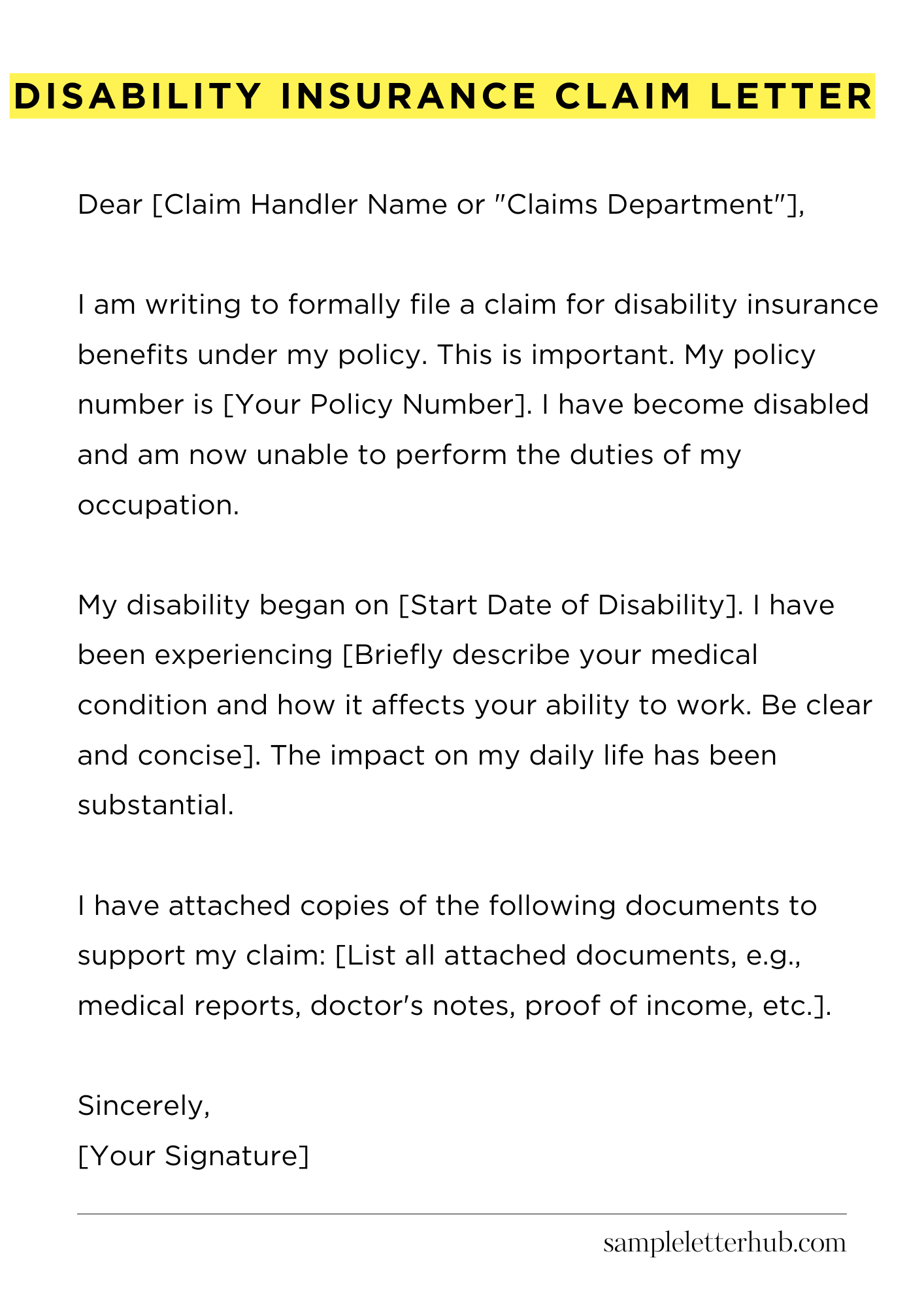
I am writing to formally file a claim for disability insurance benefits under my policy. This is important. My policy number is [Your Policy Number]. I have become disabled and am now unable to perform the duties of my occupation.
My disability began on [Start Date of Disability]. I have been experiencing [Briefly describe your medical condition and how it affects your ability to work. Be clear and concise]. The impact on my daily life has been substantial.
I have attached copies of the following documents to support my claim: [List all attached documents, e.g., medical reports, doctor’s notes, proof of income, etc.]. I included some important information. I have also been seeing [Name of Doctor/Specialist] at [Clinic/Hospital Name].
I have also been unable to perform the essential functions of my job, which include [List 2-3 essential job duties you can no longer perform]. It’s a real struggle.
I understand that you may require additional information or documentation. Please let me know what else you need. I will do everything I can to help.
I look forward to hearing from you soon regarding the status of my claim. I hope for a swift process.
Sincerely,
[Your Signature]
How to Write Disability Insurance Claim Letter
1. Initiate the Process: Gather Your Intel
The genesis of your disability claim letter begins with meticulous preparation. First, acquire all relevant documentation.
This includes your disability insurance policy, medical records corroborating your impairment, and any other pertinent correspondence related to your ailment.
Ensure you have copies; keeping originals safe is paramount. This initial phase sets the stage for a compelling and defensible claim. Ignoring these fundamentals will be a grave error.
2. Crafting the Salutation: Addressing the Insurer
Begin your missive with a formal salutation. Employ the appropriate title, followed by the name of the claims adjuster or the specific department. “Dear Claims Adjuster,” or “To Whom It May Concern,” are acceptable, though personalized greetings are often more impactful if the recipient is known. Avoid generic openings; they can diminish the impact.
3. The Introductory Statement: Declaring Your Intent
Immediately state the purpose of your communication: to file a disability insurance claim. Provide your policy number, as this is crucial for the insurer to locate your file promptly. This declarative statement should be direct and unambiguous. This immediately establishes the context and focus of your writing.
4. The Narrative Section: Detailing Your Affliction
This section is the crux of your letter. It’s where you meticulously chronicle your disability. Provide a comprehensive account of your medical condition, including its onset, symptoms, and the limitations it imposes.
Back up your assertions with specific examples, concrete evidence, and medical terminology. Be precise; vague descriptions weaken your case. Include the exact dates of treatment, diagnoses, and any other health related events. Use medical jargon appropriately to convey your situation.
5. Presenting Your Documentation: The Supporting Exhibits
List all the supporting documentation you’ve included with your letter. For example, medical reports, physicians’ notes, diagnostic results, and any other evidence that substantiates your claim.
This is a crucial section; the insurer needs to know what they are dealing with. Organizing this information neatly ensures clarity and allows the claims adjuster to readily navigate the documents. Provide a brief description of each document.
6. The Claim for Benefits: Requesting Due Compensation
Explicitly state the benefits you are seeking, according to your policy’s terms. Specify the type of disability benefit you are claiming (e.g., short-term or long-term disability).
Mention the period for which you are seeking benefits, and any other pertinent details. Clearly articulate the financial relief you expect. Avoid ambiguity; state your demands clearly and unequivocally.
7. Closing and Submission: Finalizing the Proclamation
Conclude your letter with a formal closing, such as “Sincerely,” or “Respectfully.” Sign the letter and print your name beneath the signature.
Include your contact information (address, phone number, and email address). Make copies of the letter and all enclosed documents for your records. Send the letter via certified mail with return receipt requested. This provides proof of delivery and receipt.
FAQs about Disability Insurance Claim Letter
What is the primary purpose of a Disability Insurance Claim Letter?
The primary purpose of a Disability Insurance Claim Letter is to formally notify your insurance provider about your disability and initiate the claims process.
It serves as the official document that begins your claim, triggering the insurance company’s investigation and assessment to determine your eligibility for benefits. It also provides crucial information about your disability, medical treatment, and the impact on your ability to work.
What information should I include in a Disability Insurance Claim Letter?
A comprehensive Disability Insurance Claim Letter should include your personal and policy information (name, address, policy number), a clear statement of your disability and its impact on your ability to work, the date you became disabled, details of medical treatment, the name and contact information of your treating physicians.
When should I submit a Disability Insurance Claim Letter?
You should submit your Disability Insurance Claim Letter as soon as possible after the onset of your disability, and preferably within the timeframe stipulated by your insurance policy. Delaying the submission can potentially delay the processing of your claim and impact your eligibility for benefits. Review your policy carefully for specific time limits.
What happens after I submit a Disability Insurance Claim Letter?
After submitting your letter, the insurance company will acknowledge receipt and initiate their claim investigation. This process typically involves reviewing your letter and supporting documents, requesting additional information (such as medical records), and possibly conducting an independent medical examination.
They will then assess your eligibility based on the policy terms and the medical evidence. The insurer will then either approve or deny your claim, providing the reason for their decision.
Can a Disability Insurance Claim Letter be denied? If so, what are common reasons for denial?
Yes, a disability insurance claim can be denied. Common reasons for denial include insufficient medical evidence to support the disability, pre-existing conditions (depending on policy terms), failure to meet the policy’s definition of disability, lack of required medical treatment, policy exclusions, or incomplete or inaccurate information provided in the claim.
If your claim is denied, you typically have the right to appeal the decision, often within a specified timeframe.
Related:
Resignation letter due to rude boss
Resignation letter moving to another state
Resignation letter due to illness of family member
Resignation letter due to study