

A Director of Sales resignation letter is a formal document. It announces your departure from the company. It informs your employer of your intention to leave. The letter typically includes the effective date of your resignation.
This can be a tough process. Don’t worry, we are here to help. We’ll share several templates. These are designed for your convenience. Use them as inspiration.
We have a variety of examples. You can adapt them to your specific situation. This will simplify writing your own resignation letter. We hope it makes the process a bit easier.
Director Of Sales Resignation Letter
Below is a sample of a Director Of Sales Resignation Letter:
[Your Name]
[Your Address]
[Your Phone Number]
[Your Email Address]
[Date]
[Director of Sales’s Name]
[Company Name]
[Company Address]
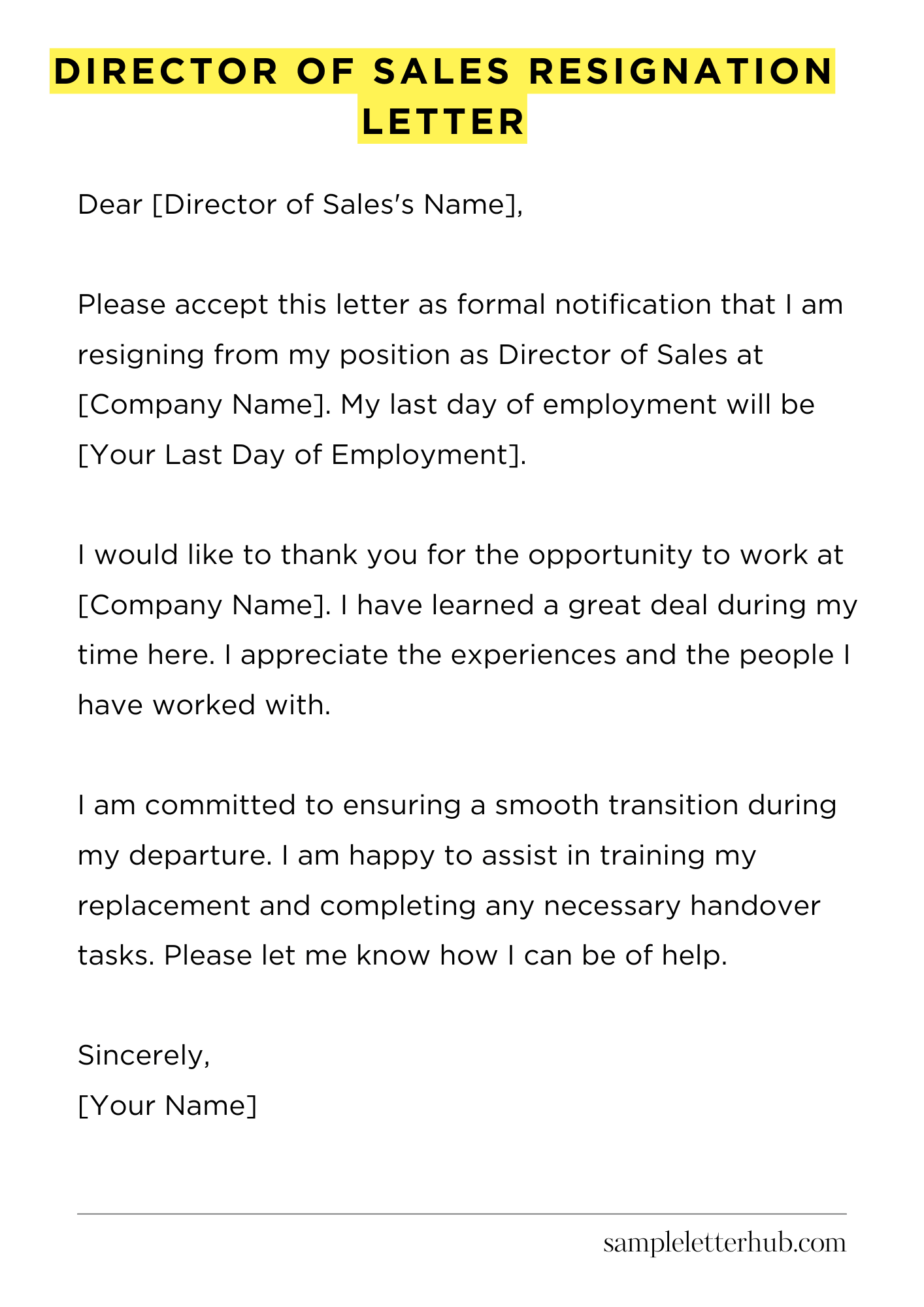
Dear [Director of Sales’s Name],
Please accept this letter as formal notification that I am resigning from my position as Director of Sales at [Company Name]. My last day of employment will be [Your Last Day of Employment].
I would like to thank you for the opportunity to work at [Company Name]. I have learned a great deal during my time here. I appreciate the experiences and the people I have worked with.
I am committed to ensuring a smooth transition during my departure. I am happy to assist in training my replacement and completing any necessary handover tasks. Please let me know how I can be of help.
I wish you and [Company Name] all the best in the future.
Sincerely,
[Your Name]
How to Write a Director of Sales Resignation Letter
1. Grasping the Basics: Why Your Letter Matters
So, you’re moving on. Leaving a Directorship of Sales role is a big deal, right? Absolutely! Therefore, your resignation letter needs to be handled with care and precision. This isn’t just about leaving; it’s about leaving well. Think of it as your final, important piece of work for this employer.
It should be professional, respectful, and crystal clear about your intentions. A well-written letter protects your professional reputation and keeps the door open for future opportunities. Remember, in the business world, you never know when paths might cross again. A simple, to-the-point letter is typically the best way to go.
2. Essential Elements: What to Include
Let’s break down what goes into this crucial document. First, date it correctly. Second, and arguably most important, explicitly state your intention to resign. Specify your last day of employment.
This is non-negotiable! Next, a brief expression of gratitude is always appreciated. Thank your employer for the opportunity and the experiences you’ve gained. You can mention specific accomplishments, but keep it brief.
Avoid lengthy explanations for why you’re leaving. You’re not obligated to give more than a short, polite explanation. Finally, consider offering your assistance with the transition. It can be something as simple as, “I am happy to assist in any way possible during the transition period.”
3. Crafting the Perfect Tone: Professionalism is Key
The tone of your letter should be professional and positive, even if your experience hasn’t been perfect. Always avoid negativity, complaints, or making demands. Your focus should be on your future, not the past issues. Use respectful language, and proofread carefully. Typos and grammatical errors are the enemy.
They can undermine your credibility. Stay concise and to the point. Long, rambling letters are often perceived negatively. Your letter should be easy to read and understand. Maintain a business-like attitude throughout.
4. Sample Structure and Template: A Practical Guide
Here’s a basic structure to follow. Start with your contact information and the recipient’s information. Next, begin with a formal salutation (e.g., “Dear [Manager’s Name],”). State your resignation, including the last day of employment. Express your gratitude for the opportunity. Mention any offer of assistance, if you choose.
Close with a professional closing (e.g., “Sincerely,” or “Best regards,”). Sign the letter, and type your name below the signature.
This format ensures clarity and professionalism. Tailor the content to your specific situation, but this provides a solid framework. Don’t be afraid to adjust it slightly to fit your circumstances.
5. Beyond the Letter: Next Steps and Considerations
After you submit your resignation letter, prepare for a conversation. Your manager will likely want to discuss your departure. Be prepared to answer questions calmly and professionally.
Be ready to discuss the transition of your duties and responsibilities. Keep all communications professional. Stay positive throughout the process. Ensure your departure goes smoothly to keep good relations intact. Lastly, keep a copy of your letter for your records. Remember, the way you leave is just as important as how you arrived.
FAQs about Director Of Sales resignation letter
How much notice should a Director of Sales provide in a resignation letter?
The standard notice period for a Director of Sales typically ranges from two weeks to a month. However, the exact duration should be specified in the employment contract.
Consider the company’s size, your relationship with the employer, and industry norms when deciding on the appropriate notice period. Giving more notice is generally considered professional and allows for a smoother transition.
What key information must be included in a Director of Sales resignation letter?
A resignation letter for a Director of Sales must include: a clear statement of resignation, the effective date of your departure, a concise expression of gratitude for the opportunity, and any necessary information regarding ongoing projects or handover processes. Providing contact information for future correspondence is also advisable.
Should a Director of Sales explain the reasons for leaving in a resignation letter?
While not mandatory, it’s often courteous to briefly mention the reason for leaving. You can keep it general, such as “pursuing other opportunities” or “seeking a new challenge.”
Avoid negative comments about the company or colleagues. In some cases, depending on your relationship with your employer, you may decide to offer more detailed explanations if you feel comfortable doing so.
How should a Director of Sales address the resignation letter?
The resignation letter should be addressed to the appropriate person, usually your direct supervisor, the CEO, or the Human Resources department. Check company policy or your employment contract for the correct recipient. If unsure, it is best to err on the side of caution and address the letter to both your supervisor and HR.
What is the proper format and tone for a Director of Sales resignation letter?
Maintain a professional and respectful tone throughout the letter. The format should be business-like, including your name, contact information, the date, the recipient’s information, a formal salutation, a clear and concise body, a closing, and your signature. Keep it brief, polite, and focused on the key information: your resignation and your final date of employment.
Related:
Resignation letter due to rude boss
Resignation letter moving to another state
Resignation letter due to illness of family member
Resignation letter due to study