

So, you’re stepping down from your role as Director of Sales and Marketing? A resignation letter is the formal document. It officially announces your departure to your employer. The letter serves a crucial purpose. It confirms your resignation date and can help maintain a positive professional relationship.
Crafting the perfect resignation letter can be tricky. This article provides various templates. We have examples and samples of Director of Sales and Marketing resignation letters. These examples cover different scenarios. Use these to tailor your own letter.
This guide simplifies the writing process. We offer a selection of letter formats. You can adapt them to your specific circumstances. Get ready to bid farewell professionally. Let’s make your exit as smooth as possible.
Director Of Sales And Marketing Resignation Letter
Below is a sample of a Director Of Sales And Marketing Resignation Letter:
[Your Name]
[Your Address]
[Your Phone Number]
[Your Email Address]
[Date]
[Director of Human Resources Name] (or relevant person)
[Company Name]
[Company Address]
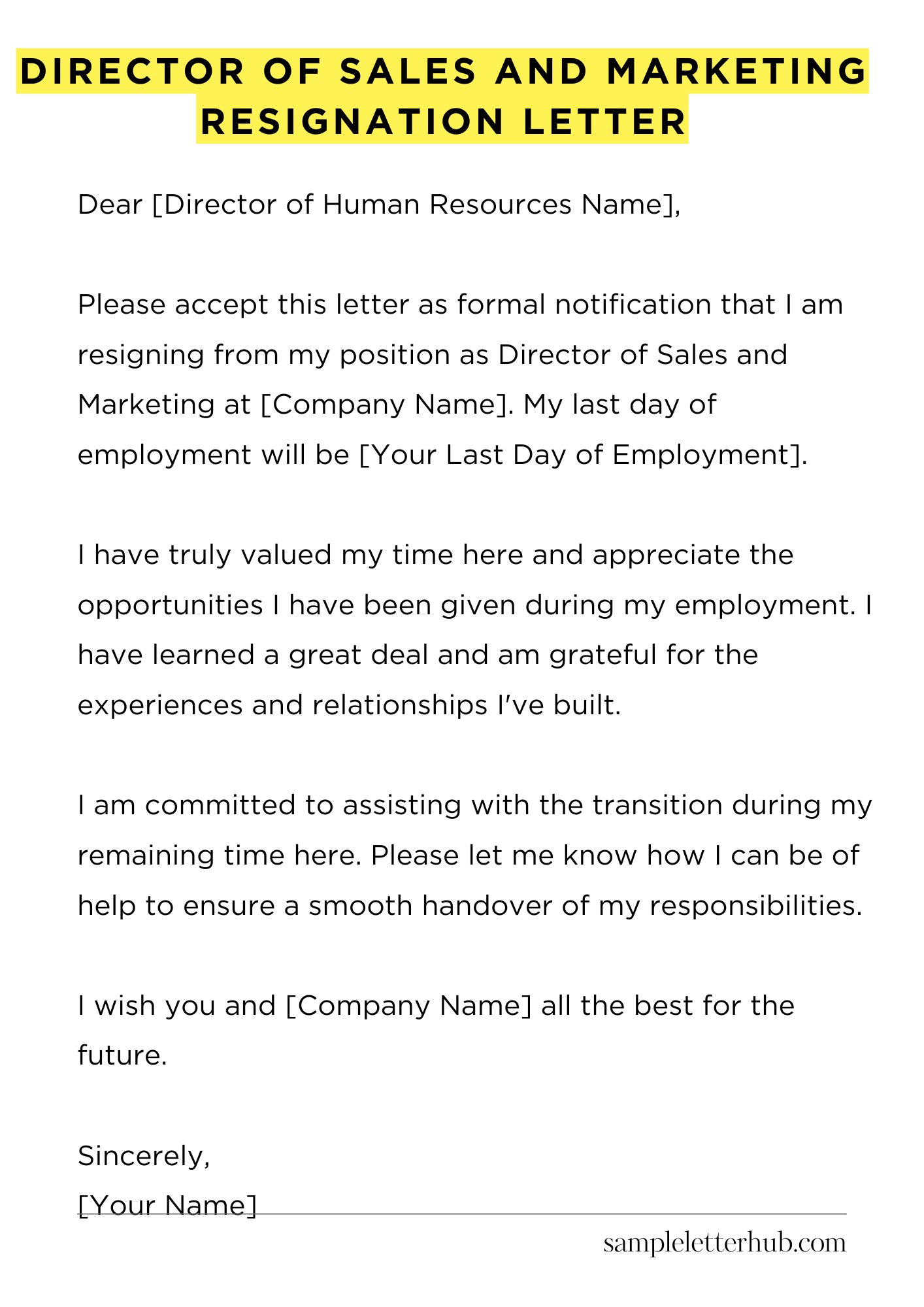
Dear [Director of Human Resources Name],
Please accept this letter as formal notification that I am resigning from my position as Director of Sales and Marketing at [Company Name]. My last day of employment will be [Your Last Day of Employment].
I have truly valued my time here and appreciate the opportunities I have been given during my employment. I have learned a great deal and am grateful for the experiences and relationships I’ve built.
I am committed to assisting with the transition during my remaining time here. Please let me know how I can be of help to ensure a smooth handover of my responsibilities.
I wish you and [Company Name] all the best for the future.
Sincerely,
[Your Name]
How to Write Director Of Sales And Marketing Resignation Letter
Understanding the Basics
Resigning from your position as Director of Sales and Marketing is a big step. This decision deserves careful consideration and a well-crafted resignation letter. Your letter is a crucial document. It officially communicates your departure. You want to leave a good impression, right?
After all, you’ve invested time and effort in this role. Keep it professional. Maintain a positive tone, even if you have negative feelings. Think about your future. A well-written letter can make a difference. Make sure it reflects your professionalism. It will be part of your permanent record.
Key Elements to Include
First things first, start with a clear and concise statement of your intent to resign. State your position, Director of Sales and Marketing. Next, include the effective date of your resignation. This gives your employer ample time to plan for your departure. Be specific. Next, it’s good practice to express your gratitude.
Thank your employer for the opportunity. Briefly mention any key accomplishments you achieved during your tenure. This is a nice touch. Now, offer to assist with the transition. Offer help in training your replacement. It shows good faith. Finally, end the letter with a professional closing. Use a formal salutation such as “Sincerely” or “Best Regards.”
Crafting the Right Tone
The tone of your letter is very important. Strive for a professional and respectful tone. Avoid negativity or personal attacks, even if you have had negative experiences. Keep things positive. Even if you’re leaving due to dissatisfaction, focus on the future. Focus on your new opportunities.
You don’t need to detail all the reasons. Your letter is not the place for venting! Keep it concise. Maintaining a professional tone is critical for your future. You want to leave a good impression. Your reputation matters in the professional world. Focus on your future goals instead.
Formatting and Structure
Proper formatting is essential for a professional letter. Start with your contact information. Your name, address, phone number, and email. Then, include the date. Next, include the recipient’s information. Their name, title, and company address. Use a standard business letter format.
Use clear and concise language. Keep paragraphs short and easy to read. Proofread your letter carefully before sending it. Check for grammatical errors and typos. Make sure everything flows logically. A well-formatted letter looks professional. It reflects well on you.
Finalizing and Delivering Your Letter
Before you send your resignation letter, review it again. Make sure everything is correct. Ensure it clearly states your intentions. Then, double-check the effective date. Make a copy for your records.
Consider your company’s internal procedures for submitting resignations. Follow their protocol. Most likely, you’ll submit it to your direct supervisor. Some companies might require submission to HR as well.
Deliver the letter in person if possible. This shows courtesy. If not possible, send it via email. It is also a good idea to confirm receipt. You want to have a record. This is a formal, yet important step. Good luck in your future endeavors!
FAQs about Director Of Sales And Marketing resignation letter
How much notice should a Director of Sales and Marketing give when resigning?
The standard notice period for a Director of Sales and Marketing varies depending on their employment contract and local labor laws. However, a notice period of at least four to eight weeks is generally considered professional.
Longer notice periods might be expected for senior leadership roles to allow sufficient time for transition and handover of responsibilities. Reviewing the employment contract is crucial to determine the specific requirements.
What key elements should be included in a Director of Sales and Marketing resignation letter?
A well-crafted resignation letter should include a clear statement of resignation, the effective date of departure, a brief expression of gratitude for the opportunity, and a concise summary of the reason for leaving (if desired).
It should also address the handover of responsibilities and offer assistance in the transition process. It is professional to express your intention to cooperate during the transition period. Include all important information such as the effective date of the resignation.
Should a Director of Sales and Marketing explain the reason for their resignation in the letter?
It’s generally not required to provide a detailed explanation of the reasons for resignation. However, it’s often acceptable to briefly state a reason, such as “to pursue other opportunities” or “for personal reasons.” If you have positive feedback or a good relationship with the company, you can choose to provide more detail. Always remain professional and avoid negativity.
How should a Director of Sales and Marketing handle the handover of responsibilities?
A Director of Sales and Marketing should proactively prepare for a smooth handover. This involves documenting ongoing projects, outlining key contacts, training team members, and creating a transition plan.
They should also be available to answer questions and provide support to the replacement or the team taking over their responsibilities. Effective handover minimizes disruption.
What is the proper format for a Director of Sales and Marketing resignation letter?
The resignation letter should be formatted professionally, usually as a formal business letter. Include your contact information, the date, the recipient’s name and title, a clear subject line (e.g., “Resignation”), a polite and concise body, and a professional closing (e.g., “Sincerely”). Keep it concise and to the point. Proofread the letter carefully before submitting it.
Related:
Resignation letter due to rude boss
Resignation letter moving to another state
Resignation letter due to illness of family member
Resignation letter due to study