

A Director of Programs resignation letter is a formal document. It is written by a Director of Programs. The purpose is to officially announce their departure from the organization. It’s a key step in ending your employment gracefully.
Writing a resignation letter can feel daunting. We’re here to help make it easier. We’ve compiled various templates. Examples are also available. These samples cover different scenarios.
Use these to craft your own perfect letter. You can adapt them to your specific situation. This will help you express yourself clearly and professionally. Get ready to write with confidence!
Director Of Programs Resignation Letter
Below is a sample of a Director Of Programs Resignation Letter:
[Your Name]
[Your Address]
[Your Phone Number]
[Your Email Address]
[Date]
[Director of Programs’ Name]
[Director of Programs’ Title]
[Organization Name]
[Organization Address]
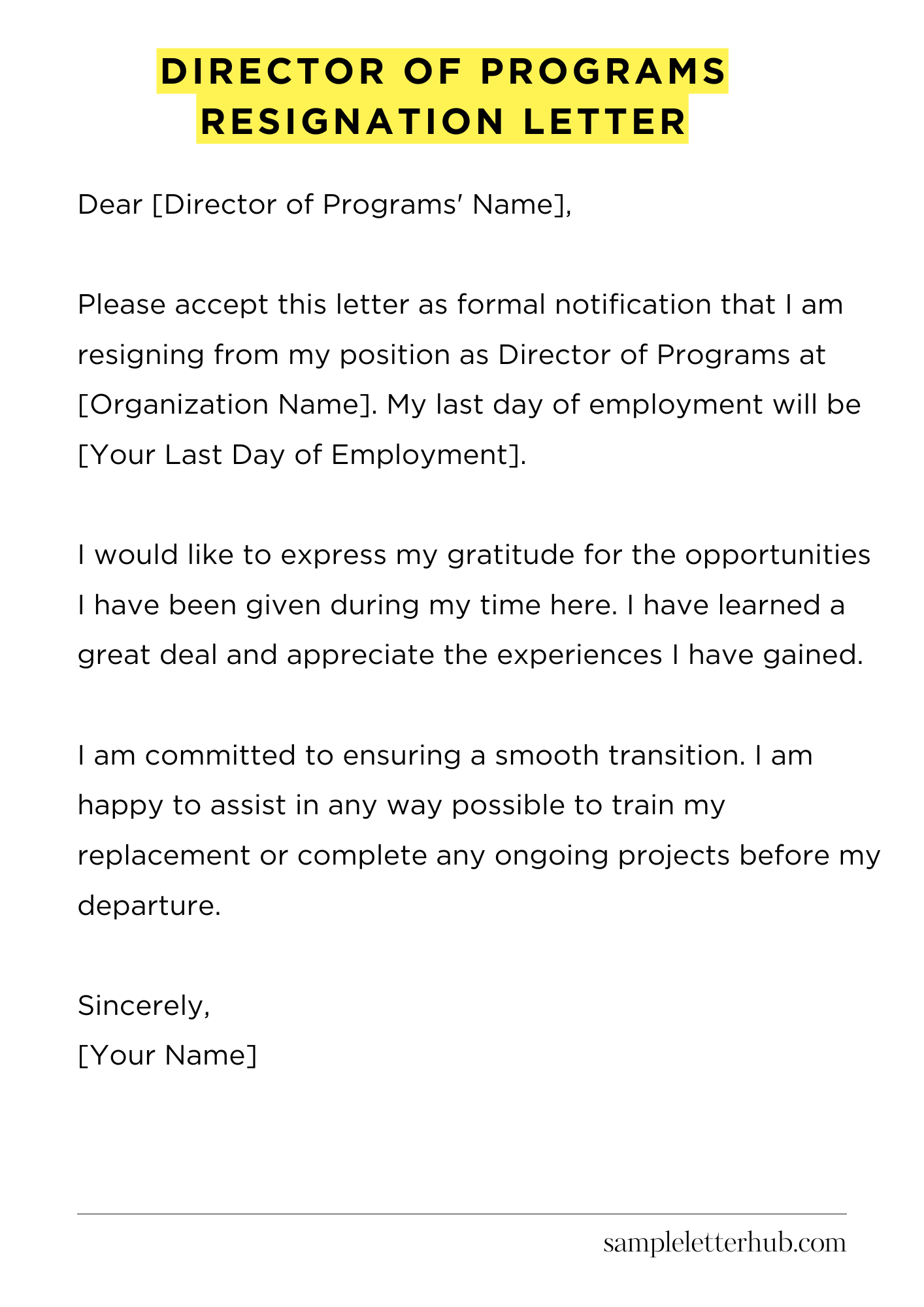
Dear [Director of Programs’ Name],
Please accept this letter as formal notification that I am resigning from my position as Director of Programs at [Organization Name]. My last day of employment will be [Your Last Day of Employment].
I would like to express my gratitude for the opportunities I have been given during my time here. I have learned a great deal and appreciate the experiences I have gained.
I am committed to ensuring a smooth transition. I am happy to assist in any way possible to train my replacement or complete any ongoing projects before my departure.
I wish you and the organization continued success in the future.
Sincerely,
[Your Name]
How to Write Director of Programs Resignation Letter
Resigning from any job can be a stressful experience, especially when you’ve held a significant leadership role like Director of Programs. You’ve likely poured a lot of time and energy into the organization. It’s important to approach this process professionally and thoughtfully.
A well-crafted resignation letter is crucial for maintaining a positive relationship with your employer and ensuring a smooth transition. Let’s delve into how to write a resignation letter that reflects your professionalism and provides a clear path forward.
1. Start with Clarity and Purpose
Your opening paragraph needs to be direct and unambiguous. State your intention clearly. Immediately announce that you are resigning from your position. Include the date your resignation will be effective. Don’t beat around the bush; get straight to the point. This sets the tone for the entire letter.
For example, you might write: “Please accept this letter as formal notification that I am resigning from my position as Director of Programs, effective two weeks from today, [Date].” This leaves no room for misinterpretation. Also, it fulfills the basic requirements.
2. Express Gratitude (and Keep It Sincere)
Even if your departure is driven by negative circumstances, it’s generally best to express gratitude. This is about maintaining professional decorum. Acknowledge the opportunities and experiences you’ve gained during your tenure. Show appreciation for the company and the people you’ve worked with.
Consider something like: “I am grateful for the opportunities I’ve been given during my time at [Company Name]. I’ve learned a great deal and value the relationships I’ve built with my colleagues.” Sincerity is key here; don’t make it a cliché. Genuine appreciation can go a long way. After all, you will want a good reference.
3. Provide a Concise Reason (Optional, But Sometimes Necessary)
You’re not obligated to give a detailed explanation for your departure. However, sometimes providing a brief reason can be helpful. This is especially true if you are leaving for a specific opportunity. If you’re comfortable, you could say: “I am pursuing a new opportunity that aligns more closely with my long-term career goals.”
Keep it short, professional, and positive. Avoid negativity or complaints. If you have concerns about the organization, it’s better to address them separately through your HR department, if needed. This is the difference between complaining and giving information.
4. Offer Assistance with the Transition
Demonstrate your professionalism by offering assistance with the transition. This highlights your commitment to the organization. Offer to help with training your replacement or documenting key processes. Mention you are happy to answer questions. Suggest a timeline for handover activities.
For instance, you could state: “I am committed to ensuring a smooth transition. I am available to assist with training my replacement and to document ongoing projects. Please let me know how I can be of assistance during this period.” This helps to leave a positive lasting impression. Remember, it’s about making things easier for the next person.
5. End on a Positive Note (and Proofread!)
Conclude your letter by reiterating your appreciation and expressing best wishes for the future of the company. A simple closing phrase like, “I wish [Company Name] continued success,” is appropriate. Before you send your letter, proofread it meticulously. Check for grammar, spelling, and clarity.
Have someone else review it if possible. The quality of your writing reflects on you. Make sure your final product is polished and professional. This attention to detail will reinforce the positive impression you want to leave. Sending an error-free letter is the right thing to do.
FAQs about Director of Programs Resignation Letter
What is the primary purpose of a Director of Programs resignation letter?
The primary purpose of a Director of Programs resignation letter is to formally notify the employer of the employee’s intent to leave their position. It serves as an official record of the resignation, including the effective date of departure, and provides an opportunity to express gratitude and offer assistance with the transition.
What key elements should be included in a Director of Programs resignation letter?
Key elements include a clear statement of resignation, the effective date of resignation, a brief expression of gratitude for the opportunity, and a willingness to assist with the transition. It may also include a reason for leaving (though this is often optional) and contact information for future correspondence.
How much notice should a Director of Programs give when resigning?
The amount of notice typically depends on the employment contract, company policy, or industry standards. Generally, a Director of Programs should aim to provide at least two to four weeks’ notice to allow for a smooth handover of responsibilities. Reviewing the employment contract is crucial to determine the required notice period.
Should a Director of Programs include a reason for resigning in their letter?
While not always mandatory, including a brief and professional reason for resigning can be beneficial. It allows the employer to understand the employee’s decision.
Reasons can range from seeking new opportunities, personal or family reasons, or a desire for a different work environment. However, the level of detail is at the employee’s discretion; keeping it concise and positive is often recommended.
How should a Director of Programs handle the transition process after submitting their resignation letter?
After submitting the resignation letter, the Director of Programs should proactively work with their employer to ensure a smooth transition.
This involves collaborating on the handover of ongoing projects, training a replacement (if applicable), completing any outstanding tasks, and documenting processes and procedures. Maintaining a professional and helpful attitude during the transition period is crucial.
Related:
Resignation letter due to rude boss
Resignation letter moving to another state
Resignation letter due to illness of family member
Resignation letter due to study