

A “Director of Marketing and Communications resignation letter” is a formal document. It informs an employer of your departure. This letter is a crucial step in ending your employment professionally. It outlines your last day and any relevant details.
Preparing to leave a role can be tricky. We’re here to help make it easier. We’ve compiled various templates. They cover different scenarios. You’ll find examples and samples.
Consider these your starting points. Adapt them to fit your specific needs. Crafting your own resignation letter is simplified. Ensure your letter is clear and impactful. Good luck with your future endeavors!
Director Of Marketing And Communications Resignation Letter
Below is a sample of a Director Of Marketing And Communications Resignation Letter:
[Your Name]
[Your Address]
[Your Phone Number]
[Your Email Address]
[Date]
[Director of Marketing and Communications’ Name]
[Company Name]
[Company Address]
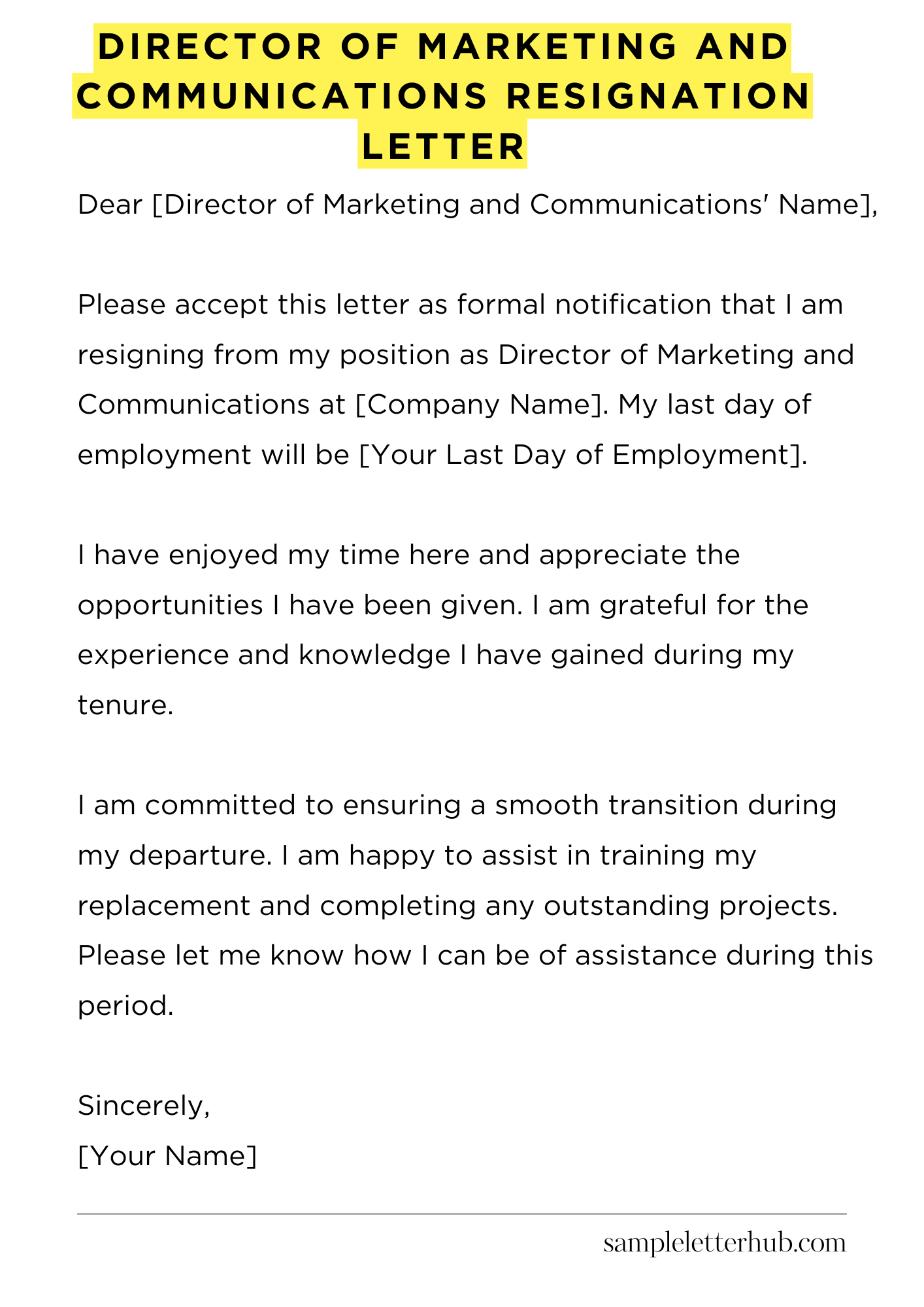
Dear [Director of Marketing and Communications’ Name],
Please accept this letter as formal notification that I am resigning from my position as Director of Marketing and Communications at [Company Name]. My last day of employment will be [Your Last Day of Employment].
I have enjoyed my time here and appreciate the opportunities I have been given. I am grateful for the experience and knowledge I have gained during my tenure.
I am committed to ensuring a smooth transition during my departure. I am happy to assist in training my replacement and completing any outstanding projects. Please let me know how I can be of assistance during this period.
I wish you and [Company Name] all the best in the future.
Sincerely,
[Your Name]
How to Write a Director of Marketing and Communications Resignation Letter
So, you’re moving on. Leaving your Director of Marketing and Communications role. It’s time to craft that all-important resignation letter. Don’t worry; it doesn’t have to be a stressful experience.
A well-written letter can ensure a smooth transition and maintain a positive relationship with your soon-to-be former employer. Here’s a helpful guide to assist you in writing a resignation letter that is clear, professional, and respectful.
1. Start with the Basics: Your Opening Paragraph
The first paragraph is where you state your intention clearly. Keep it straightforward and direct. Begin by stating your resignation. Include the date of your departure. Keep the tone formal but not overly stiff.
For example: “Please accept this letter as formal notification that I am resigning from my position as Director of Marketing and Communications at [Company Name], effective [Your Last Day of Employment].” This is a simple and effective way to begin.
Do not include any unnecessary emotional content. Stick to the facts. This shows your professionalism and respect for the company.
2. Briefly Acknowledge Your Time and Express Gratitude
Next, it’s nice to add a little something about your time with the company. Keep it short and sweet. Briefly mention your positive experiences and what you’ve learned. Express gratitude for the opportunity. This is a chance to show your appreciation. It helps maintain a positive image.
Consider a sentence like: “I have truly valued my time at [Company Name] and appreciate the opportunities I have been given over the past [Number] years.” Keep the focus on the positive aspects of your employment.
3. The Important Transition Details: Your Offer of Assistance
This is where you demonstrate your commitment to a smooth handover. Offer your assistance during the transition period. Be willing to help train your replacement, complete any outstanding projects, or provide documentation. This speaks volumes about your character and professionalism.
You might write: “I am committed to ensuring a smooth transition. I am happy to assist in any way possible during my remaining time, including training my replacement and completing any pending projects.” This shows your willingness to help and your dedication to the company, even as you leave.
4. Formalities and Closing: Your Professional Sign-off
Conclude your letter with a formal closing and your signature. Thank the employer again, perhaps reiterating your appreciation. End with a professional sign-off such as “Sincerely,” “Best Regards,” or “Respectfully,” followed by your full name. Be sure to proofread the letter carefully for any errors in grammar or spelling.
Adding your contact information isn’t required. Ensure it is neat, and easy to read. After your signature, consider including your printed name. This makes it clear who the letter is from.
5. Review and Submission: The Final Steps
Before sending your letter, review it thoroughly. Make sure it is clear, concise, and professional. Ensure that it reflects a positive and respectful tone. Have someone else read it over too for an extra set of eyes. Once you’re satisfied, print a hard copy and sign it. Then, submit it to the appropriate person, usually your direct supervisor or HR department.
Keep a copy for your records. Good luck with your future endeavors!
FAQs about Director Of Marketing And Communications resignation letter
How much notice should a Director of Marketing and Communications give when resigning?
The standard notice period for a Director of Marketing and Communications typically aligns with their employment contract and local labor laws. This usually ranges from two weeks to one or two months.
High-level positions often warrant a longer notice period to ensure a smooth transition, allowing time for knowledge transfer, project handover, and the search for a replacement. Always consult the employment agreement and local regulations to determine the legally required or contractually obligated notice period.
What should be included in a Director of Marketing and Communications resignation letter?
A well-crafted resignation letter for a Director of Marketing and Communications should include: a formal statement of resignation, the effective date of resignation, a brief expression of gratitude for the opportunity, a concise explanation (optional) for the reason for leaving (though not required), and an offer to assist with the transition process.
It’s often advisable to offer to help train a replacement or provide ongoing support. Maintain a professional and positive tone, even if you are leaving due to negative circumstances. Information about accrued vacation time or any final compensation details may also be included, depending on company policy.
Should a Director of Marketing and Communications state the reason for resignation?
While not mandatory, providing a reason for resignation in the letter is a personal choice. You can opt for a general statement such as “pursuing other opportunities” or “seeking a new challenge.”
Specific reasons can be provided if you wish, but be mindful to keep it positive and professional. Avoid negativity, especially regarding colleagues or the company. If departing due to a conflict, consider addressing it separately with HR or your supervisor rather than including it in the resignation letter. It is always wise to remain polite and professional.
How should a Director of Marketing and Communications handle the transition process?
As a Director of Marketing and Communications, ensuring a smooth transition is vital. This includes documenting ongoing projects, key contacts, and strategic plans. Offer to train a replacement or assist in the onboarding process, providing necessary information and insights. Be proactive in transferring knowledge to avoid disruption.
Meeting with key stakeholders, and summarizing current marketing campaigns and communications initiatives is a great way to ensure a smooth departure. Maintaining a positive and supportive attitude during this period will leave a positive lasting impression.
What are the legal considerations for a Director of Marketing and Communications resignation?
Legal considerations involve adhering to the employment contract, local labor laws, and any non-compete agreements. Ensure compliance with the notice period specified in your contract. Be aware of any clauses regarding intellectual property, confidential information, and client relationships.
If you have a non-compete clause, understand its scope and limitations. Consult with an attorney if you have any questions or concerns about legal obligations before resigning. Thoroughly reviewing all employment documentation before submitting your resignation letter is highly recommended.
Related:
Resignation letter due to rude boss
Resignation letter moving to another state
Resignation letter due to illness of family member
Resignation letter due to study