

A Director of Human Resources resignation letter is a formal document. It announces your departure from the company. Its primary purpose is to officially inform your employer of your intention to leave.
Crafting this letter can seem daunting. Where do you even begin? Don’t worry, we’ve got you covered. We’ll provide you with various templates. You’ll find different examples here.
Use these samples as your guide. They will help you compose your own letter. This will make the process simple and stress-free.
Director Of Human Resources Resignation Letter
Below is a sample of a Director Of Human Resources Resignation Letter:
[Your Name]
[Your Address]
[Your Phone Number]
[Your Email Address]
[Date]
Director of Human Resources
[Company Name]
[Company Address]
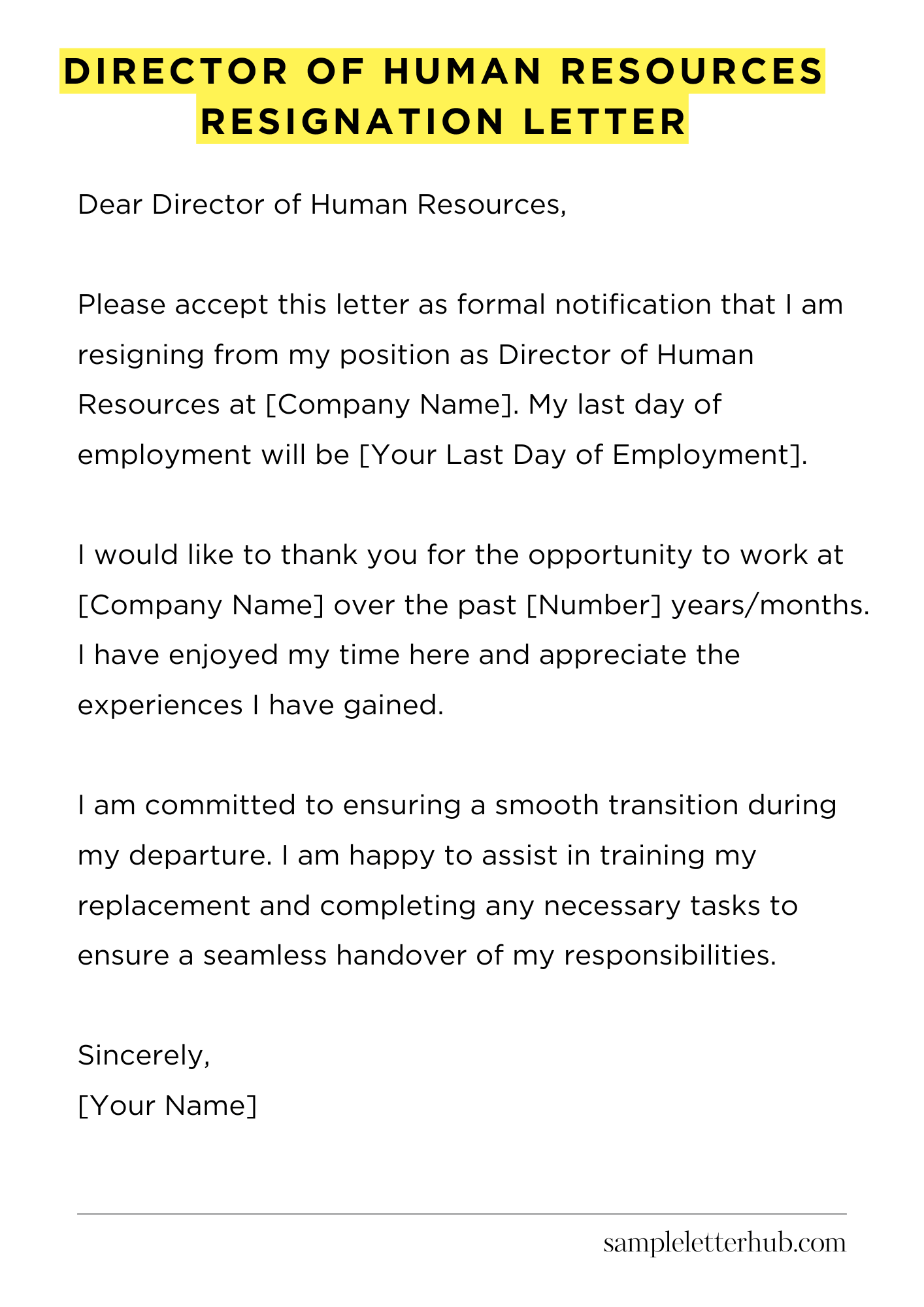
Dear Director of Human Resources,
Please accept this letter as formal notification that I am resigning from my position as Director of Human Resources at [Company Name]. My last day of employment will be [Your Last Day of Employment].
I would like to thank you for the opportunity to work at [Company Name] over the past [Number] years/months. I have enjoyed my time here and appreciate the experiences I have gained.
I am committed to ensuring a smooth transition during my departure. I am happy to assist in training my replacement and completing any necessary tasks to ensure a seamless handover of my responsibilities.
I wish you and the company continued success in the future.
Sincerely,
[Your Name]
How to Write a Director of Human Resources Resignation Letter
Resigning from any position can be daunting. But a Director of Human Resources (HR) role carries extra weight. You’re dealing with people, policies, and potentially sensitive information.
A well-crafted resignation letter is critical. It’s not just a formality; it reflects your professionalism. It also sets the stage for a smooth transition. Let’s delve into how to get it right.
1. Start with the Basics: Formatting and Tone
Your letter needs to look professional. Keep it concise. Use a standard business letter format. Include your name, address, and the date. Then add the recipient’s information (usually your supervisor or the CEO).
The tone is equally important. Maintain a polite and respectful voice. Even if you’re unhappy, avoid negativity. Stick to factual statements. Remember, this letter is a permanent record of your departure.
Here’s a basic structure: Begin with a formal salutation (e.g., “Dear [Recipient’s Name]”). Clearly state your intention to resign. Then, specify your last day of employment. These are the essential elements. They set the stage effectively.
2. State Your Reason (Briefly)
You don’t need to provide an exhaustive explanation. You can keep the reason brief and professional. It’s generally best to avoid overly personal or negative details. Examples include stating that you are pursuing a new opportunity. You could also reference personal reasons. The focus is to keep it concise.
Consider these approaches. You might say: “I am writing to inform you of my decision to resign from my position as Director of Human Resources, effective [Date].”
Or perhaps: “I have accepted a new role that presents exciting career growth opportunities. Therefore, I am submitting my resignation…” Keep it simple. Less is often more. The goal is clarity.
3. Express Gratitude and Acknowledge Contributions
This is where you showcase professionalism. Expressing gratitude to the company is vital. Acknowledge your experience and any accomplishments.
Thank the company for the opportunities you received. This leaves a positive lasting impression. It also maintains a strong reputation. Don’t be afraid to highlight positive aspects of your tenure.
Phrases such as, “I am grateful for the opportunities I have been given during my time here” or “I have learned a great deal, and I appreciate the experience” can be very effective. Mentioning specific projects or achievements can further emphasize your contributions. This adds more value to your resignation letter.
4. Offer Assistance with the Transition
This shows further professionalism and courtesy. Offer to assist with the transition process. This can involve training your replacement, or creating helpful documentation.
This willingness to help can be invaluable. It also helps to smooth the process. Make sure to specify the extent of your availability. Be clear about what you are willing to do.
Consider using statements such as, “I am committed to ensuring a smooth transition during my departure. I am willing to assist in training my replacement and transferring my responsibilities.” Be as specific as you can. It also shows your willingness to do a good job. Make it as easy as possible for everyone.
5. Formal Closing and Sign-Off
The final touch is the formal closing. Use a professional closing such as “Sincerely,” “Best Regards,” or “Yours sincerely.” Following the closing, you’ll sign your name. Then type your full name. Proofread meticulously. Check for grammar errors and typos. This ensures your letter is perfect. This can affect how people see you.
Before submitting, always make a copy for your records. This ensures you have a reference. You’ve now written a strong resignation letter. It protects your reputation and sets a positive tone for your next career move.
FAQs about Director Of Human Resources resignation letter
How do I write a resignation letter as a Director of Human Resources?
A Director of Human Resources resignation letter should be professional, concise, and clearly state your intent to resign, your last day of employment, and ideally, offer assistance during the transition period.
Address the letter to the appropriate individual (e.g., the CEO, President, or your direct supervisor). Keep the tone positive and express gratitude for the opportunity. Briefly mention any significant achievements or contributions during your tenure.
What should I include in a Director of Human Resources resignation letter?
The essential components include a clear statement of resignation, your official last day of employment, a brief expression of gratitude for the opportunity, and a willingness to assist with the transition.
You may optionally include a brief explanation for your departure (although it’s not required) and any information regarding outstanding tasks or projects. Maintain a tone of professionalism throughout.
What is the proper format for a Director of Human Resources resignation letter?
The format should follow standard business letter conventions. Include your contact information, the date, the recipient’s contact information, a formal salutation (e.g., “Dear [Name]”), the body of the letter, a closing (e.g., “Sincerely”), and your typed name and signature. Use a professional font like Times New Roman or Arial, and keep the letter concise, ideally one page.
What are some common mistakes to avoid in a Director of Human Resources resignation letter?
Avoid being overly negative or critical of the company or its management. Do not include unnecessary details about your reasons for leaving. Refrain from burning bridges or making demands. Do not neglect to provide a clear last day of employment. Avoid including personal or unprofessional language. Ensure the letter is free of grammatical errors and typos.
How much notice should a Director of Human Resources give when resigning?
Generally, a Director of Human Resources should provide at least two to four weeks’ notice, or as stipulated by their employment contract or company policy.
However, consider the complexity of your role and ongoing projects. Giving more notice allows for a smoother transition, which reflects well on your professionalism and strengthens your professional reputation. Always review your employment contract for specific guidelines on the notice period.
Related:
Resignation letter due to rude boss
Resignation letter moving to another state
Resignation letter due to illness of family member
Resignation letter due to study